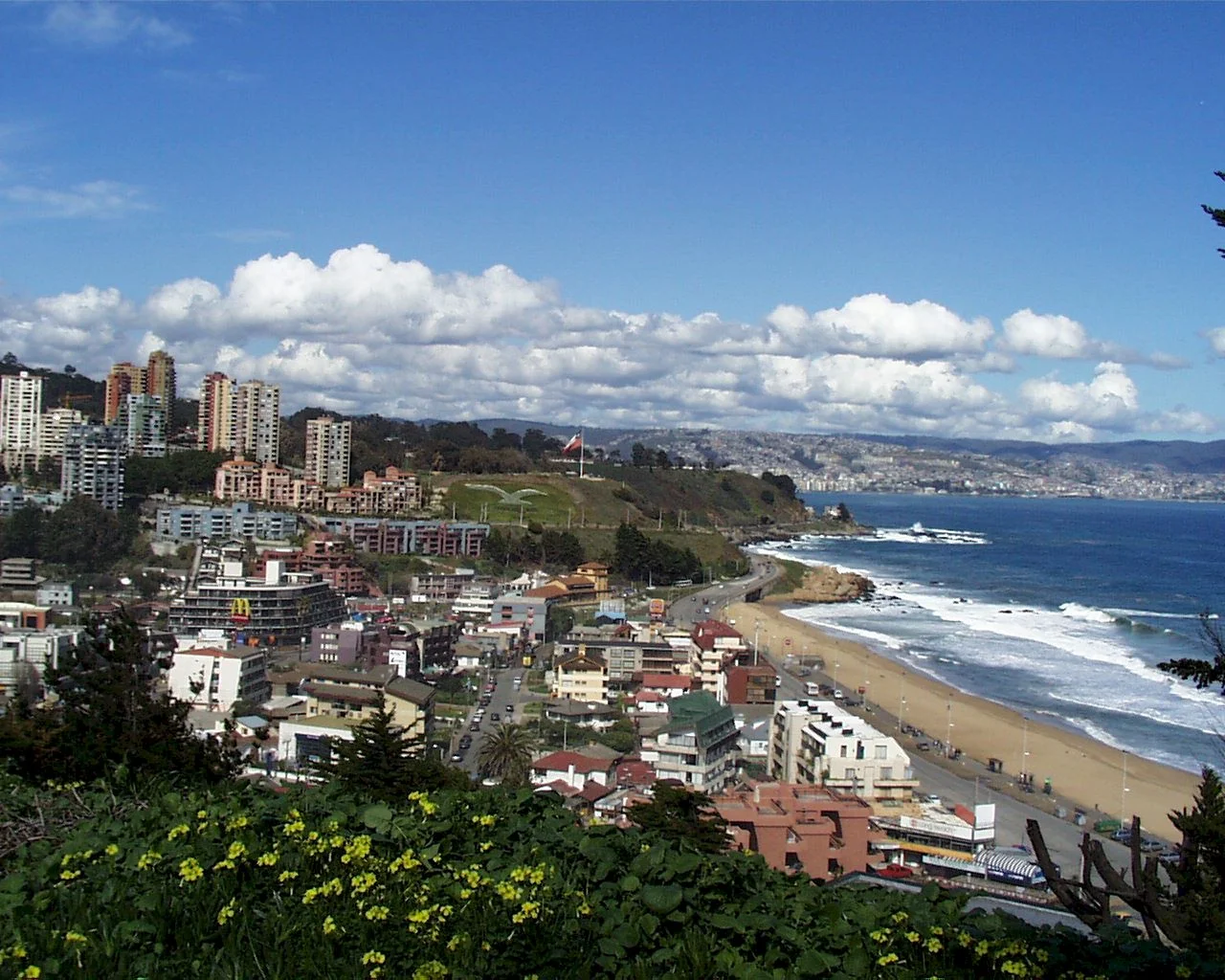

Viña del Mar
The name promises a vineyard by the sea, and once that is exactly what stood here. In 1580 a Spaniard named Alonso de Riberos acquired the land along the Marga Marga stream and planted the first vines, and travelers passing between the port of Valparaíso and the Quillota Valley came to know the spot as the Viña de la Mar, the vineyard of the sea. The grapes lasted almost two and a half centuries. Then, in 1827, a savage storm of wind and rain tore the old vineyards apart and ended the winemaking for good. The vines never came back. The name did, and the city that grew up in their place became Chile's pleasure ground, La Ciudad Jardín, the Garden City.
A City Built on Purpose
Viña del Mar did not drift into existence. A young engineer named José Francisco Vergara married into the family that owned these lands, and rather than let the place remain an appendage of Valparaíso next door, he set out to build a city of his own. On 28 December 1874 he founded it under its present name, hiring engineers to lay out streets and raise an urban core from open ground. A sugar refinery and a foundry gave it an economic engine; military and naval barracks brought people. By the time President Carlos Ibáñez del Campo authorized a casino in 1928, the city's destiny as a resort was sealed. The Casino Municipal opened on the last night of 1930, art deco and ringed by tended gardens, and a presidential summer palace soon followed on Cerro Castillo, making Viña the place where Chile came to play.
Flowers, Castles, and a Stranded Moai
The Garden City earns its nickname in detail. Near Caleta Abarca beach a giant flower clock, the Reloj de Flores, keeps time with numerals planted in blooming flowers; it was inaugurated in 1962 when Viña hosted matches of the football World Cup. Storybook architecture lines the coast and the hills. Castillo Wulff, a neo-Tudor fantasy with a turret reached by a little medieval bridge, was built in 1906 for a German-Chilean businessman, perched where the Marga Marga meets the sea. Inland, the Fonck Museum, founded in 1937, guards a collection of Rapa Nui artifacts crowned by a genuine moai, the only Easter Island statue standing on the Chilean mainland. Around them spread the parks, fountains, and beaches that have made the city a fixture of South American holidays for a century.
Boom, Bust, and Recovery
Prosperity here has never been guaranteed. Through the early twentieth century the city thrived on industry and tourism alike, but the global downturn of the 1980s hit hard. Factories that had anchored the local economy went bankrupt, among them the sugar refinery and the textile mills that were two of the city's biggest employers, and unemployment climbed alarmingly as companies consolidated their work in Santiago. Viña struggled to recover. What pulled it back was a return to its strengths: the steady rise of international tourism and a redevelopment of the old industrial belt along 15 Norte into shopping malls, cinemas, and restaurants. The 2010 earthquake tested it again. Through it all the city stayed conurbated with Valparaíso, the two so completely merged that the modern metro tunnels straight through Viña's downtown on its way between them.
The Voices It Sent Out
For a city of beaches and casinos, Viña del Mar has produced a surprising roster of artists. The singer and painter Mon Laferte, winner of multiple Latin Grammys, was born here in 1983 and grew into one of the defining voices of Latin American music. So, improbably, was Tom Araya, born here in 1961, who moved to California as a small boy and went on to front the American thrash-metal band Slayer. The city also gave Chile the writer María Luisa Bombal and the priest Alberto Hurtado, the country's second Catholic saint, who founded the Hogar de Cristo charity. Each February the world's attention turns to the Quinta Vergara, where the International Song Festival fills the amphitheater and reminds everyone why this Garden City has always been, at heart, a stage.
From the Air
Viña del Mar sits at 33.03°S, 71.53°W on Chile's central Pacific coast, immediately north of and fully merged with Valparaíso. From the air it reads more openly than its hillside neighbor: a coastal plain along the Marga Marga stream rising 6 to 9 meters above the sea, framed by terraced hills that climb to 200 meters and more inland. Beaches line the shore north toward Reñaca and Concón. A viewing altitude of 2,500 to 4,500 feet shows the city, its beaches, and the green expanse of the Quinta Vergara. Nearest airfields are the local Viña del Mar / Concón strip (SCVM) just north and Santiago's Arturo Merino Benítez International (SCEL) inland to the east. The Mediterranean climate keeps temperatures mild year-round; morning fog from the Humboldt Current is the most common visibility hazard.
Nearby Stories
- Battle of Papudo 24 km away
- Casa de Isla Negra 28 km away
- Battle of Chacabuco 31 km away
- Battle of Maipú 38 km away
- Aconcagua 94 km away
- Constitución, Chile 237 km away
- Santa Olga 278 km away
- 1687 Peru Earthquake 1982 km away