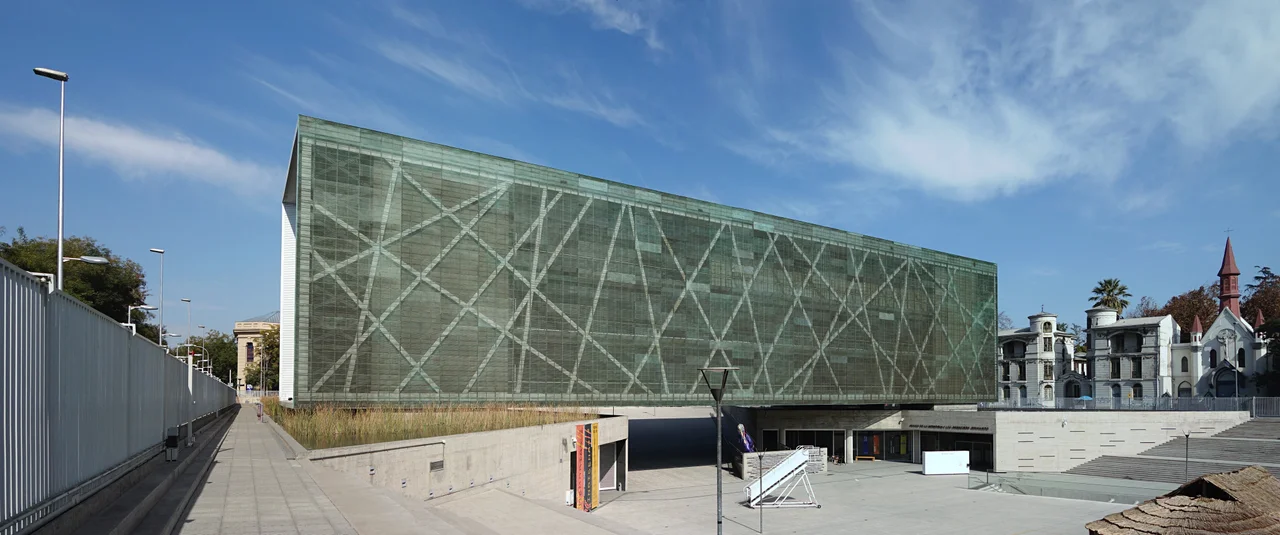

Museum of Memory and Human Rights
The poem is the first thing you meet. Víctor Jara wrote it inside a stadium turned into a prison, in the days before the soldiers smashed his hands and killed him, and his words now stretch across the entrance of this museum like a wound that refuses to close. The folk singer was one of thousands seized in the chaos after the coup of September 11, 1973. The Museum of Memory and Human Rights exists so that he, and the tens of thousands who suffered alongside him under Augusto Pinochet, are not reduced to a number in a report. They were people. The museum insists, room by room, that you remember it.
A President Lays the First Stone
It was Michelle Bachelet who willed this place into being. In a 2007 address to the full Congress, she announced that Chile would build a museum to its own darkest years, and within a month a public design competition was underway. A team of Brazilian architects from the Estudio America office in Sao Paulo won, and on December 10, 2008, Bachelet laid the first stone. The date and the act carried a weight beyond ceremony. Bachelet had herself been tortured during the dictatorship; her father, an air force general loyal to Allende, died from the treatment he suffered in custody. A survivor was founding a museum to the suffering she had lived through. It opened on January 11, 2010, timed to the bicentennial of Chilean independence.
What the Numbers Mean
After democracy returned, Chile tried to account for what had been done in its name. The Rettig Report of 1991 documented 2,279 people killed or forcibly disappeared, taken by the state and never returned, their families left to search for graves that often do not exist. The later Valech Report identified more than thirty-eight thousand who had been imprisoned and tortured. Together, roughly forty thousand victims. The museum gathers the evidence behind those figures: photographs, letters, court records, the small personal objects that survive a person. Much of the founding collection came from Casa de la Memoria, a civic organization whose donations were formally received at the presidential palace in 2009. These are not statistics on a wall. They are faces, arranged so you cannot look away.
The Singer in the Stadium
Víctor Jara's story stands for the rest. A teacher, theater director, and beloved musician of Chile's New Song movement, he was arrested the day after the coup and held in the Estadio Chile with thousands of others. Witnesses describe him singing to keep the prisoners' spirits up; his captors broke his hands and taunted him to play. He was killed with a gunshot and his body left riddled with bullets. He was forty years old. In 2004 the stadium was renamed in his honor. The poem at the museum's entrance, written on paper smuggled out in a friend's shoe, is the last thing he is known to have composed. It is, in the end, a witness statement from inside the machine.
Why a Museum, and Not a Tomb
A place like this could easily become only a monument to grief. The architects and curators chose something more active. A 2021 academic study tested what the museum actually does to the people who walk through it, and found that Chilean university students who visited afterward showed stronger support for democratic institutions and for restorative justice, effects that lingered for months and held regardless of the visitors' prior politics. The museum, in other words, changes minds. It works not by lecturing but by confronting visitors with the human cost of what happened, and trusting them to draw the obvious conclusion: that this must never be allowed again.
Memory as a Living Thing
The work of remembering does not stand still. The Modern Endangered Archives Program funded the digitization of four personal collections documenting the human rights violations of 1973 to 1990, now preserved and accessible through the UCLA library, so that the record survives beyond any single building or government. That impulse is the whole point. Memory left untended fades, and a society that forgets its cruelties tends to repeat them. The Museum of Memory and Human Rights is Chile's deliberate refusal to forget. It is a hard place to visit, and it is meant to be. The people it commemorates deserved better than what they were given; the least the living can offer them is to remember clearly.
From the Air
The museum sits near the Quinta Normal district in west-central Santiago, around 33.44°S, 70.68°W, a short distance from the natural history museum and its park. From the air, it lies amid the dense urban grid west of the downtown core, with the green block of Quinta Normal Park nearby as a landmark. Santiago occupies a basin near 520 meters elevation, hemmed by the Andes to the east and the coastal range to the west. Winter haze frequently dulls visibility over the city; clearer air follows rain or wind. A viewing altitude of 3,500 to 5,000 feet AGL frames the district well. Nearest airport is Comodoro Arturo Merino Benitez International (SCEL), about 11 nautical miles to the northwest.
Nearby Stories
- Paine Memorial 14 km away
- Viña del Mar International Song Festival 28 km away
- Battle of Chacabuco 29 km away
- Cerro El Plomo 30 km away
- Casa de Isla Negra 30 km away
- Paso Internacional Los Libertadores 49 km away
- Pichilemu 92 km away
- Uruguayan Air Force Flight 571 113 km away