
El Teniente
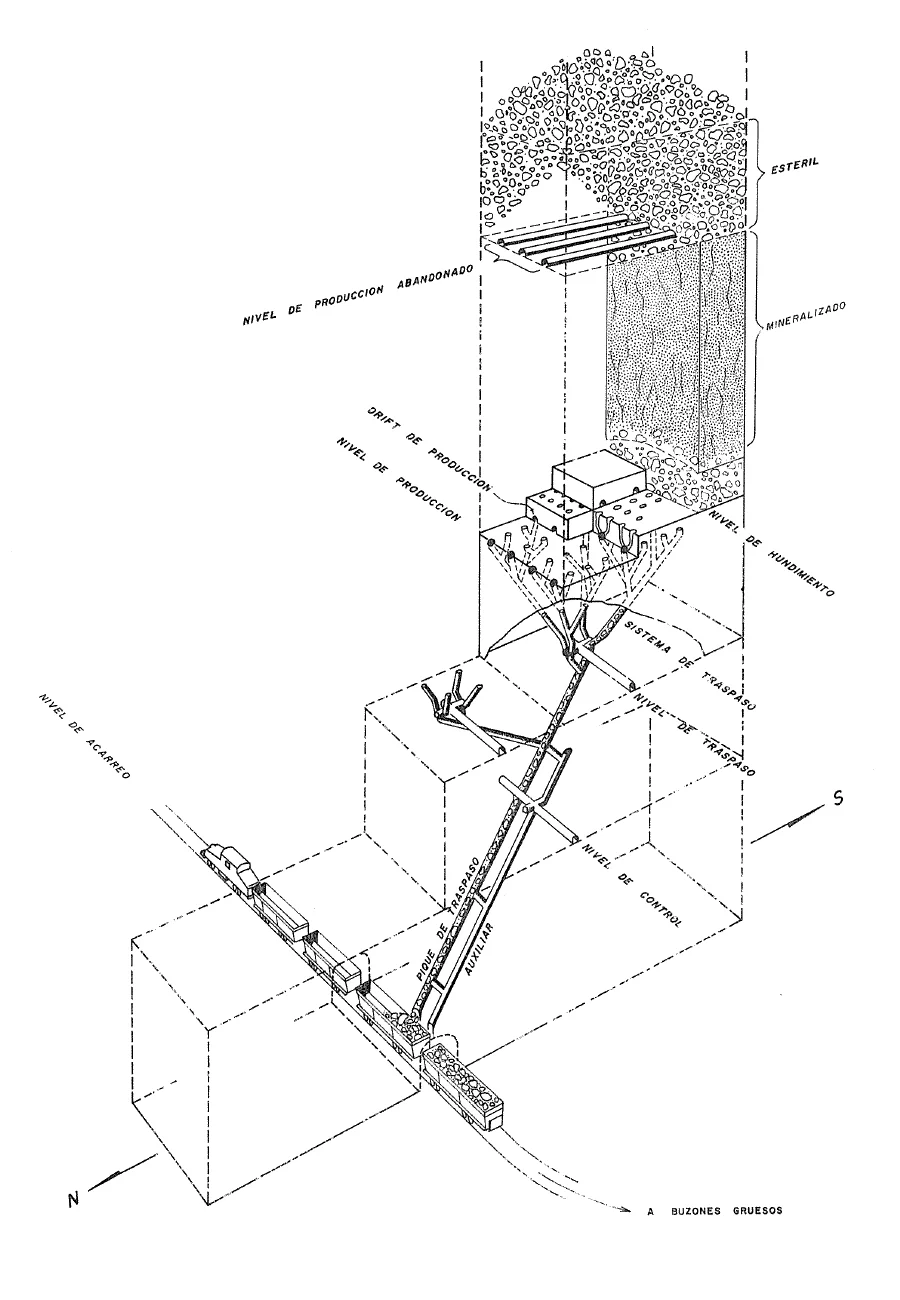
There are more than three thousand kilometers of tunnels inside this mountain - enough, laid end to end, to cross a continent. From the surface El Teniente looks like a scar of roads and dumps on an Andean slope at 2,300 meters. Underground, it is the largest underground copper mine on the planet, a hollowed labyrinth where some five thousand workers move ore out of the rock around the clock. The name means "The Lieutenant" in Spanish, and according to local legend the deposit was found in the 1800s by a fugitive Spanish officer who needed somewhere to vanish. The mountain has been giving up copper ever since, and central Chile has been built, in no small part, on what comes out of it.
From Ponies to Block Caving
Extraction here began in 1819, when the best ore was hacked out by hand from the Fortuna sector and carried out on the backs of ponies and mules. The high-grade veins were exhausted by 1897. Then in 1904 an engineer from New York named William Braden, with the financier E. W. Nash, formed the Braden Copper Company, built a cart road and a concentrating plant, and had industrial mining running by 1906. Guggenheim money took control in 1910. What turned this from a mine into a phenomenon is the geology: the ore wraps around the Braden Pipe, an inverted cone of shattered rock 1,200 meters across at the surface, formed in the Pliocene where two great fault systems intersect and let magma and mineral-rich fluids rise. Mineralization that began as a deep geologic accident became one of the richest copper bodies ever found.
The Copper Nation
Chileans call operations on this scale la Gran Mineria del Cobre, the great copper mining, and for most of the twentieth century these mines supplied a huge share of the foreign currency the country earned. That made ownership a political question as much as an economic one. In 1971, during the presidency of Salvador Allende, Chile nationalized its copper industry and took full control of El Teniente, with the government paying the American owner Kennecott $92.9 million for the property. The state created Codelco - the Corporacion Nacional del Cobre - to run it, and El Teniente became, and remains, the largest division of the largest copper company on Earth. As of 2023 it ranks as Chile's third most productive copper mine, behind Los Pelambres and the vast Escondida.
Where Workers Made History
A mine that employs thousands becomes a stage for the country's struggles. In 1983, El Teniente and two sister mines shut down when roughly 13,000 workers voted to strike indefinitely after a union leader was arrested for calling for an end to military rule - and at least 3,300 workers and 37 labor leaders were fired for taking part. A 2008 contractor strike closed the mine again, with picketers stoning buses carrying employees down the highway toward Rancagua. These were not abstractions. They were arguments, sometimes dangerous ones, over who the mountain's wealth belonged to and what a miner's life was worth - the same questions that had haunted the place since 1945, when the Smoke Tragedy killed 355 men here and forced Chile to rewrite its safety laws.
Digging Deeper, Carefully
The mountain is not done, and neither is the mine. Since 2011 Codelco has pursued the New Mine Level project, an enormous effort to extend the workings deeper into the rock without ever halting production above. But going deeper into a stressed mountain has its own dangers. On July 31, 2025, a magnitude 4.2 earthquake triggered a collapse in the mine; a rescue operation of more than a hundred people - including experts from the famous 2010 Copiapo rescue - worked the site until the final body was recovered on August 3, bringing the toll to six and turning the focus to a criminal investigation. Even copper that was set in stone in the Pliocene cannot be taken for free. El Teniente has always exacted a price, and it is still being paid.
From the Air
El Teniente lies at 34.09 degrees south, 70.35 degrees west, in the Andes of Chile's O'Higgins Region at about 2,300 meters elevation. From the air, look for the network of access roads, waste dumps, and the smelter at Caletones cut into steep mountain terrain roughly 60 km east of Rancagua; the ruined company town of Sewell, a UNESCO World Heritage site known as the City of Stairs, clings to the slope nearby. The nearest regional airport is Rancagua's De la Independencia (ICAO SCRG); Santiago's Comodoro Arturo Merino Benitez International (ICAO SCEL) sits about 100 km to the northwest. Expect high terrain, turbulent mountain winds, and the clearest views in the dry Andean summer.
Nearby Stories
- Attempted Assassination of Augusto Pinochet 18 km away
- La Frontera (Chile) 45 km away
- 1947 BSAA Avro Lancastrian Star Dust accident 46 km away
- Uruguayan Air Force Flight 571 57 km away
- Casa de Isla Negra 71 km away
- Santa Cruz, Chile 76 km away
- Uco Valley 88 km away
- Pierre Auger Observatory 119 km away