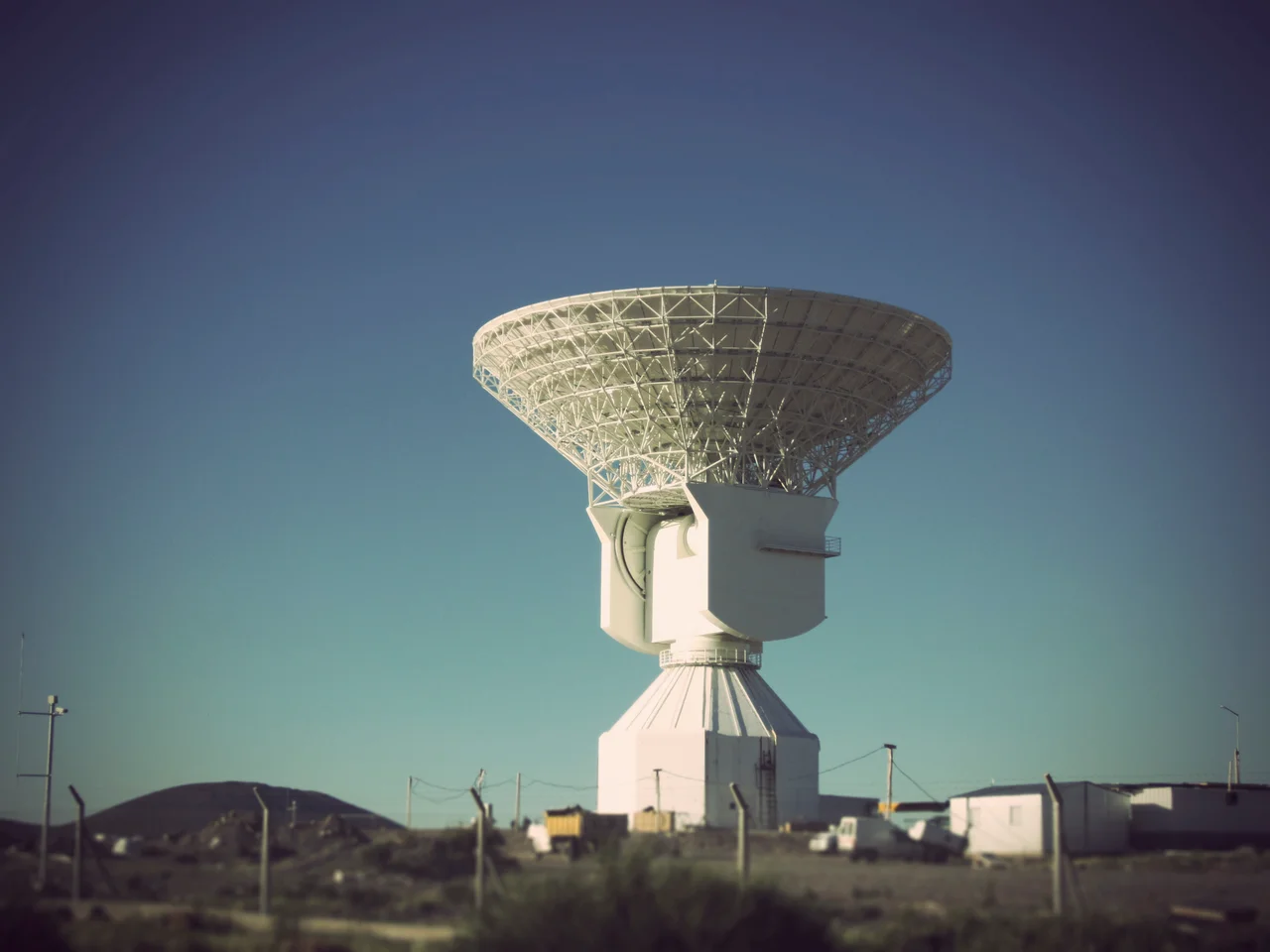

Malargüe Station
They needed a windless day. On 7 December 2011, engineers waited for the Patagonian air to fall still, then began hoisting a 35-metre dish into place atop its mount on the dry plain south of Malargüe. The operation took hours, and a single strong gust could have ruined it. When the dish finally settled and the bolts went home, Argentina had become the third anchor of Europe's reach into deep space - a 610-tonne ear, tilted toward the sky, built to catch signals so faint they arrive as little more than a rumor of a spacecraft.
The Third Ear
Officially it is Deep Space Antenna 3, or DSA 3, one of three giant tracking stations the European Space Agency operates around the globe. Its sisters sit near Cebreros in Spain and at New Norcia in Western Australia. The geometry is deliberate: spaced roughly a third of the planet apart, the three dishes hand spacecraft off to one another as Earth turns, so that a probe sailing toward a comet or a distant planet is never out of touch for long. Malargüe completed the set in 2013, closing the gap over the Americas and giving ESA the ability to follow its most distant missions around the clock.
Listening Across the Void
The dish transmits commands in X-band and listens in both X- and Ka-band, straining for telemetry that has crossed the solar system to get here. Malargüe was one of the stations that tracked Rosetta, the probe that chased and orbited a comet, and it has carried daily traffic for Gaia, the mission charting more than a billion stars, as well as Mars Express and the ExoMars program. A 20-kilowatt amplifier built in Italy boosts outgoing signals; a separate Ka-band transmitter, installed with the Italian Space Agency, has run experiments jointly with NASA. Every byte of a Mars weather report or a comet's chemistry may pass through this single white bowl on the pampa.
An Advantage of Distance
Malargüe's remoteness, often a liability for an outpost 30 kilometres from the nearest town, turns out to be a scientific asset. Sitting far from the great radio dishes of the Northern Hemisphere, it gives astronomers a long baseline across the planet for a technique called very-long-baseline interferometry, in which widely separated antennas combine their views to pinpoint radio sources with extraordinary precision. From here, the southern sky opens up. The same isolation that makes the drive feel endless makes the measurements sharper, and helps fix the positions of distant galaxies and quasars that anchor our maps of the heavens.
Where the Sky Goes Quiet
There is a reason this corner of Mendoza Province draws people who study the universe. The air is thin and dry, the population sparse, the radio noise low. A short drive away, on the same high plain, the Pierre Auger Observatory spreads its cosmic-ray detectors across thousands of square kilometres. Stand near the DSA 3 dish at dusk and the scale of the place asserts itself: an enormous machine, almost motionless, turning by tiny degrees to keep its gaze locked on a point of light too distant to see, while the Andes darken to the west and the first stars come out over the steppe.
From the Air
Malargüe Station (DSA 3) sits at 35.776°S, 69.398°W, about 40 km south of the town of Malargüe on the high Mendoza pampa near an elevation of roughly 1,550 m. The white 35-metre dish and its 40-metre support structure stand out sharply against the flat, treeless steppe and are visible from cruising altitude in the clear, dry air typical of the region. The nearest airfield is Malargüe (ICAO SAMM); Mendoza's airport (SAME) lies well to the north. Best viewing is in calm, cloudless conditions; the Andes rise to the west as a navigation reference.
Nearby Stories
- Malargüe 14 km away
- Las Leñas 42 km away
- Reserva Provincial La Payunia 48 km away
- Atuel Canyon 75 km away
- Altos de Lircay National Reserve 90 km away
- Gruta del Indio 122 km away
- Pincheira Brothers 131 km away
- FaSinPat 326 km away