_2022-11_(31).jpg)
Atuel Canyon
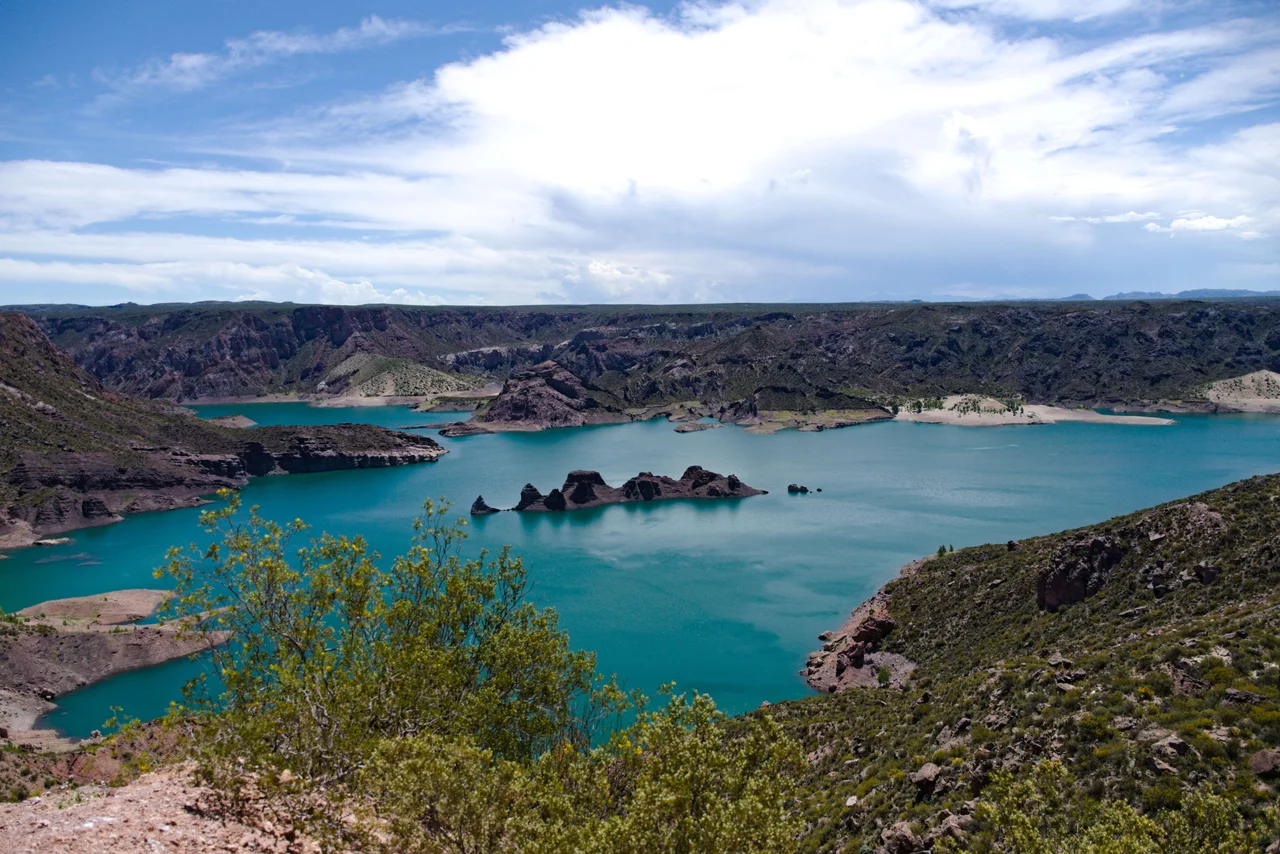
The rock here cannot decide on a color. Drive the winding road south from San Rafael and the canyon walls flush rust-red, then bleach to ochre and sulfur-yellow, then streak with an improbable copper-green, all of it carved and polished by a single restless river. The Cañón del Atuel runs through the heart of Argentina's Mendoza Province like a wound in the earth, and travelers come to raft its rapids, climb its faces, and simply stand at the lip and watch the light change the walls hour by hour.
A Palette Written in Minerals
The colors are not decoration; they are chemistry. The deep reds come from iron oxide, the same rust that stains an old nail left in the rain. The yellows are the signature of sulfur compounds, and the strange greens betray copper in the rock. Wind and water have done the carving, scouring softer layers away and leaving the harder stone in fins, hoodoos and slumping cliffs that locals have named for the shapes they resemble. The Atuel River drops roughly five hundred metres as it threads the canyon, and over uncounted millennia that falling water has acted like a slow blade, opening the mountainside to reveal the banded geology beneath.
From Lagoon to Reservoir
The canyon does not run wild end to end. It begins, traveling upstream, at the Embalse El Nihuil and ends at the Embalse Valle Grande, two reservoirs that bracket the gorge roughly 37 kilometres from San Rafael. Between them, the Atuel's torrential energy has been put to work: a chain of power stations harnesses the river as it falls, beginning at the El Nihuil dam. This is a landscape where raw geology and human engineering share the same narrow valley, the turquoise pool of Valle Grande sitting still and bright at the canyon's foot while the river above it crashes through stone.
Whitewater and the Adventure Trade
For all its geological drama, the Atuel is best known to many as a playground. The rapids that punctuate the river run from Class II, gentle enough for novices, up to Class IV, where the water demands real skill and a guide who knows the line. Rafts and kayaks ride the current through the gorge while horseback riders and mountain bikers trace the rim. Hotels, campsites and country clubs have grown up along the surrounding roads to serve the steady flow of visitors, making the canyon one of the anchors of tourism in southern Mendoza, an easy day trip that rewards a traveler with a full menu of ways to get wet, get high, or simply get lost in the colors.
The Hour of Best Light
Like all great desert canyons, the Atuel saves its finest moments for the edges of the day. In the flat noon glare the walls can read as merely dusty, but as the sun drops low the reds deepen to ember, the yellows turn to gold, and shadows pool in the side gullies to throw every ridge into relief. Photographers learn to wait. The same wall that looked ordinary at midday becomes, an hour before sunset, a vertical canvas of warm and cool tones stacked in ragged bands, the still water of Valle Grande catching the whole show upside down.
From the Air
The Cañón del Atuel centers near 34.88°S, 68.58°W in Argentina's Mendoza Province, with the canyon floor descending from roughly 1,250 metres to 700 metres. From the air, look for the bright reservoir of Embalse Valle Grande and the larger Embalse El Nihuil bracketing a narrow, colorfully banded gorge about 37 km south-southwest of the city of San Rafael. The nearest airport is San Rafael (SAMR, elevation 2,470 ft), a short hop to the northeast; Malargüe (SAMM, elevation 4,683 ft) lies to the south and Mendoza El Plumerillo (SAME, elevation 2,310 ft) to the north. The canyon photographs best in the low, raking light of early morning or late afternoon; midday haze can flatten the colors.
Nearby Stories
- Pierre Auger Observatory 7.7 km away
- San Rafael, Mendoza 36 km away
- Malargüe 71 km away
- Malargüe Station 92 km away
- El Teniente 117 km away
- Tragedy of Alpatacal 146 km away
- San Luis 247 km away
- Lihué Calel National Park 385 km away