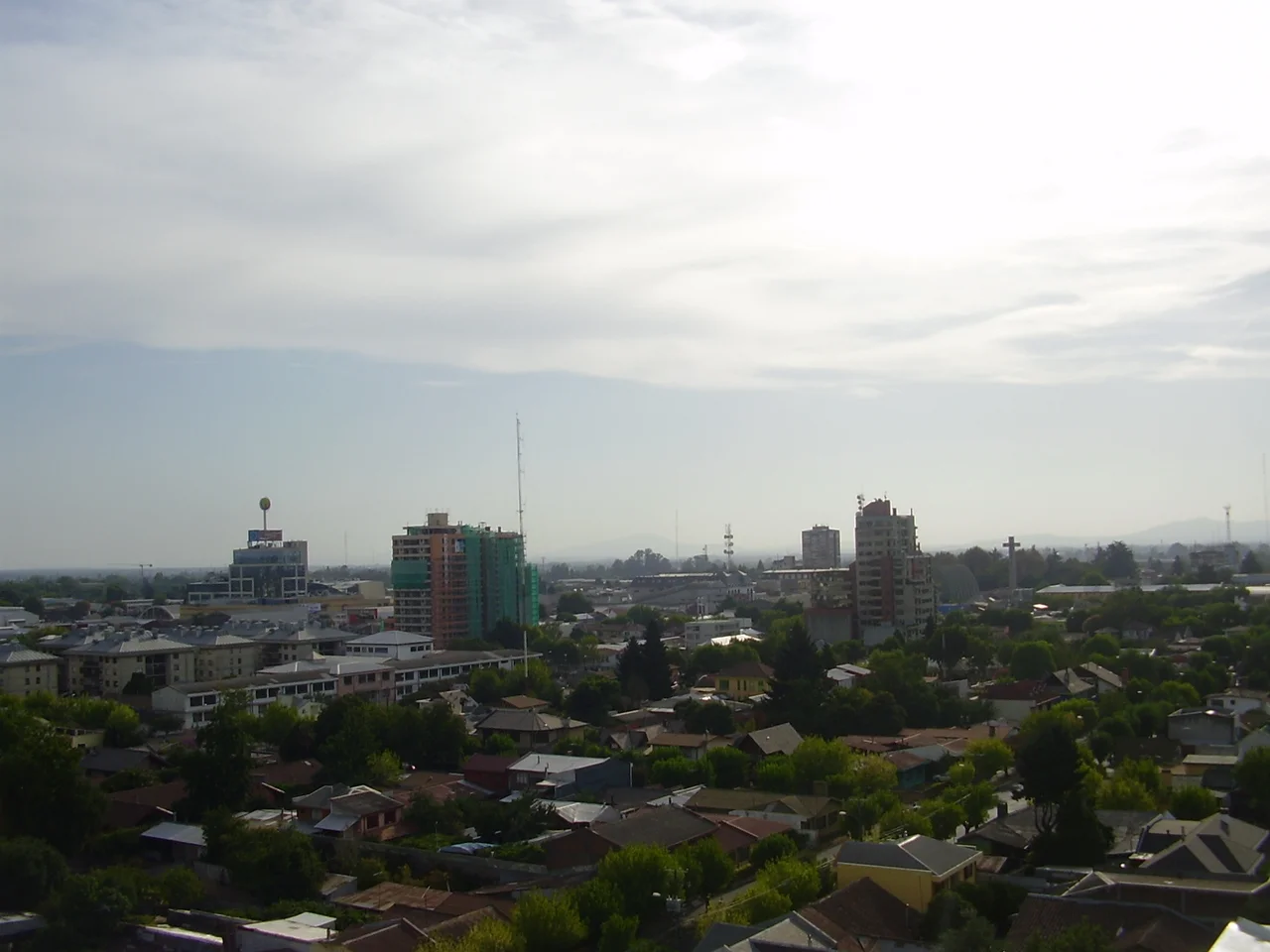

Chillán
On a winter night in January 1939, the ground beneath Chillán heaved for less than a minute and erased most of the city. The earthquake measured magnitude 8.3, the deadliest in Chilean history, and when the dust settled roughly one in four of Chillán's residents were dead. Whole families vanished in collapsing adobe. The survivors woke to a town that no longer existed. What they built in its place, and what neighbors sent from across a continent to help them grieve, is the story this valley city carries to this day.
The Night the Adobe Fell
The quake struck in the small hours of January 24, 1939, rupturing deep beneath the Ñuble countryside. Chillán took the worst of it. Some ninety percent of the city's buildings came down, most of them the thick adobe that had stood since colonial times and turned, in seconds, into the thing that killed. Estimates of the dead across the region run as high as 50,000, with the figure most often cited around 28,000. The numbers are almost too large to hold. Behind each one was a person asleep in a house that did not survive the shaking. The disaster reshaped Chile itself, prompting the state to create a development corporation that would drive the country's industrialization for decades. But that was the aftermath. First there was only the rubble, and the work of pulling the living from it.
Death to the Invader
Mexico answered Chillán's grief with paint. In solidarity after the earthquake, the Mexican government sent two muralists south to decorate a new school being built for the children of the ruined city, the Escuela México. David Alfaro Siqueiros, one of the giants of Mexican muralism, covered the library walls with Muerte al invasor, "Death to the Invader." On one wall he painted Mexican history through the Aztec emperor Cuauhtémoc; on the opposite wall, Chilean resistance through the Mapuche leaders Galvarino and Caupolicán. At the entrance, Xavier Guerrero painted De México a Chile, binding the two nations together. Painted by men mourning a tragedy that was not their own, the murals were declared a National Monument of Chile in 2004. They survived the 2010 earthquake, were carefully restored by Mexican conservators, and still face the schoolchildren of Chillán.
The Founder and the Prodigy
Long before the earthquake, Chillán had given Chile two of its most famous sons. On August 20, 1778, Isabel Riquelme, the daughter of a local councilman, gave birth here to Bernardo O'Higgins, the illegitimate child of an Irish-born colonial official who would never acknowledge him and whom he would never meet. The boy grew into the soldier and statesman who led Chile to independence and became its first head of an independent state. More than a century later, in 1903, another Chillán child stunned his family: Claudio Arrau could read Beethoven sonatas at the age of four, gave his first concert at five, and went on to become one of the twentieth century's supreme interpreters of Beethoven, recording all thirty-two piano sonatas. A founding father and a piano prodigy, both from the same provincial valley town.
Smoke and Firewood
Chillán today is the capital of Chile's youngest region, Ñuble, a market town set among orchards and wheat fields between the coastal range and the Andes. Its winters are damp and cold, and the city heats itself the old way: roughly sixty-two percent of households burn firewood, which on still winter days makes Chillán's air among the most polluted in the country, ranking behind only Santiago, Temuco, and nearby Concepción. The smoke is the price of a particular kind of life, one lived close to the forests and the cold. Modern highways and the rebuilt TerraSur railway now connect Chillán to Santiago in under five hours, but the city remains unmistakably its own place, more agricultural fair and mountain gateway than metropolis.
From the Air
Chillán sits at 36.61°S, 72.10°W in Chile's Central Valley, at roughly 120 meters elevation, framed by the coastal Cordillera de la Costa to the west and the snow-capped Nevados de Chillán volcanoes to the east. The city's grid was rebuilt after 1939 around the Plaza de Armas; look for the cathedral and the surrounding agricultural patchwork of the Ñuble valley. The nearest field is General Bernardo O'Higgins Airport (ICAO SCCH) just outside town; Carriel Sur International (ICAO SCIE) at Concepción, about 100 km west, handles scheduled commercial traffic. Best viewing is early morning before woodsmoke haze builds; winter brings low cloud and reduced visibility across the valley.
Nearby Stories
- Tomé Tragedy 16 km away
- Cobquecura 28 km away
- Cueva de los Pincheira 31 km away
- El Chiflón del Diablo 39 km away
- Parral, Chile 45 km away
- Tucapel 49 km away
- Tragedy of Antuco 62 km away
- LAN-Chile Flight 621 69 km away