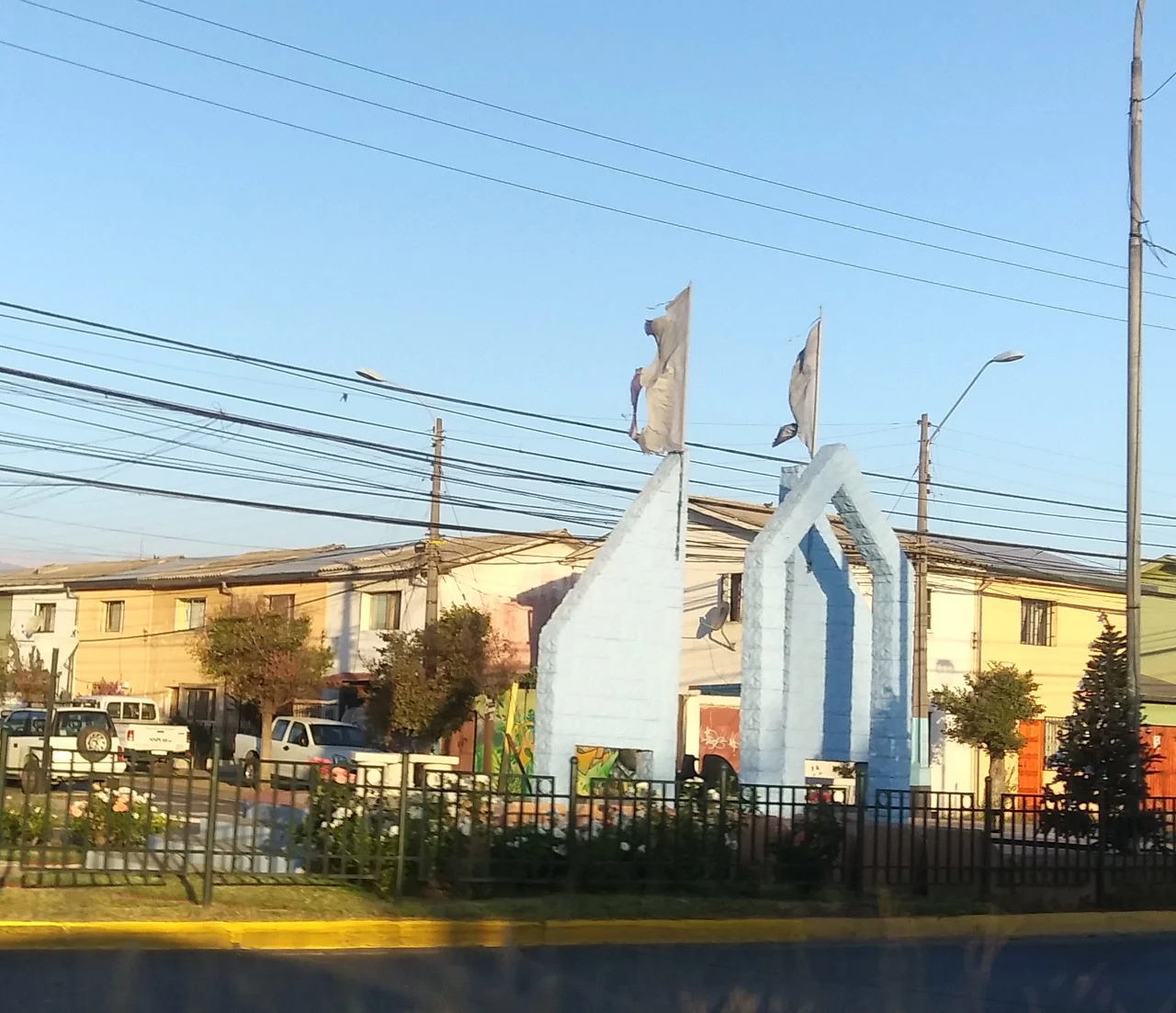

Tomé Tragedy
Their team had just won. On the night of February 9, 2013, a bus of O'Higgins supporters left the Estadio CAP in Talcahuano carrying the easy happiness of fans whose side has taken the match two to nil. They were heading up the coast toward Dichato, along a road called the Cuesta Caracol that climbs and twists above the sea near Tomé. Somewhere on those curves the bus went over the edge and fell roughly a hundred meters into a ravine. Sixteen people did not come home. It remains the deadliest disaster involving football fans in Chilean history.
The Curve Above the Sea
The coast road north of Concepción is beautiful and unforgiving, switchbacking through hills that drop steeply to the Pacific. The Cuesta Caracol earns its name, caracol meaning snail, from the tight spiraling bends that fold back on themselves as the road gains height. For a bus full of tired, jubilant passengers late at night, the margin for error was thin. When the vehicle left the road and plunged into the ravine below, the fall was long enough that survival, for many aboard, came down to where they happened to be sitting. The first casualty figures that night were uncertain, swinging higher and lower until the rescue effort ended and the true count was known.
Sixteen Names
The dead were confirmed the next day, and the list is hard to read, because so many of them had barely begun. Most were teenagers. Rodrigo Valdés Aliaga was fifteen. So were Andrés Osorio Cantillana, Luis Contreras Aedo, and others. Joaquín Ávila Muñoz and Matías Droguett Carrasco were sixteen. The youngest was Tomás Benjamín Contreras Román, one year old. Hugo Contreras Becerra, thirty-eight, was the bus driver. They were not statistics or a barra brava abstraction; they were children and young adults and one infant, riding home from a football match with the people they loved. Twenty-one others survived, several from the same families that had just lost someone.
A City and a Club in Mourning
Grief moved fast through two cities. O'Higgins is the pride of Rancagua, hundreds of kilometers north, and the news emptied the joy out of a season that had been going well. Days of mourning were declared in Rancagua and in Tomé, and across the leagues of Chile's football association a date of mourning was set. When the remains of the sixteen reached Rancagua, fans and residents met them in caravans and lined the route. They were laid to rest at the Estadio El Teniente, the club's own ground, where thousands came to say goodbye. A football stadium, built for ninety minutes of noise, became for a day a place of national silence.
How a Club Remembers
The supporters' group affected was the Trinchera Celeste, the Sky-Blue Trench, named for the club's colors. In the months that followed, O'Higgins built memorials so its dead would not fade into a date on a calendar. Ten months after the crash, the club inaugurated a memorial at the Monasterio Celeste; a year on, another rose near the Estadio El Teniente. Inside the rebuilt stadium, sixteen seats were set aside in the section where the Trinchera Celeste stands, one for each life lost, a permanent absence kept deliberately present. Every home match, the team plays in front of sixteen empty places that are never really empty.
What the Road Holds
Years later, the Cuesta Caracol still climbs above Tomé as it always did, and most who drive it know nothing of what happened on a February night in 2013. That is how roads are; they keep no memory of their own. The remembering is left to the living, to a club that plays beneath sixteen reserved seats and a city that learned, in the worst way, how far the love of a team can travel and what it can cost. The fans who set out that night went only to watch a game and ride home together. The tragedy of Tomé is not a cautionary tale. It is sixteen people, mostly young, who deserve to be named and mourned rather than reduced to the place where they died.
From the Air
The Tomé tragedy occurred on the Cuesta Caracol coastal road near Tomé, Chile, at approximately 36.64°S, 72.96°W, on the Pacific coast northeast of Concepción and Talcahuano. The nearest airport is Carriel Sur International Airport (ICAO: SCIE, IATA: CCP) at Talcahuano, about 25 km southwest. From the air, the site reads as steep, folded coastal hills meeting the sea, with the small port town of Tomé to the south and the resort village of Dichato to the north; the road itself is a thin switchbacking line cut into the slopes above the water. The Bahía de Concepción and the Itata coast are useful orienting features. This stretch is frequently shrouded in coastal cloud and winter rain, so clear visibility favors a summer day after a front clears; recommended viewing altitude 2,000 to 4,000 feet AGL to take in the coastline and terrain.
Nearby Stories
- Battle of El Roble 12 km away
- Santa María Island, Chile 16 km away
- El Chiflón del Diablo 26 km away
- 2010 Chile Earthquake 30 km away
- HMS Monmouth (1901) 43 km away
- Tucapel 59 km away
- Parral, Chile 59 km away
- 1687 Peru Earthquake 2366 km away