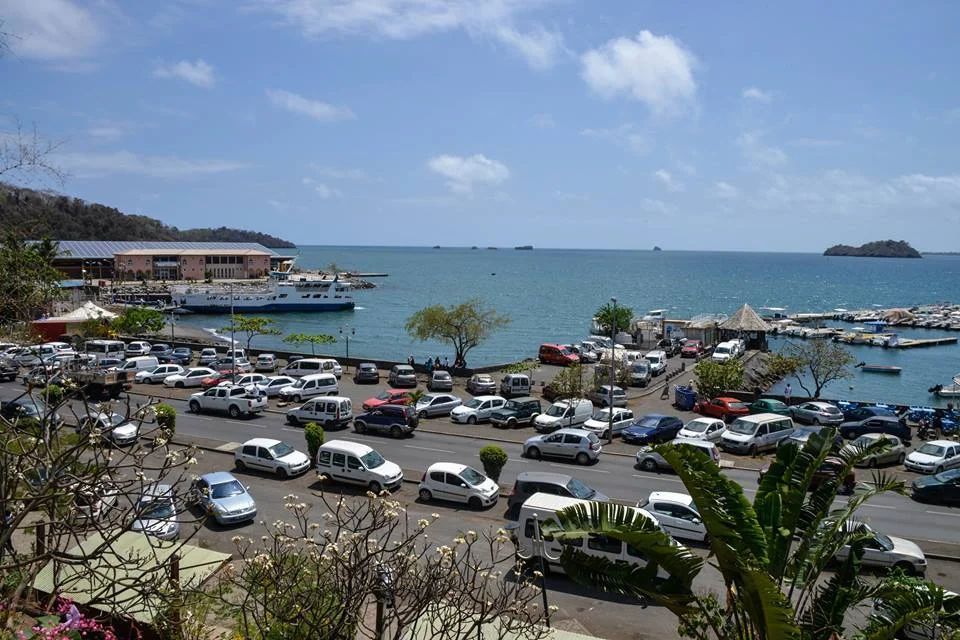

Mamoudzou
Look at a political map of the Mozambique Channel and one detail jars: a scatter of islands flying the French tricolor, a thousand kilometers from any other piece of France and far closer to Madagascar than to Paris. Mamoudzou is their capital, the largest town in Mayotte and the busiest place on the archipelago. It crowds onto a strip of flat land on the main island of Grande-Terre, looking out across a two-kilometer channel to its sister island, Petite-Terre, where the airport sits. To stand on its harbor front is to stand at the meeting point of three worlds at once: African, Comorian, and French.
The Island That Said No
Mamoudzou is the capital of a place that chose, repeatedly and emphatically, to be French. When the Comoro Islands voted for independence from France in 1974, the result across the archipelago was overwhelming, nearly 95 percent in favor. But Mayotte broke ranks. Its voters chose by a clear majority to remain with France, and a 1976 referendum on rejoining the newly independent Comoros was rejected by more than 99 percent of Mahorais. The Comoros has never accepted the split and still claims Mayotte as its own; the United Nations has at times sided with that claim. France, and the people of Mayotte, have not budged. In 2009, more than 95 percent voted to deepen the bond further, and in 2011 Mayotte became the 101st department of France, governed by the same laws and using the same euro as a town in Provence. Mamoudzou is where that improbable status is administered, the capital of the only piece of the old Comoros to fly the tricolor.
The Accidental Capital
Mamoudzou owes its existence to geography and accident. In the 1860s it was no more than a handful of villages and sugar plantations, but it occupied one of the few stretches of flat ground on a rugged island and made the obvious landing point opposite the old capital of Dzaoudzi. So it grew, and grew, until in 1977 it was named the provisional capital. The word provisional turned out to be permanent: the change was meant to be confirmed by a decree that no one ever got around to signing, leaving little Dzaoudzi the capital in law while Mamoudzou became the capital in every way that mattered. At the town's northern edge, the village of Kawéni traces its roots to the 14th century, though its old mangroves have since been filled in and built over to make an industrial zone.
Bush Taxis and a Tyre Race
Daily life here has its own rhythm and its own rules. There are no scheduled buses; instead, shared bush taxis ply fixed routes for a flat fare, and the longest ride you can take, all the way south to Boueni, costs only a few euros. Road discipline is famously erratic, and most visitors are advised to leave the driving to locals. The central market is a riot of color and noise, and boats head out into the great surrounding lagoon to watch dolphins and, in season, whales. Once a year in June the town hosts one of the stranger sporting events anywhere: the Course de Pneus, a tyre-rolling race in which costumed competitors whack car tyres along nearly two kilometers of street with batons, all dressed to an annual theme. Even the football team plays by its own logic, hosting friendly matches against neighboring island sides without belonging to FIFA.
After the Storm
On 14 December 2024, the rhythm broke. Cyclone Chido struck Mayotte head-on, a storm of Category 4 strength that drove sustained winds of around 226 kilometers per hour across the islands and tore through Mamoudzou and the country beyond. Around 40 people are known to have died in Mayotte, with many more feared lost in the sprawling informal settlements that ring the capital. The airport's control tower was wrecked, its roof and windows blown away, and commercial flights stopped for days. It was the most destructive cyclone to hit the archipelago in living memory. Yet Mamoudzou is a survivor by nature, a town that grew from villages into a capital almost by stubbornness, and the work of clearing, rebuilding, and carrying on began even as the wind dropped. The market reopens, the bush taxis run, and the lagoon still glitters off the harbor front.
From the Air
Mamoudzou lies at roughly 12.78 degrees south, 45.23 degrees east, on the island of Grande-Terre in Mayotte. From the air, the defining feature is Mayotte's vast turquoise lagoon, one of the largest enclosed lagoons in the world, ringed by coral reef and enclosing the two main islands. Mamoudzou sits on the eastern shore of Grande-Terre, facing the smaller Petite-Terre across a narrow channel. Dzaoudzi-Pamandzi International Airport (ICAO FMCZ, IATA DZA) is on Petite-Terre, the nearest field. The wet season runs roughly November through April and carries real cyclone risk, as Chido demonstrated in December 2024; the drier middle months offer the calmest, clearest flying. A viewing altitude of 3,000 to 6,000 feet over the lagoon frames the town, the channel, and the reef-rimmed water all at once.
Nearby Stories
- Sunny South (clipper) 4.9 km away
- 2008 Invasion of Anjouan 36 km away
- Anjouan 64 km away
- Moheli 156 km away
- Glorioso Islands 205 km away
- Anjajavy Forest: Where Stone Forests Meet Living Ones 279 km away
- Nosy Be 285 km away
- Juan de Nova Island 495 km away