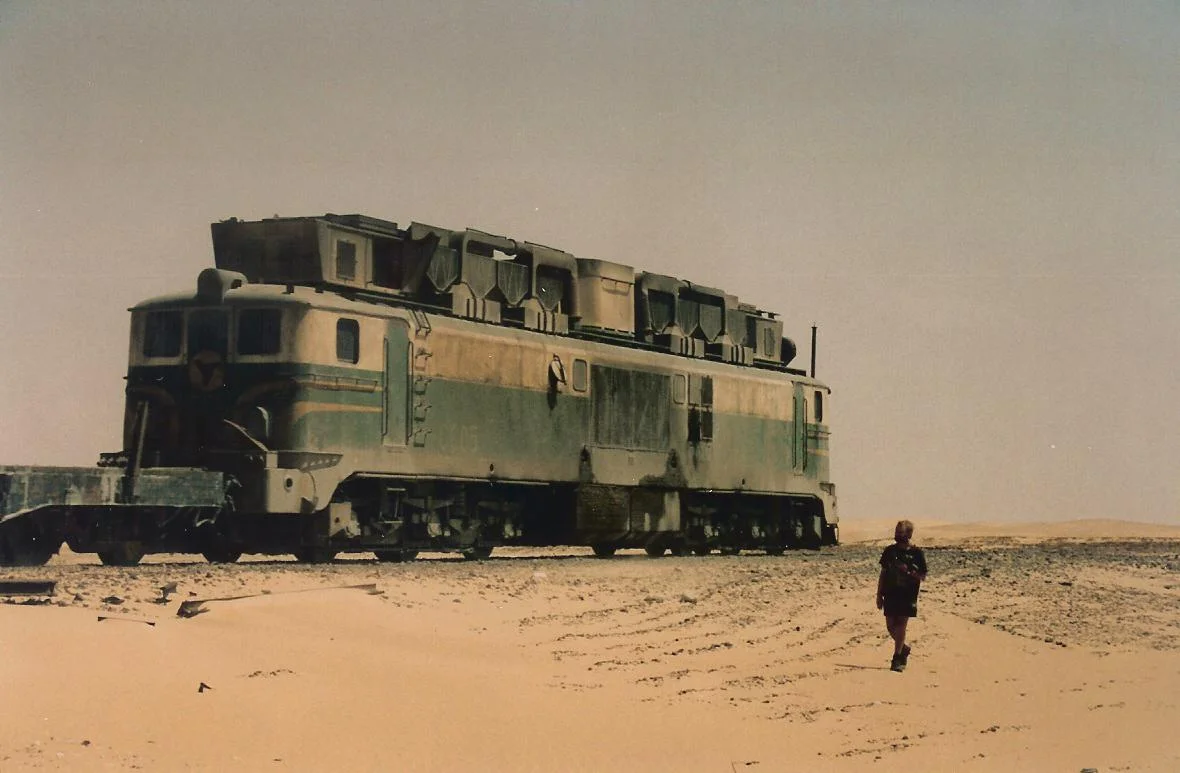

Mauritania Railway
It can stretch nearly three kilometers from the locomotives to the final car, so long that as the front rounds a curve the rear is still hidden over the horizon. The Mauritania Railway runs a single track across 704 kilometers of open Sahara, and the trains that grind along it rank among the longest and heaviest the world has ever built. There are no first-class carriages, no dining car, no schedule you would trust. What there is, instead, is one of the last great free rides on the planet: climb the ladder of an open hopper, find a perch on the iron ore, and let the desert carry you to the sea.
Backbone of a Nation
The line opened in 1963, three years after construction began, built for a single purpose: to move iron ore. It links the mining center of Zouérat, deep in the desert near the Western Sahara border, with the Atlantic port of Nouadhibou, running through Fderîck and the railway stop at Choum along the way. The ore proved so valuable that the line was nationalized in 1974 and remains under the state mining agency, SNIM. For decades the railway has been an economic lifeline, hauling roughly 16.6 million tonnes of ore a year. In a country where so much is sand and distance, this thin steel thread is the spine that holds the north together.
A Train Like No Other
The numbers strain belief. Two diesel-electric locomotives drag between 200 and 210 cars, each loaded with up to 84 tonnes of ore, for a train that can run close to three kilometers end to end. It was custom-built to survive the Sahara. The earliest French-made MIFERMA locomotives were specially adapted for the dust and heat; later came modified American EMD engines, and in 2010 SNIM ordered six EMD SD70ACS units fitted with pulse air filtration and movable sand plows to keep the desert from grinding them to a halt. Everything about the railway is engineered against the same relentless enemies: blowing sand, brutal heat, and the sheer punishing weight of the load.
Hot, Free, and Dangerous
The most famous passengers do not pay a fare at all. While an SNIM subsidiary occasionally attaches a passenger car, most riders simply climb atop the open ore hoppers and ride for free: local families, merchants moving goods, and a trickle of adventurous travelers. The journey is genuinely punishing. Daytime temperatures soar past 40°C, nights drop toward freezing, and the ore dust coats everything and everyone in fine black grit. It is also dangerous: falls from the moving cars have killed riders over the years. Those who endure the seventeen-hour crossing describe something close to transcendence, the Sahara unrolling for hour after hour beneath an enormous sky, but the risks are real and unforgiving.
Through Contested Ground
The railway carries more than ore; it carries the region's tangled politics. Since the closure of the Choum Tunnel, a roughly five-kilometer stretch of the line cuts across the part of Western Sahara controlled by the Polisario Front, the Sahrawi independence movement, threading the train through territory whose sovereignty remains disputed. The line has also drawn outside money. In 2014, the mining giant Glencore paid SNIM a billion dollars for eighteen years of access, hoping to link new mines to the existing track and avoid building its own. Within a few years, with iron ore prices down nearly 40 percent, Glencore walked away. The desert railway, as it has for sixty years, simply kept running.
From the Air
The Mauritania Railway runs roughly 704 km between Zouérat (interior, near 22.7°N, 12.5°W) and the Atlantic port of Nouadhibou. The reference point here is near Choum at 21.30°N, 13.05°W. From the air the single track is a faint dark line scored across otherwise featureless desert, sometimes traced by the long shadow of a train. Skies are usually clear, with occasional Saharan dust events cutting visibility. Atar (GQPA) lies south of the central section; Nouadhibou (GQPP) sits at the coastal terminus. Best viewed from moderate altitude with low sun to pick out the rails.
Nearby Stories
- Zug, Western Sahara 50 km away
- Azougui 59 km away
- Agounit 63 km away
- Chinguetti Mosque 76 km away
- Chinguetti 105 km away
- Tourine Ambush 122 km away
- Akjoujt 166 km away
- Afonso Gonçalves Baldaia 325 km away