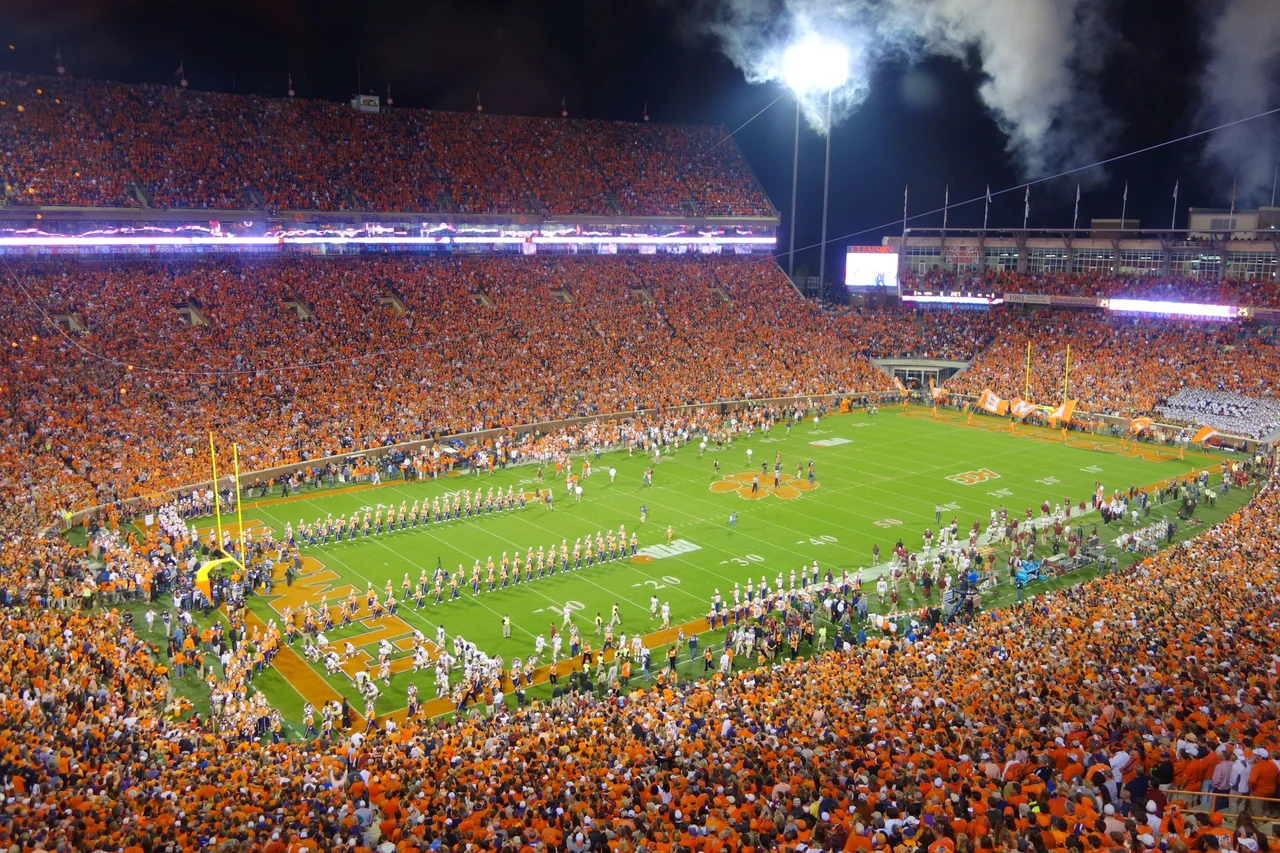

Memorial Stadium (Clemson)
The outgoing head coach told his successor not to build it. Jess Neely, leaving Clemson for Rice University after the 1939 season, gave Frank Howard one piece of parting advice: don't let them talk you into building a big stadium. Put about 10,000 seats behind the YMCA. That's all you'll ever need. Howard ignored him. Construction began in 1941 with a $150,000 bond issue and a $125,000 budget, and the first 20,500-seat stadium that opened on September 19, 1942 has expanded ever since into the largest venue in the Atlantic Coast Conference. The cemetery that gave the place half its nickname is still up on the hill, though the upper decks now block the view.
Six Dollars and Twenty-Five Cents a Seat
The original stadium was built for the cost of a small house. The South Carolina General Assembly ratified the bond issue on April 3, 1941. Governor Burnet R. Maybank signed off, and construction began in a valley in the western part of campus that Howard's staff had chosen against Neely's advice. The first 20,500 seats, the lower south grandstand of the current facility, cost about $6.25 per seat. Much of the early construction work was done by scholarship athletes themselves, including the very first staking out of the field by football players A.N. Cameron and Hugh Webb. The stadium opened in September 1942 and was dedicated to all Clemson men who have made the supreme sacrifice for their country, a memorial purpose the Scroll of Honor outside Gate 1 has carried forward. Today the scroll lists 498 names. A flypast of two T-34B Mentors marked its dedication in April 2010.
Why It's Called Death Valley
The nickname has two origins. The first is the location: the western valley where the stadium was built was already called Death Valley by Clemson students in the 1940s, partly because of the cemetery on the hill above it. That cemetery still exists, though the upper decks added over the decades have hidden it from the field. The second origin is a quote. In 1948, Lonnie McMillian, the longtime football coach at Presbyterian College, complained to sportswriters that he had to take his team up to Clemson and play in Death Valley, where they rarely scored or won. The name stuck immediately. Frank Howard, the legendary head coach and athletic director who retired in 1974, embraced it. When Howard retired the playing surface was renamed Frank Howard Field in his honor, but the stadium is still Death Valley to anyone who has ever been there on a Saturday.
Howard's Rock
Samuel Columbus Jones, Clemson class of 1919, brought Howard a rock from Death Valley, California in the early 1960s as a souvenir. He told Howard, Here's a rock from Death Valley to Death Valley. Howard used it as a doorstop in his office for several years. In September 1966, cleaning his office, he told IPTAY executive director Gene Willimon to take this rock and throw it over the fence or out in the ditch, but get it out of my office. Willimon did not throw it out. Instead, he placed it at the top of the hill at the east end of the stadium, where the players entered the field. Howard, never one to miss a marketing opportunity, turned it into the centerpiece of a tradition. Give me 110 percent or keep your filthy hands off my rock, he told his players. Players have been rubbing it before games ever since. The rock was vandalized in 1992 and again in 2013; it now sits under a protective case. The Clemson Ranger Club guards it during the 24 hours preceding the South Carolina game, with ROTC cadets keeping a drum cadence that can be heard across campus.
The Most Exciting 25 Seconds
Running Down the Hill started accidentally. The football locker rooms were originally in Fike Field House, up the hill northeast of the stadium. Players ran down the hill from the locker rooms to the field as a matter of routine, and they did it fast enough to feel intimidating. The tradition stuck even after the locker rooms moved. Today, after pregame warmups, the players board buses and ride around to the east side of the stadium. They gather at the top of The Hill around Howard's Rock. A cannon fires, the band launches into Tiger Rag, and the players run down. Brent Musburger called it the most exciting 25 seconds in college football during a 1985 broadcast. The line stuck. By the end of the 2018 season the Tigers had made the run down the hill 402 times.
Loud Nights and Famous Games
The stadium set a college football decibel record at 133 in 2007 during a game against Boston College. That record fell in 2023 when Tennessee-Georgia hit 137 decibels at Neyland Stadium, but at the time it stood as the loudest stadium in college football. The biggest crowd ever was October 23, 1999, when the top-ranked Florida State Seminoles, coached by Bobby Bowden, visited his son Tommy Bowden's Tigers; Ann Bowden, wife of one and mother of the other, wore a sweater that was half Clemson and half Florida State and read FloridaSon. Memorial Stadium has hosted concerts too: the Rolling Stones in 1989, Pink Floyd in 1994, Elton John and Billy Joel in 1995, the Eagles in 1996, U2 with Rage Against the Machine in 1997. Before their permanent stadium opened in Charlotte, the Carolina Panthers used Memorial Stadium as their home venue for their inaugural 1995 NFL season. The current capacity is over 81,000, the largest in the ACC, with the WestZone expansion completed in 2015 adding the Oculus structure as the final piece of Phase 3.
From the Air
Located at 34.6786 degrees N, 82.8431 degrees W on the western edge of the Clemson University campus in Pickens County, South Carolina. Field elevation approximately 800 feet MSL. The bowl is among the most recognizable structures in the upstate from altitude, particularly with the orange end zones visible on a clear day. Recommended viewing altitude 3,500 to 5,000 feet AGL. KCEU (Oconee County Regional / Clemson) sits about 4 nm west and is the standard general aviation field. KGSP (Greenville-Spartanburg International) lies about 35 nm east. Lake Hartwell forms the western and southern boundary of the campus. On football Saturdays, expect significant traffic and TFR notices.
Nearby Stories
- Caesars Head State Park 23 km away
- Georgia Guidestones 26 km away
- 1988 Oakland Elementary School Shooting 28 km away
- Battle of Lindley's Fort 32 km away
- Green River (North Carolina) 41 km away
- Tree That Owns Itself 56 km away
- Dahlonega, Georgia 64 km away
- Great Smoky Mountains National Park 71 km away