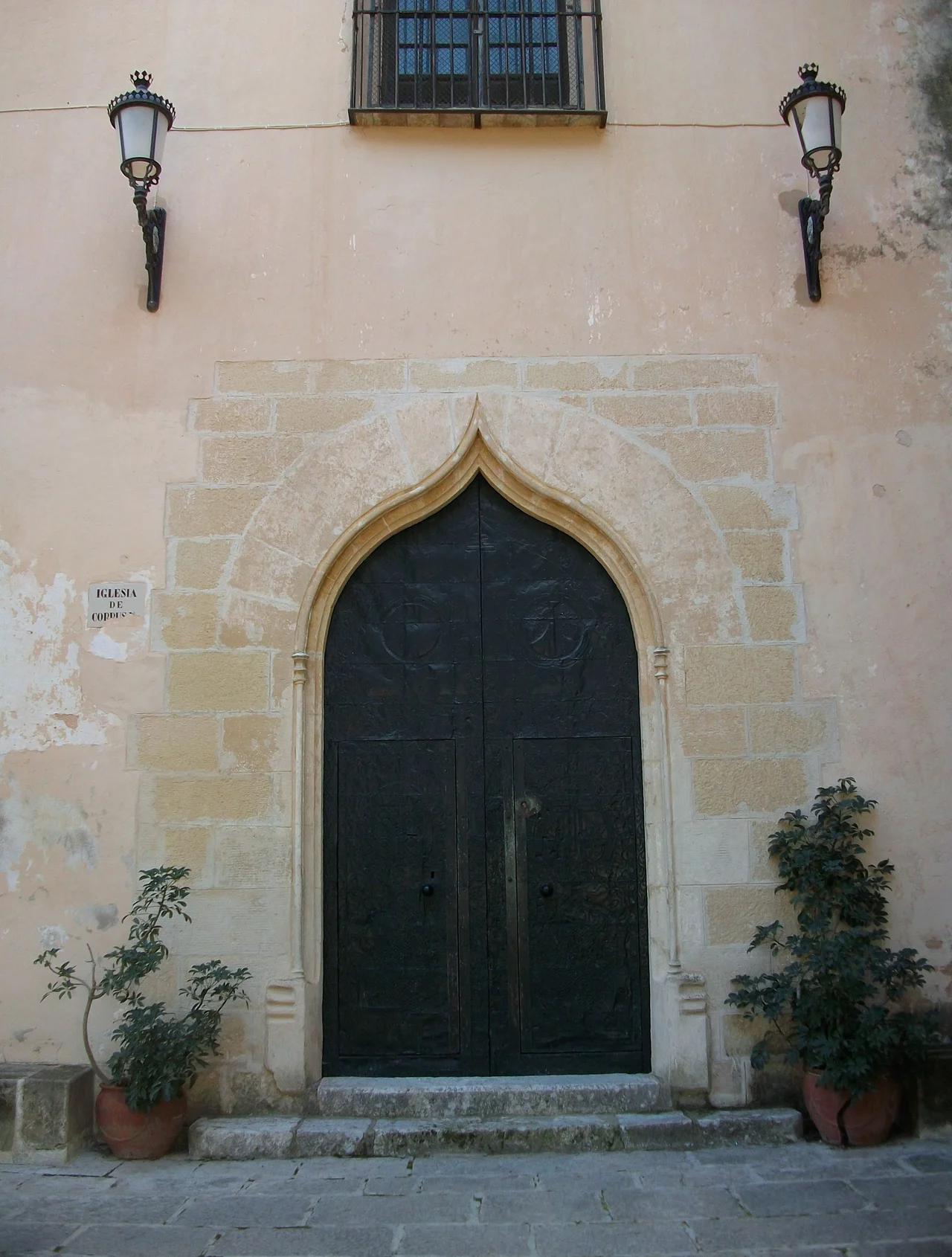

Monastery of the Corpus Christi (Llutxent)
As the Muslim army closed in, the priest faced a terrible choice. Six pieces of consecrated bread still lay on the altar, and there was no time to give communion before the fighting began. So he folded the hosts into the linen altar cloth, the corporal, and hid them among the rocks of a hill in what is now inland Valencia. When the Christian soldiers came back victorious and unwrapped the cloth, tradition says the bread had turned to flesh and the linen was soaked in blood.
A Battle on the Holy Mountain
The year was 1239, and the armies of King Jaume I were prising the region from the Muslim taifa of Valencia. Companies of Christian soldiers from the Aragonese towns of Calatayud, Daroca and Teruel, led by the noble Berenguer de Entenza, found themselves surrounded here during a mass held to bless the troops before battle. It was in that desperate moment that the officiating priest concealed the six hosts he had not been able to distribute. The Christians prevailed, and the discovery of the bloodstained corporals that followed gave the hill its enduring name: Mont Sant, the Holy Mountain. Whatever a modern visitor makes of the account, its power over the medieval imagination was immense.
The Mule's Long Walk
What happened next became legend across three kingdoms. When soldiers from different towns each claimed the sacred relic, they resolved the dispute in a way that left the choice to heaven. The corporals were sealed in a wooden box and loaded onto a mule that had never before crossed into Christian lands, and the animal was allowed to wander where it would. For eleven days it walked, refusing to stop, until it reached the collegiate church of Santa Maria in Daroca, far away in Aragon, where it finally dropped dead of exhaustion. There the Sacred Corporals have been kept ever since, in what is now the Basilica of Santa Maria de los Sagrados Corporales. The miracle came to bind three towns together: Llutxent, where it happened; Daroca, which guards the relic; and Carboneras de Guadazaon in Cuenca, keeper of a fragment.
Stones of Many Ages
The monastery that rose to honour that story is really several buildings from several centuries, knitted together on the mountainside above the town of Llutxent. Its roots reach back to a 13th-century hermitage on the sacred site. Building in stone began in the 14th century, the monastery took fuller shape in the early 1400s, and further renovation came in the 18th century, so that a visitor today reads the complex like tree rings. This layering is not a flaw but the whole point. Each generation added to what it inherited, unwilling to let the memory of Mont Sant fade, and the state now protects the ensemble as a Bien de Interes Cultural.
Cloister and Church
At the heart of the complex lies a square cloister of two storeys, its lower gallery carried on pilasters whose capitals are carved with Eucharistic motifs, a fitting echo of the miracle of the bread. Along its southern range run the old classroom, the monks' cells and the refectory. On the north side stands the Church of the Corpus Christi, a single vaulted nave of four bays with a raised choir at its foot. Two chapels added in the 18th century open off the epistle side: one dedicated to the Holy Face, and a communion chapel built on a Greek-cross plan and capped by a dome resting on pendentives. To the east, a service courtyard gathers the working rooms that once kept the community alive.
A Sanctuary Still
Centuries after the mule made its choice, the Holy Mountain has not been forgotten. Pilgrims and travellers still climb to the monastery along the Route of the Sacred Corporals, drawn as much by the quiet of the pine-clad summit as by the medieval drama that consecrated it. Whether one comes as a believer, a historian, or simply a walker in search of a view over the Vall d'Albaida, the place rewards the effort. It is a monument to a moment when faith, fear and war collided on a Valencian hilltop, and to the long human habit of building something lasting on the site where the extraordinary is remembered to have happened.
From the Air
The Monastery of the Corpus Christi stands at 38.95 degrees N, 0.36 degrees W, on the wooded slopes of Mont Sant above the town of Llutxent, in the Vall d'Albaida inland from Gandia. From the air, look for the monastery's church and square cloister set on a pine-covered rise overlooking the town and its surrounding farmland, roughly midway between the Costa Blanca coast and the mountainous interior. Best viewed from 2,000 to 4,500 feet in clear weather. Valencia (LEVC) lies about 75 km to the north; Alicante-Elche (LEAL) roughly 90 km to the south, with the Gandia coastline about 25 km to the east. Morning light picks out the hilltop cleanly before valley haze builds.
Nearby Stories
- Font Roja Natural Park 1.9 km away
- Calpe 5 km away
- Battle of Almansa 7.6 km away
- Hēmeroskopeion 14 km away
- Battle of Alcalá (1129) 19 km away
- Jumilla 32 km away
- Requena 32 km away
- Festival Internacional de Benicàssim 95 km away