
The Trees That Hid Their Height
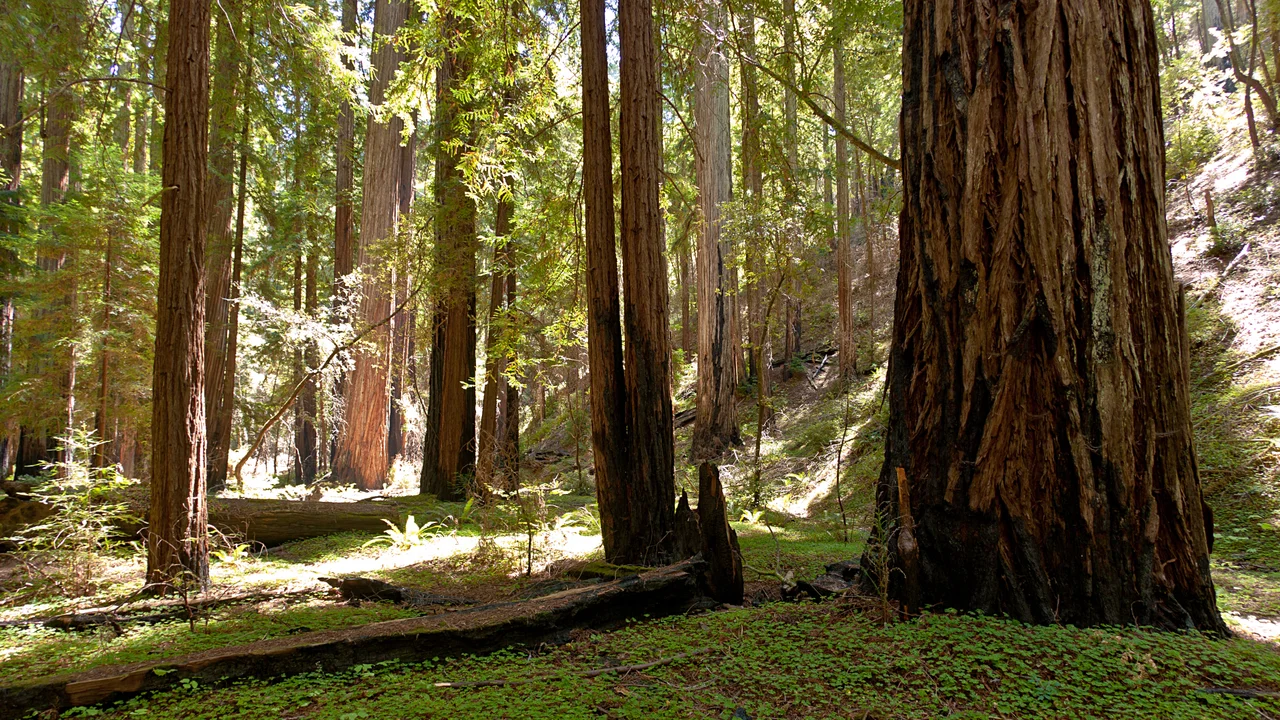
For five years, the tallest living thing on Earth stood in a valley so steep and remote that most Californians had never heard of it. The Mendocino Tree, a coast redwood in Montgomery Woods State Natural Reserve, claimed the title of world's tallest known tree from 1999 to 2004. Park managers knew exactly which tree it was. They refused to mark it. Previous record-holders had suffered root damage from tourists who trampled the ground around their bases, compacting the soil and slowly choking the very trees they had come to admire. So the Mendocino Tree stood unmarked among dozens of its near-equals, its record a secret kept in plain sight, towering over a grove that owes its survival to the simple fact that the terrain was too difficult for loggers to bother with.
Saved by Steepness
Before European settlers arrived, roughly two million acres of old-growth coast redwood forest stretched along California's coast from Big Sur to southern Oregon. By the twentieth century, logging had reduced that figure to an estimated 100,000 acres -- a ninety-five percent loss. Montgomery Woods survived because of geography. The reserve occupies the headwaters of Montgomery Creek, a tributary of the Big River, in a valley whose steep walls made commercial logging impractical. Most preserved redwood groves grow on broad alluvial plains, where the flat terrain that made the trees accessible to loggers also made them accessible to conservationists. Montgomery Woods is different. Its groves cling to an upland riparian habitat, a now-rare ecosystem where redwoods grow along narrow streambeds rather than wide floodplains. The terrain that saved the trees also makes them unusual -- ecological specimens of a forest type that has mostly vanished.
Nine Acres and a Legacy
The reserve began in 1945 with a nine-acre donation from Robert T. Orr. It was a modest start for what would become one of California's most significant redwood preserves. Since 1947, the Save the Redwoods League has donated 765 additional acres, expanding the reserve to its current 1,323 acres. The growth has continued into the present day, with recent acquisitions adding more buffer land to protect the watershed. Access comes from a parking area along Orr Springs Road, thirteen miles west of Ukiah and fifteen miles east of the tiny community of Comptche. From there, a moderately steep trail climbs along Montgomery Creek for about three-quarters of a mile before entering the grove, where a three-mile loop winds through the old growth on boardwalks designed to protect the fragile forest floor from the very footsteps of people who come to appreciate it.
Giants by the Dozen
The numbers alone are staggering. Montgomery Woods contains eighteen coast redwood trees taller than 350 feet and four that exceed 360 feet. To put that in perspective, a 350-foot tree would stand roughly as tall as a thirty-five-story building. These are not isolated specimens but members of a community, growing close enough that their canopies merge into a continuous ceiling that filters the light into green-gold columns. The Mendocino Tree lost its world record when taller specimens were discovered in Humboldt Redwoods State Park and later in Redwood National Park, both in Humboldt County to the north. But the distinction was always somewhat artificial. Coast redwoods grow in groves, not in isolation, and what matters at Montgomery Woods is not whether any single tree is the planet's tallest but that an entire community of giants persists here, quietly adding rings in a valley that time and industry overlooked.
The Forest Floor
Below the canopy, Montgomery Woods hums with life that visitors often overlook while craning their necks upward. American robins, Pacific wrens, cedar waxwings, and chestnut-backed chickadees move through the understory. Mule deer browse along the creek banks. Three species of newt inhabit the reserve -- the Coast Range California newt, the rough-skinned newt, and the red-bellied newt -- along with foothill yellow-legged frogs, a species whose dependence on clean, undammed streams makes it an indicator of watershed health. Summer temperatures can climb into the high eighties, but the grove stays cool under its canopy, and winter rains often flood the lower trails, reminding visitors that this forest runs on water. The creek that feeds these trees flows eventually into the Big River and out to the Pacific Ocean at Mendocino Headlands State Park, connecting this hidden valley to the open coast through a watershed that the redwoods have been filtering for centuries.
From the Air
Located at 39.23°N, 123.38°W in the Coast Ranges of Mendocino County. The reserve occupies a narrow valley along Montgomery Creek, a tributary of the Big River. From the air, look for the dense, unbroken canopy of old-growth redwoods in a steep valley west of Ukiah, along Orr Springs Road. The surrounding hills have been logged at various points, so the old-growth stand contrasts with younger second-growth forest nearby. Nearest airport: Ukiah Municipal Airport (KUKI), approximately 15 nm east-northeast. Recommended viewing altitude: 2,000-4,000 ft AGL. Terrain rises to 1,500-2,500 ft MSL in this area. Winter fog and low clouds are frequent along the coast but may not reach this inland valley.
Nearby Stories
- Elem Indian Colony: Poisoned Homeland 2.7 km away
- Anderson Valley Brewing Company 12 km away
- August Complex Fire 24 km away
- The Asbill Massacre 25 km away
- The Pawnee Fire 26 km away
- Pixieland 609 km away
- Neskowin Ghost Forest 646 km away
- Red Sand Beach 3682 km away