
Moonville
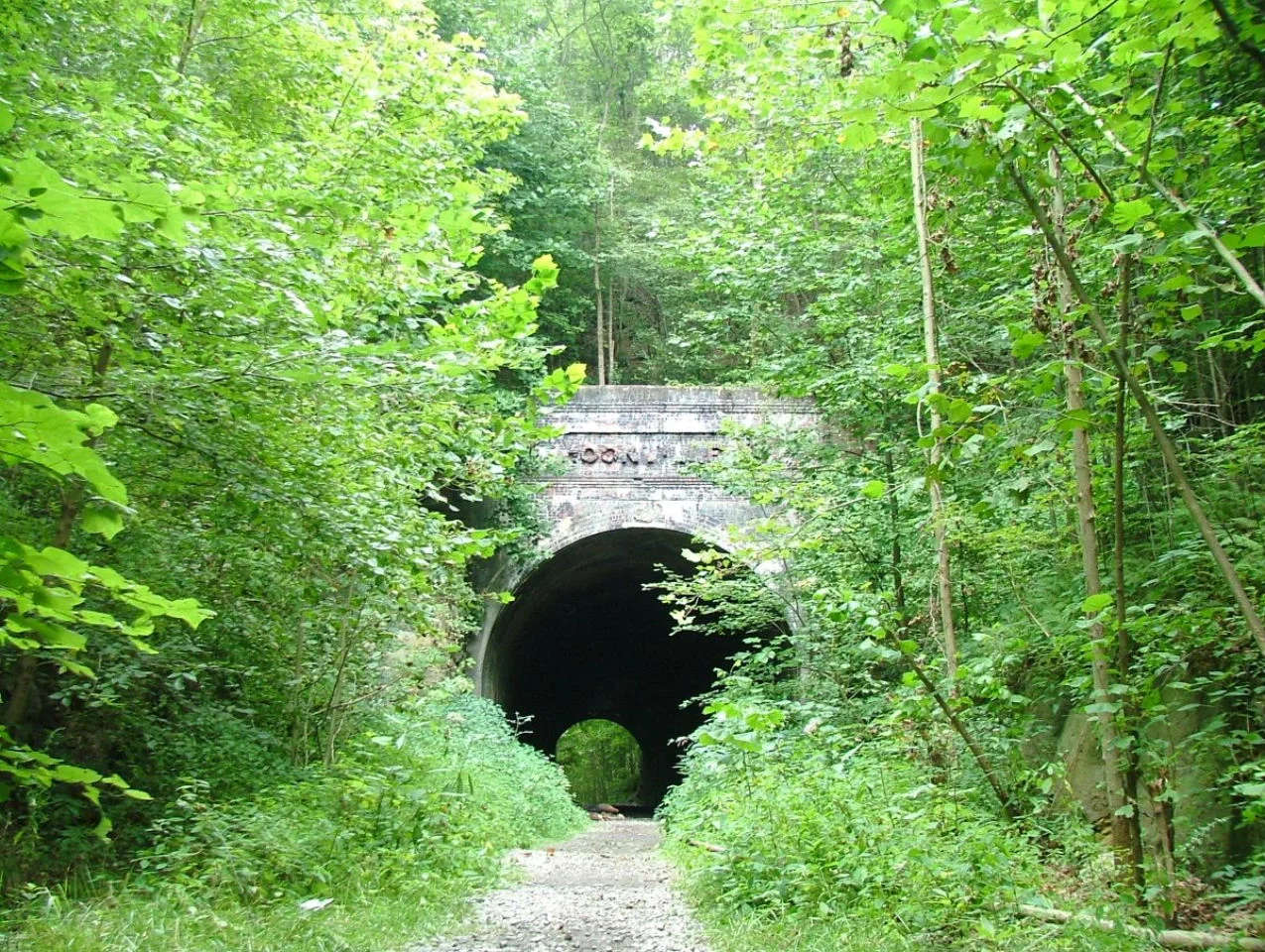
Moonville is gone, but the tunnel remains. The coal town that briefly existed beside the Marietta and Cincinnati Railroad in mid-19th-century Vinton County was always a hardscrabble place. Only two families, the Coes and the Fergusons, anchored the early population. By 1947 the last family had left. By the 1960s the buildings were gone. What survives is a cemetery, a few foundation stones, and a railroad tunnel through a high hill - a curved stone-and-brick passage where the tracks bent into darkness. The tunnel and the death toll of those tracks are what people remember now, and the four named ghosts who are said to walk between them.
Town That Almost Was
The Marietta and Cincinnati Railroad pushed through southeast Ohio in the mid-1800s on its way to Cincinnati, seeding small stations and coal communities along the way - Zaleski, Hope Furnace, Hope Furnace Station, Ingham Station, Kings Station, and the cluster called Moonville. The hills around Moonville held coal seams thin enough to mine but never rich enough to build a real town on. The railroad needed somewhere to put the trestles and the tunnel, and Moonville happened to be where the geometry worked. Two trestles bridged the winding Raccoon Creek; the Moonville Tunnel cut through the high hill between them. The community lived in the spaces the railroad left behind.
A Dangerous Way Home
Walking the tracks was the only practical way to get anywhere from Moonville. The trestles and the tunnel made it deadly. One trestle stood within 50 yards of the tunnel mouth, leaving almost no escape if a train came around the curve. At least 21 people died on or near the Moonville tracks over the railroad's working life, including a thirteen-year-old girl in 1978 who fell from the trestle as a train passed over it - the last recorded death. Coal mines around the area began to play out by the early 1900s. Families left as the work disappeared. By the time the line became part of the Chessie System in 1973, the town itself had been gone for a generation.
Four Ghosts
The Moonville Tunnel is one of the most-told ghost story sites in the Ohio Valley. Four named ghosts have specific stories attached to them. The Engineer is Theodore Lawhead, who died in a head-on train collision in the 1880s and is said to walk the tracks carrying a lantern. The Brakeman is said to be a young railroad worker who drank too much one night, fell asleep on the tracks, and was killed. The Lavender Lady is identified with Mary Shea, a thin elderly woman killed on the tracks at the far end of the tunnel - visitors report seeing a figure walking alongside the trail before she vanishes and the scent of lavender remains. The Bully is Baldie Keeton, a hard-drinking local who liked to fight, was thrown out of the saloon one night, and was later found dead on the tracks under circumstances some thought suggested murder. Mothers used the Bully to scare children into coming home before dark.
Midnight at Moonville
The railroad finally abandoned the line. Some 8 miles of track ran through the most isolated stretch between Parkersburg, West Virginia and St. Louis - dark, unsignaled, governed only by train orders. Workers hated the run. After the tracks were lifted, the right-of-way was preserved as the Moonville Rail Trail, with the tunnel still passable on foot. Each fall, the Vinton County Convention and Visitors Bureau holds Midnight at Moonville, a Halloween-themed festival that gathers hikers, ghost story enthusiasts, and reenactors at the tunnel for nighttime walks through the dark passage. Whether the ghosts are real or simply the residue of a place where 21 people actually died, the tunnel concentrates the past. The town is gone. The hill remains. The dark goes all the way through it.
From the Air
Located at 39.31 N, 82.32 W in Brown Township, eastern Vinton County, Ohio. The site lies along Raccoon Creek between former mining and iron-furnace communities. John Glenn Columbus International (KCMH) is about 75 miles north. Best viewed at 3,000-5,000 feet on clear days, when the forested hills and the remnants of the rail line tracing the creek are clearly visible.
Nearby Stories
- Hopewell Culture National Historical Park 10 km away
- Buffington Island 13 km away
- Blennerhassett Island 25 km away
- Gavin Power Plant 30 km away
- Portsmouth 33 km away
- Columbus: The Test Market Where America Tries Things First 46 km away
- The Y-Bridge of Zanesville 57 km away
- Gnadenhutten Massacre 98 km away