
Moonville Rail-Trail
The trail starts where the railroad ended. CSX Transportation abandoned the Marietta and Cincinnati line in stages through the late 1980s, pulling up rails and leaving the right-of-way to whatever came next. What came next was a ten-mile rail-trail that winds through Zaleski State Forest, skirts Lake Hope State Park, and threads two tunnels - the masonry Moonville Tunnel, where the ghosts of a vanished coal town are said to walk, and the timber King's Hollow Tunnel, where the engineering is a curiosity in itself. Cyclists and hikers now use the same dark passages that once moved freight between Marietta and Cincinnati.
From M&C to Rail-Trail
The Marietta and Cincinnati Railroad, built in the mid-1800s, ran across southern Ohio between its two namesake cities. The line was absorbed into the Baltimore and Ohio Railroad as its Southwestern Division, then merged into the Chessie System in the 1970s, then into CSX Transportation. When CSX abandoned the segment through the Zaleski State Forest in the late 1980s, the right-of-way could have been sold piecemeal and lost. Instead, Athens and Vinton County commissioners acquired the abandoned grade using Clean Ohio Conservation Fund grants. Track went out. Trail came in. The corridor passed from one form of public transportation to another.
Two Tunnels
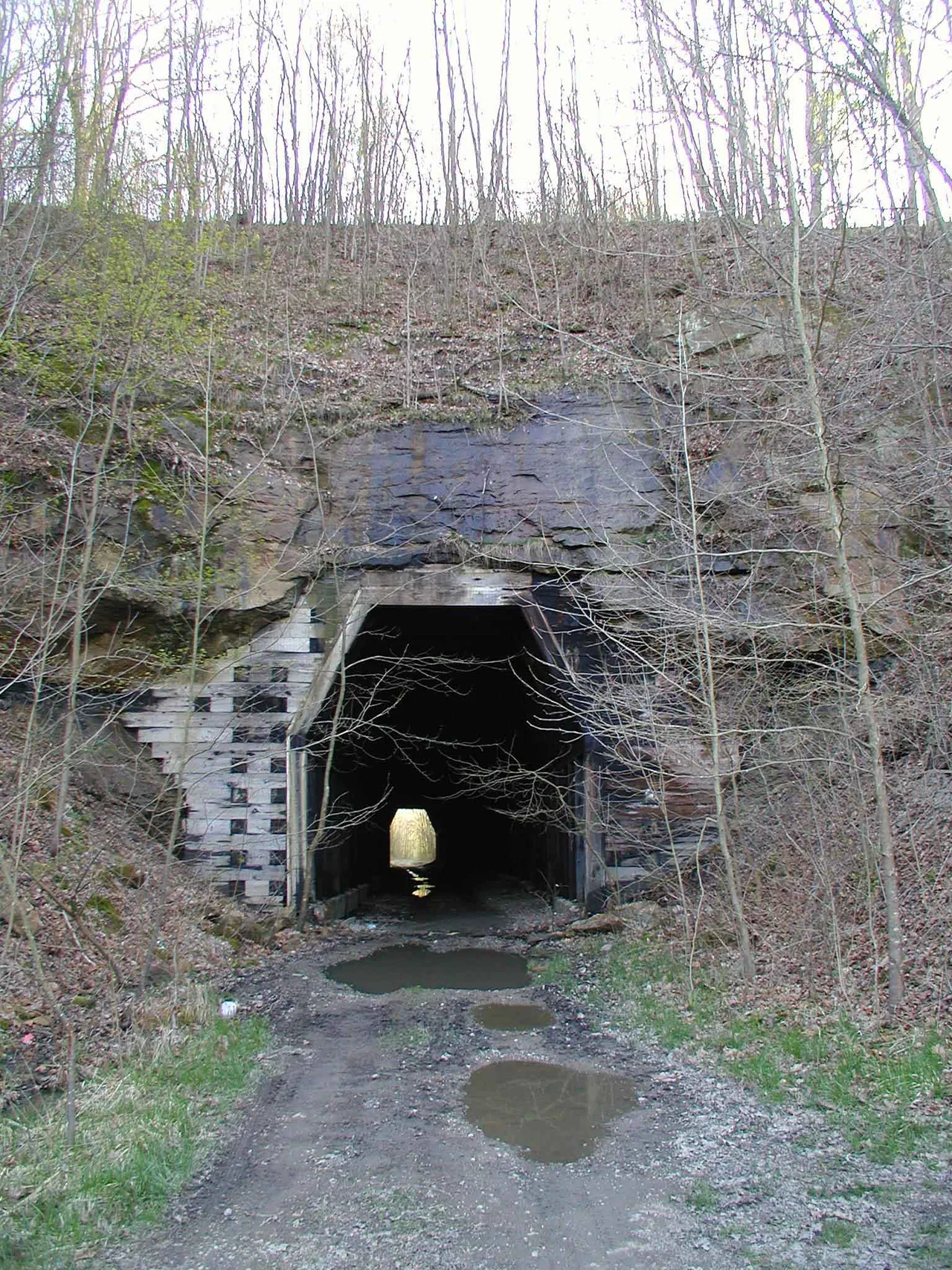
The trail's most distinctive features are its two tunnels, each from a different era of railroad construction. The Moonville Tunnel is the famous one, a stone-and-brick masonry passage in Vinton County that lent its name to the ghost town it once served and which still draws thousands of visitors a year for the legends attached to it. The King's Hollow Tunnel in Athens County is structurally rarer - a timber tunnel, with wooden support framing rather than masonry. Timber tunnels were cheaper to build but harder to maintain, and most have disappeared from American rail lines. The King's Hollow Tunnel survives largely because the railroad abandoned it before time and weather had finished their work.
Bridges and Stream Crossings
Rail-trails often inherit the bridges of the railroads that preceded them, but the M&C corridor presented a problem: the dismantling crews removed many of the railroad bridges along with the track. The trail surface is gravel and dirt, and many of the stream crossings now require improvised fords or detours. The Moonville Rail-Trail nonprofit has been working since the 2000s to rebuild bridges that allow continuous passage. A new Raccoon Creek bridge funded in 2020 marked an important step toward a complete through-route. Until all the gaps are bridged, hikers and cyclists handle the stream crossings the way the locals always did - by hopping rocks or wading.
An Unfinished Network
The current rail-trail runs from Zaleski on the west end to Mineral on the east, but the long-term ambition reaches farther. The west end could eventually link toward Chillicothe, where M&C track remains intact. The east end could extend toward New Marshfield and then to Athens, where it would meet the Hockhocking Adena Bikeway. A complete southeast Ohio rail-trail network would link Wayne National Forest to multiple state parks, river towns, and the campus of Ohio University. For now, the Moonville Rail-Trail is a ten-mile sample of what the network could be - and a way to walk into the Moonville Tunnel on a fall afternoon without having to climb over a chain-link fence.
From the Air
Located at 39.29 N, 82.39 W spanning Vinton and Athens counties in southeast Ohio, mostly embedded in Zaleski State Forest. The trail runs roughly east-west between Zaleski and Mineral. John Glenn Columbus International (KCMH) is about 75 miles north. Best viewed at 3,000-5,000 feet on clear days, with the wooded ridges of southeast Ohio spread below and Lake Hope visible to the north.
Nearby Stories
- Hopewell Culture National Historical Park 10 km away
- Buffington Island 13 km away
- Blennerhassett Island 25 km away
- Gavin Power Plant 30 km away
- Portsmouth 33 km away
- Columbus: The Test Market Where America Tries Things First 46 km away
- The Y-Bridge of Zanesville 57 km away
- Gnadenhutten Massacre 98 km away