
Morongo Valley
The drive into Morongo Valley from Palm Springs climbs out of the Coachella Valley's heat through the San Gorgonio Pass, gaining elevation until the landscape opens into something different — cooler, quieter, brushier. At about 2,700 feet, you reach a community that has attracted an unlikely range of people over the decades: Western film actors, professional athletes, musicians, and several thousand residents whose median household income tells a story of working-class desert life.
Gateway to the Canyon
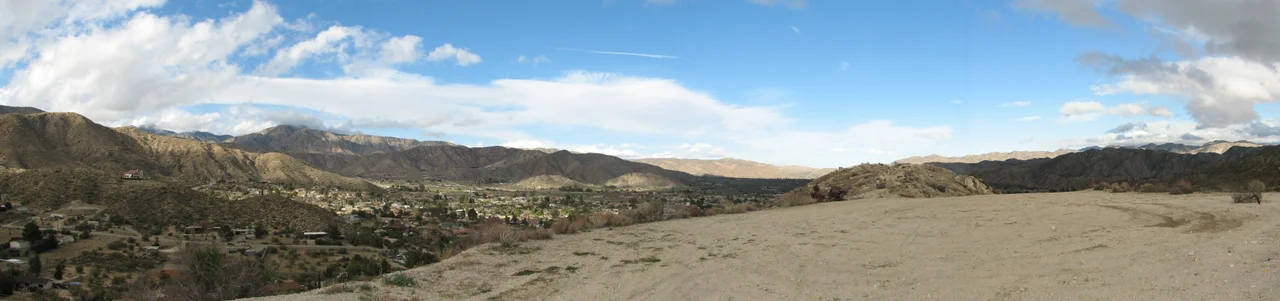
Morongo Valley's primary claim on outsiders' attention has long been its position at the entrance to Big Morongo Canyon Preserve, one of the most important birding sites in the American Southwest. The preserve's 31,000 acres begin effectively at the edge of town, and the steady stream of birders, hikers, and naturalists who come to see the riparian oasis creates a kind of reflected significance for the community at its gate. The valley itself runs east-west, sheltered by hills that separate it from the Joshua Tree plateau to the north and the Coachella Valley floor to the south. Elevation brings moderating temperatures — Morongo Valley averages significantly cooler than Palm Springs — and a different plant community: pinyon pine and juniper begin to appear on the surrounding slopes, and the chaparral is denser than what the valley floor below supports.
Cowboys and Champions
Among the notable people who have called Morongo Valley home, Guy Madison occupies a particular place. Madison was an actor best known for his role as Wild Bill Hickok in the 1950s television series, and he built a ten-acre ranch house in the valley that reflected the Western character he played on screen. The community has also produced Aaron Gwin, who became one of the most successful downhill mountain bikers in the history of the sport, winning the UCI Mountain Bike World Cup overall title multiple times. Gene Parsons, drummer and guitarist for the Byrds, spent time here, as did Steve Reevis, a Native American actor with credits that included Dances with Wolves and The Last of the Mohicans. These are not the kinds of people who typically cluster in the same small desert community, which says something about what the valley offers: space, privacy, and proximity to both the Los Angeles basin and the open desert.
Fire Seasons
In 2005, the Paradise Fire burned through portions of Morongo Valley and the adjacent Big Morongo Canyon Preserve, taking out more than 2,000 acres of riparian vegetation and hillside chaparral. The following year, the Sawtooth Complex Fire added more destruction to the surrounding landscape. These fires were not isolated events but part of a pattern intensifying across Southern California as drought conditions extended and fuel loads accumulated. The valley community rebuilt, as desert communities do, and the preserve continued its slow recovery around them. Fire has become a recurring fact of life at the desert's edge, and Morongo Valley's residents have developed the matter-of-fact relationship with that reality that prolonged exposure tends to produce.
The Numbers Behind the Valley
About 3,500 people live in Morongo Valley, occupying a census-designated place that covers considerable acreage but supports a modest density. The median household income of approximately $32,000 reflects a community where people have chosen desert living over urban convenience, often at real economic cost. There is a post office and a handful of businesses along State Highway 62, the road that connects the valley to the greater world running east toward Twentynine Palms and west toward Palm Springs. The Morongo Band of Mission Indians operates a casino and resort complex to the south near Cabazon, not in the valley itself but close enough to employ residents and contribute to the regional economy. Morongo Valley remains what it has been for most of its existence: a quiet, slightly removed community whose relationship to the broader world is mediated by the canyon, the highway, and the mountains that hold them all in place.
From the Air
Located at 34.055°N, 116.582°W in the pass between the San Gorgonio Mountain range and the Little San Bernardino Mountains, Morongo Valley is visible from altitude as a settled valley cutting through the mountains northwest of the Coachella Valley. The valley's orientation and the transition from desert floor to higher desert terrain are clear from the air. San Gorgonio Pass and the Interstate 10 corridor are visible nearby. Nearest airports: KPSP (Palm Springs International, approximately 14 miles south), KBNG (Big Bear City Airport, approximately 30 miles northwest).
Nearby Stories
- Tell Them Willie Boy Is Here 1.7 km away
- Murders of Jan Pietrzak and Quiana Jenkins-Pietrzak 4 km away
- Rancho Mirage Library and Observatory 11 km away
- Cholla Cactus Garden 13 km away
- San Bernardino Train Disaster 29 km away
- Tenaja Fire 31 km away
- Amboy Crater 36 km away
- Edwards Air Force Base 102 km away