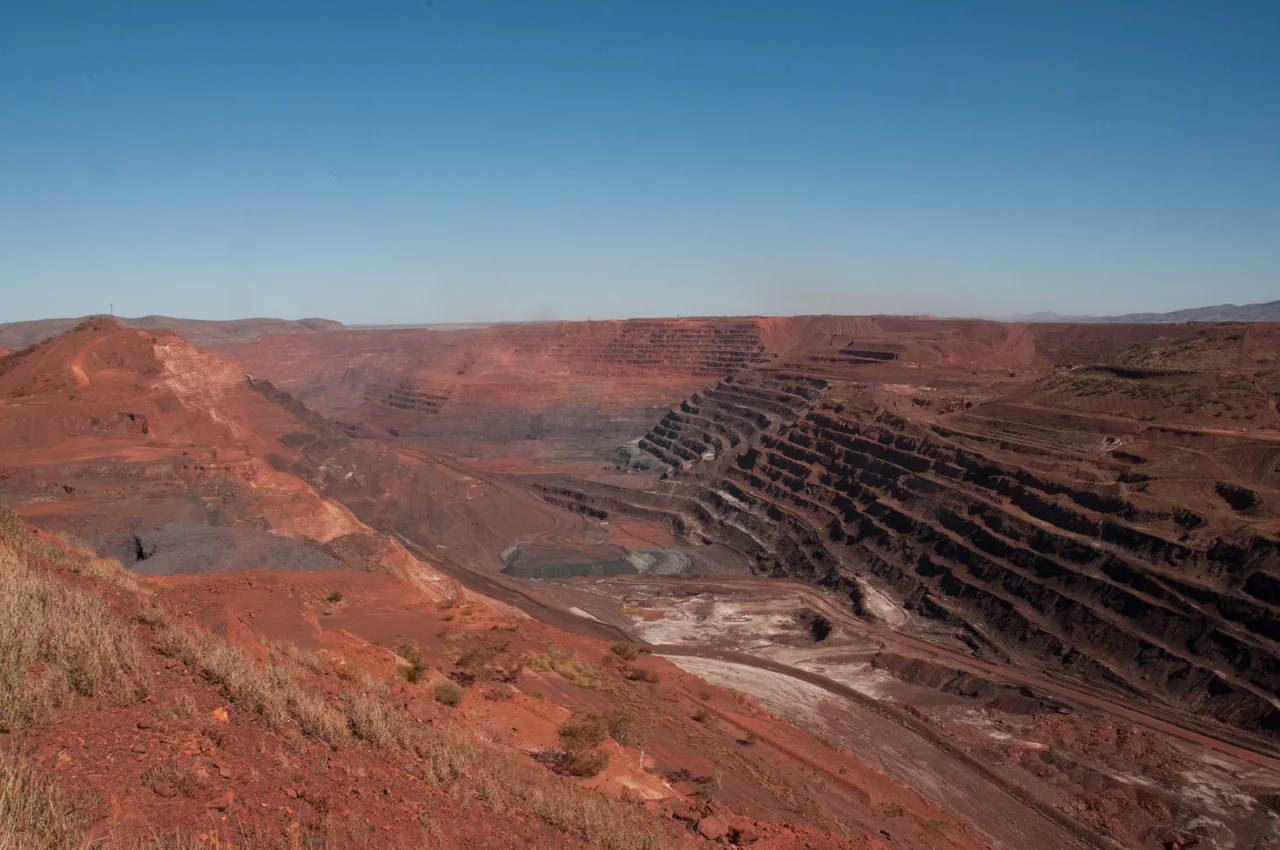

Mount Whaleback Mine
There used to be a mountain here. Stan Hilditch found it in 1957 - a long, humped ridge of iron-rich rock that someone, looking at its shape against the sky, called Whaleback. The whale is gone now. In its place is a hole: more than five kilometres long, a kilometre and a half wide, descending in stepped terraces toward an eventual depth of half a kilometre. Mount Whaleback is the largest single-pit open-cut iron ore mine in the world, and standing at its rim is one of the few places where you can watch a mountain that has been entirely turned inside out and carried away by train.
The Secret Mountain
Hilditch knew what he had found, but he could not tell anyone - not properly. Since wartime, the Australian government had banned the export of iron ore, fearing the country's reserves were too scarce to give away. So the discovery stayed quiet for three years. Only in 1960, when the embargo was partially lifted, could the scale of the Pilbara's iron wealth begin to be admitted out loud - the remaining restrictions were not fully rescinded until 1966. What followed was a rush. The first Pilbara shipment left in June 1966 from the Goldsworthy mine; two years later, in 1968, the far larger Whaleback operation opened, designed and built originally by the American engineering firm Bechtel Pacific. The ban that had hidden the mountain gave way to one of the great mining booms of the century.
A Town and a Railway From Nothing
You cannot work a mine this size with no one nearby, so they built everything. A new company town, Newman, rose six kilometres east of the pit. A railway - the Mount Newman line, 426 kilometres of it - was laid across empty country to reach the coast at Port Hedland. The logistics were biblical. The first train pulled out of Newman on the first day of 1969, and the first shipment of Newman ore sailed on 1 April 1969 aboard a Japanese carrier, the Osumi Maru, bound for the steel mills that were rebuilding postwar Japan. In barely a decade, a mountain in the desert had become a town, a railway, a port berth, and a steady river of rock flowing north.
The Rhythm of the Rock
The numbers at Whaleback have a hypnotic quality. Ore is hauled from the pit, processed, and railed to Nelson Point at Port Hedland, where it is loaded onto bulk carriers. A single ship takes about thirty hours to fill; some eight hundred of them are loaded at the port each year. The iron itself is impossibly old - banded ironstone from the Archean and early Proterozoic, more than two billion years in the making, laid down when the young Earth's oceans first turned oxygen-rich and iron precipitated out in alternating bands of grey and red. Every truckload climbing out of the pit carries away a slab of deep planetary time, headed for a blast furnace and, eventually, a car, a bridge, a building.
Standing at the Rim
BHP majority-owns and operates Whaleback - eighty-five per cent of it - as one of five iron ore mines the company runs across the Pilbara, fed by more than a thousand kilometres of its rail. For all its industrial vastness, the mine is oddly approachable: visitors can take a tour of about ninety minutes, peering down into the terraced abyss where haul trucks the size of houses crawl like beetles far below. It is a strange kind of spectacle - not a natural wonder but a made one, an absence on a colossal scale. Where a whale-shaped mountain once broke the horizon, there is now a void, and the void, too, has become something people come to see.
From the Air
Mount Whaleback sits at roughly 23.37°S, 119.67°E, immediately west of the town of Newman in the East Pilbara. From the air it is unmistakable: an enormous elongated open pit more than 5 km long and 1.5 km wide, stepped in concentric grey-and-rust terraces, with the grid of Newman just to its east and rail lines running north toward Port Hedland. Nearest airport is Newman (ICAO YNWN), with daily Perth connections; Port Hedland (YPPD), the ore-export port, lies to the northwest. Dry-season visibility (May-September) is excellent; summer (December-April) brings heat haze, dust, and monsoonal storms. Recommended viewing altitude 6,000-10,000 ft AGL to capture the full length of the pit alongside the town.
Nearby Stories
- Hope Downs Mine 9.5 km away
- Talawana Track 30 km away
- Jigalong 57 km away
- Collier Range National Park 127 km away
- Glikson Crater 144 km away
- Wittenoom, Western Australia 146 km away
- Peak Hill, Western Australia 236 km away
- Parnngurr Community 243 km away