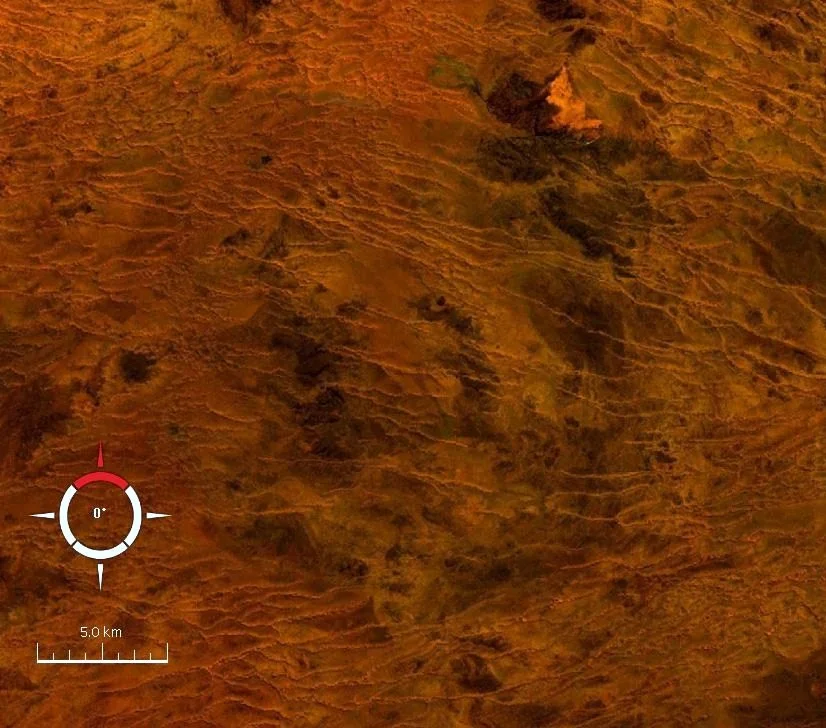

Glikson Crater
There is almost nothing to look at. Stand in the Little Sandy Desert at the centre of the Glikson crater and you will see sand dunes, a scatter of broken sandstone, and the same red emptiness in every direction. The crater that gives the place its name is a ruin, scoured down over hundreds of millions of years until the bowl itself is gone. What gave it away was invisible. An aircraft trailing a magnetometer detected a near-perfect ring of magnetic anomaly, 14 kilometres across, etched into the rock beneath the sand. Something had once struck here hard enough to leave a mark that outlasted the crater that contained it.
A Ring You Cannot See
The Glikson structure first surfaced not in a photograph but in an aeromagnetic survey, where a strikingly circular anomaly hinted at buried violence. Most of the site is smothered by dunes; only sparse outcrops of uplifted, deformed Neoproterozoic sandstone break the surface. The telltale ring almost certainly marks where the impact shattered a buried sheet of magnetic igneous rock, a sill, snapping a once-flat layer into a circle. It is a strange way to find a crater, reading the planet's magnetism like a hidden text. The collision wrote its signature deep in the rock, and the desert, by burying everything else, accidentally preserved exactly that one legible line.
The Cones That Don't Lie
A circle in the magnetism is a clue, not a verdict. The proof came from the rocks themselves. Geologists found shatter cones, distinctive branching fractures that form only under the colossal, instantaneous pressure of an impact, alongside microscopic shock effects in the mineral grains. Nature has no slow way to make these. Tracing the deformed sandstone outward, researchers mapped the damage to about 19 kilometres across, their best estimate for the original crater's true diameter, roughly a third wider than the visible magnetic ring. The bowl has vanished. The scars it pressed into the bedrock have not, and they speak clearly enough to settle the question of origin.
Reading the Age of a Ghost
Dating an eroded crater means dating the rocks around it. Nearby dolerite has been measured at 508 million years old, with an uncertainty of about 5 million years either way, placing it in the Middle Cambrian. If that same igneous rock is the source of the magnetic ring, then the impact had to come afterward, sometime in the Paleozoic, the long era when fish filled the seas and the first forests crept across the land. There is no neat figure, no single year. There is only a floor beneath which the event cannot lie, and the patient logic geologists use to read time from stone when no fresher evidence survives. The dunes that buried Glikson erased the easy answers, so the rock has to be cross-examined instead, one clue at a time.
The Man and the Crater That Called Him
The structure carries the name of Andrew Glikson, an Australian geologist who graduated from the University of Western Australia in 1968 and spent a career hunting impacts across the continent, eventually counting dozens of proven and possible craters. A possible impact here was first reported in 1997 and named in his honour. The tribute proved fitting in an unexpected way. A decade later, when Arthur Hickman spotted a suspicious circle north of Newman on Google Earth, it was Glikson he emailed for a second opinion, and Glikson who confirmed it as a true crater. Two scars in the Western Australian desert, one fresh and one ancient, are bound together by the same expert eye, and now by the name on a map.
From the Air
Glikson crater lies at about 23.98 degrees south, 121.57 degrees east in the Little Sandy Desert of central Western Australia. Be warned: this is one of the harder impact structures to spot from the air, since the original crater is eroded away and largely buried beneath sand dunes, leaving only subtle circular patterns in the deformed sandstone outcrops and surrounding terrain rather than an obvious bowl. The roughly 14-to-19-kilometre footprint is best appreciated on a clear, low-sun morning when faint ring structures cast shadow. There are no nearby airports or services; this is deep desert, with the remote Aboriginal communities of Parnngurr and Punmu and their airstrips lying generally to the north, and Newman (Newman Airport, ICAO YNWN) the nearest substantial hub far to the west. Carry ample reserves and expect excellent dry-season visibility but severe summer heat.
Nearby Stories
- Jigalong 44 km away
- Kumpupintil Lake 89 km away
- Little Sandy Desert 118 km away
- Newman 145 km away
- Parnngurr Community 145 km away
- Talawana Track 172 km away
- Collier Range National Park 173 km away
- Gunbarrel Highway 198 km away