
Newman
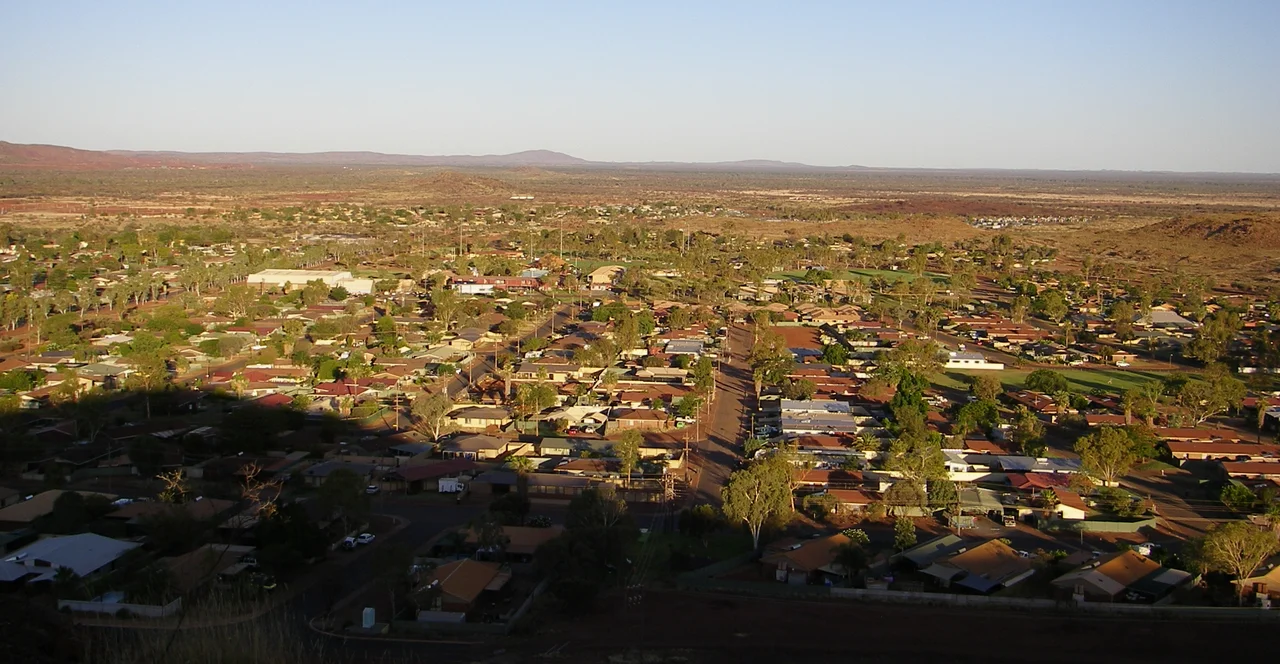
Almost everything in Newman exists because of the mountain next door. There was no town here before 1966, when BHP's mining arm laid one out in the red desert to house the workers digging into Mount Whaleback. The result is an instructive place: a settlement designed, like a machine, around a single purpose. The houses even advertise the company's product - many are prefabricated steel, slotted in halves into exposed I-beam frames left bare on the outside, both a showroom and a defence against cyclone winds. Newman is a company town in the most literal sense, dropped onto ancient country just north of the Tropic of Capricorn, about 1,186 kilometres from Perth.
The Country Beneath the Town
Long before the surveyors and the steel, this was Martu country - and remains so. Aboriginal people have lived in this part of the Western Desert for around 45,000 years. The Martu are not a single group but roughly a dozen language communities whose lands stretch across the Gibson and Great Sandy Deserts. They were among the very last Aboriginal Australians to make sustained contact with Europeans; some Martu had never seen a white person until the 1960s. From the late nineteenth century, gold strikes, missions and expanding pastoral leases pulled and pushed people off their ancestral lands. That history sits quietly under Newman's tidy grid, and the Martu name remains attached to the place. The town's retail centre, opened in 2017, is called Parnawarri - 'united' or 'all together' in the Nyiyaparli language.
A Man Who Never Saw It
The town is named, at a remove, for someone who died decades before it existed and never set eyes on the spot. Aubrey Woodward Newman was a government surveyor who fell ill on an expedition through this country and died of typhoid at the goldfields town of Cue in May 1896. He was twenty-eight. When his colleague William Frederick Rudall took command of the party, he named a nearby peak Mount Newman in honour of his lost leader. Seventy years later the mining town borrowed the mountain's name. It is a small, melancholy thread running through the place: a settlement of the iron boom carrying, almost by accident, the memory of a young man who died of fever in the desert long before the first ore was ever shipped.
Engineering a Home
Newman was laid out the way company towns are: a core of shops and hotels, residential streets wrapped around it, industry pushed to the edges. The design shows a deliberate hand. Houses are raised on steps - partly to clear flood and heat, partly cyclone sense - and bristle with oversized air-conditioning units, because summers here are merciless. The temperature climbs past 38 degrees Celsius for days on end; on 15 January 1998 it hit 47. The architecture is unapologetically modernist and functional, devoid of ornament, all steel frame and straight line. Today around 6,456 people live here, many of them on the same fly-in-fly-out rhythm that powers the mines, with two supermarkets, a handful of hotels, and one outdoor pool against the heat.
Giants of Iron and Rock
Superlatives gather around Newman. Out of here once rolled the longest train ever assembled - a BHP iron-ore haul of 682 wagons pulled by eight locomotives, a record-setter; even ordinary ore trains run well over two kilometres long. Thirty-five kilometres north lies the Hickman Crater, a meteorite impact scar only identified in 2007 by a geologist studying satellite images from his desk. The country around town is studded with such things: deep time and heavy industry layered together, the impossibly old and the brand new sharing the same red ground. Newman is a service hub for the whole district - Tom Price, Paraburdoo, the desert mines - a modern town living, as it always has, off the iron in the hills.
From the Air
Newman lies at roughly 23.34°S, 119.71°E in the East Pilbara, about 9 km north of the Tropic of Capricorn and 1,186 km from Perth. From the air, the compact grid of the town sits immediately east of the vast Mount Whaleback open pit, with rail lines running north toward Port Hedland and the red Ophthalmia Range nearby. Newman Airport (ICAO YNWN) has daily Perth connections and serves the surrounding mining district. Dry-season visibility (May-September) is excellent; summers (December-April) are extremely hot, with heat haze, dust, and occasional monsoonal storms - the record high here is 47°C. Recommended viewing altitude 5,000-9,000 ft AGL to take in the town against the Whaleback pit and surrounding ranges.
Nearby Stories
- Hope Downs Mine 9.5 km away
- Talawana Track 30 km away
- Jigalong 57 km away
- Collier Range National Park 127 km away
- Glikson Crater 144 km away
- Wittenoom, Western Australia 146 km away
- Peak Hill, Western Australia 236 km away
- Parnngurr Community 243 km away