
Mukdahan
Chao Kinnari chose the site carefully: a bend in the Mekong River, a promising omen, a defensible position on the right bank. In 1767 he broke ground on a new town at the mouth of the Huai Muk stream. The work took three years, and when it was finished in 1770, he named it Mukdahan — 'moonstone' or 'pearl' in reference to an auspicious sign that had appeared to him during construction. The name stuck, and so did the town. More than 250 years later, Mukdahan is Thailand's 49th province, a city of trade and transit on one of the region's most important international crossings, still sitting at the same bend in the same river, watching Laos from the opposite bank.
Eight Peoples, One Province
Mukdahan's population is not a single community but a layered one. Eight distinct ethnic minorities call the province home: Thai Isaan, Phu Thai, Thai Kha, Kraso, Thai Kaloeng, Thai Yo, Thai Saek, and Thai Kula. Each group maintains its own traditions, dress, and in many cases its own dialect, within the broader fabric of northeastern Thai life. This diversity reflects the Mekong's historic role as a corridor rather than a boundary — people moved along it and across it for centuries before any modern border existed. The local relationship with the Lao communities directly across the river in Savannakhet Province is long and familial, grounded in shared language roots, shared religious practices, and generations of cross-river trade that continued even when political circumstances made the crossing difficult. The river here is not a wall but a seam.
The Bridge That Changed the Border
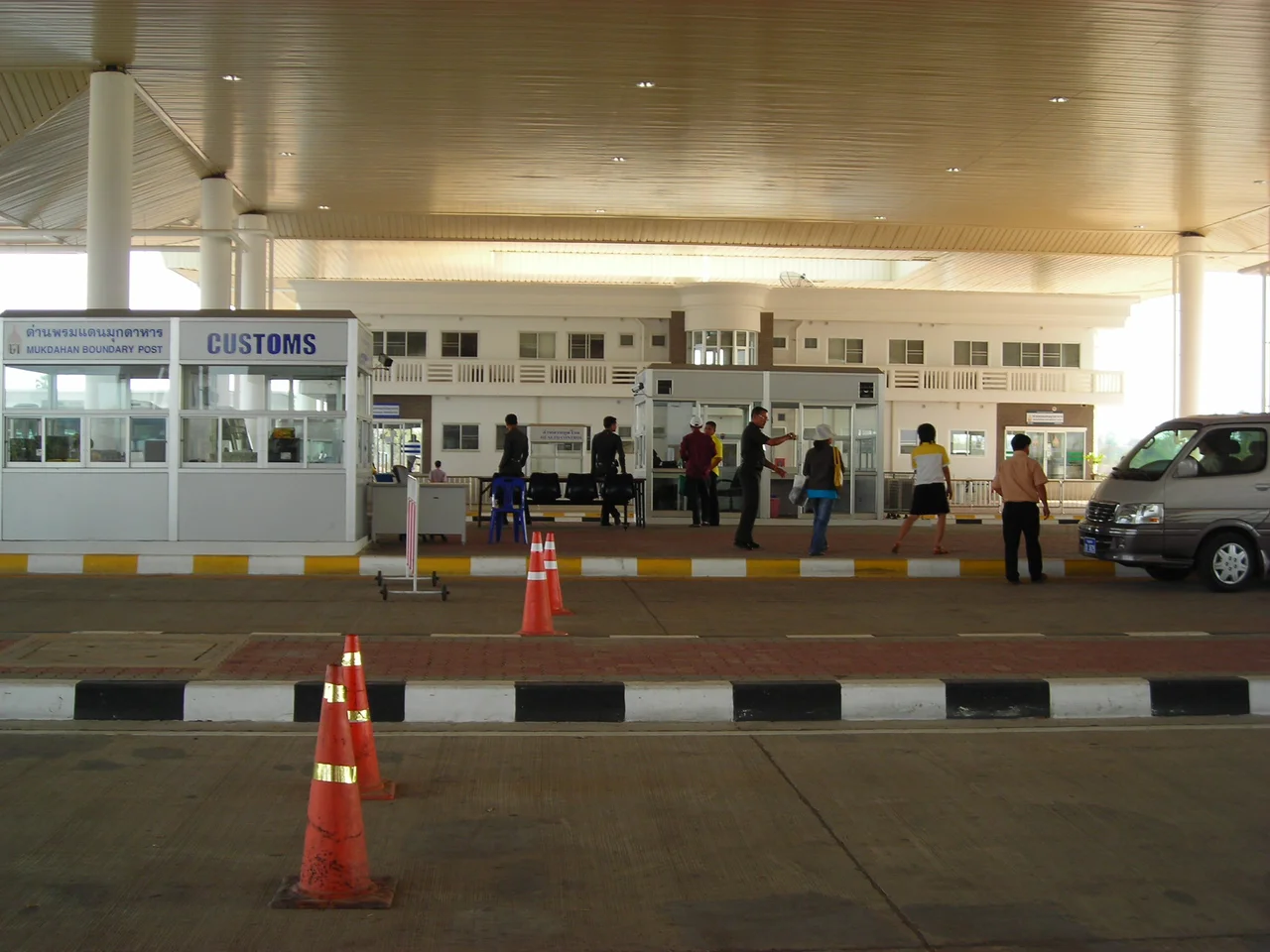
For most of Mukdahan's history, crossing to Laos meant a boat. That changed in 2007 when the Second Thai-Lao Friendship Bridge opened approximately 7 kilometres north of Mukdahan city centre, a 1,600-metre span connecting Mukdahan to Savannakhet across the Mekong. Regular buses run between the two cities roughly once an hour; a one-way ticket costs 100 baht. The crossing involves immigration formalities on both sides, but the logistics are straightforward, and the bridge has transformed Mukdahan from a river-end town into a functioning international gateway. Trucks carrying goods between Thailand and Vietnam now pass through on a corridor that follows Highway 9 from Savannakhet east through Laos to the Vietnamese coast — a route that has turned Mukdahan into part of one of mainland Southeast Asia's main east-west trade arteries.
Gateway to Indochina
From Mukdahan, the logic of Southeast Asian geography becomes clear. Laos is immediately across the water. Vietnam is a day's drive beyond that. The province sits at what geographers call the East-West Economic Corridor — a route connecting the Andaman Sea coast of Myanmar through Thailand, Laos, and Vietnam to the South China Sea. The practical consequence is visible in the city's character: Mukdahan has the energy of a place where things pass through, where currencies exchange, where goods change hands between countries that do not yet share a direct connection. The city's Indochina Market draws cross-border shoppers from Laos and beyond. Buses leave regularly for Ubon Ratchathani, Nakhon Phanom, and Khon Kaen within Thailand, and for Savannakhet and onward to Vientiane in Laos. The 4,126 square kilometres of the surrounding province hold forests, rivers, and traditional villages largely unseen by international visitors — but Mukdahan city itself has always been a node, not a dead end.
The Moonstone Town Today
Mukdahan's riverfront stretches along the Mekong with the views across to Savannakhet's French colonial rooflines visible on clear days. The Haw Kaew observation tower offers a panoramic perspective on the river valley, the bridge, and the flat agricultural plains that extend in every direction. The town has the practical, unpretentious quality of a working border city: hotels serving business travellers, bus terminals, and markets that reflect both the Thai and Lao worlds it sits between. Domestic air passengers arrive at Nakhon Phanom or Ubon Ratchathani before taking a bus the final stretch — there is no airport in Mukdahan itself. What the city offers in return for the detour is something increasingly rare: a genuine frontier town that still feels like one, on a great river that still divides countries while quietly, persistently, connecting them.
From the Air
Mukdahan lies at 16.543°N, 104.723°E on the Thai bank of the Mekong River. From the air at 5,000–8,000 feet, the Second Thai-Lao Friendship Bridge is visible as a distinct crossing approximately 7 km north of the city centre — the pale concrete span crossing the dark Mekong connects directly to the Savannakhet urban area on the Laotian bank. The Mekong's wide, meandering channel through the flat Isaan plateau makes it an unmistakable landmark from altitude. Nearest airports: VTUN (Nakhon Phanom Airport, approximately 100 km to the north) and VTUU (Ubon Ratchathani Airport, approximately 167 km to the south). The Savannakhet Airport (VLSK) is across the border in Laos. Clear weather gives good views of the border crossing infrastructure and the agricultural grid of both Thai and Lao floodplains.
Nearby Stories
- Wat Phra That Phanom 16 km away
- Phu Sa Dok Bua National Park 28 km away
- National Route 9 (Vietnam) 59 km away
- Sam Phan Bok 69 km away
- Khammouane Province 73 km away
- Ban Chiang 106 km away
- 2022 Nong Bua Lamphu Massacre 214 km away
- Cambodian Landmine Museum 313 km away