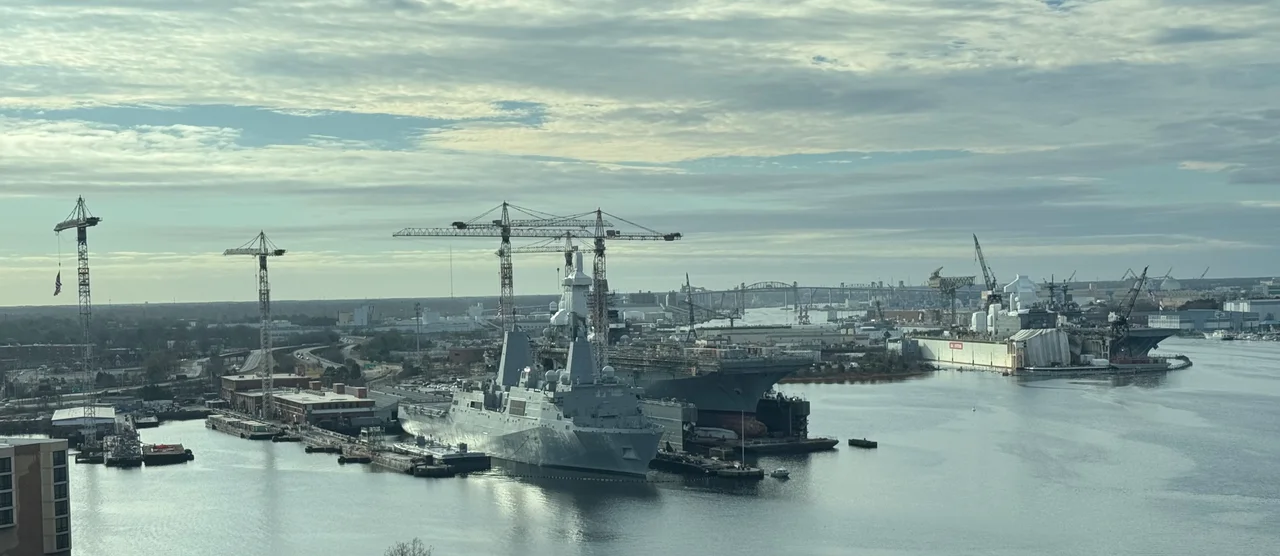

National Steel and Shipbuilding Company
On the eastern shore of San Diego Bay, south of downtown and north of the Coronado Bridge, a shipyard has operated continuously since 1960. The National Steel and Shipbuilding Company — NASSCO — is the sole remaining major shipyard on the West Coast of the United States capable of building new oceangoing vessels. It has outlasted competitors, survived acquisition by General Dynamics, witnessed the Exxon Valdez tanker it built become infamous, and adapted from commercial to military construction as markets changed. In an era when American shipbuilding has largely retreated from commercial competition, NASSCO holds a peculiar position: irreplaceable, specialized, and the last of its kind on this coast.
Founded on an Industrial Shore
NASSCO was founded in 1960 on a waterfront site with deep shipbuilding history. The location had previously hosted Lynch Shipbuilding, which built wooden vessels during World War II, and subsequently Martinolich Ship Repair. NASSCO's founders chose steel and new construction — an ambitious bet on San Diego's capacity to support major industrial maritime operations. The company built dry docks, gantry cranes, and fabrication facilities suited to ocean-going ship construction. Early contracts mixed commercial and government work. The yard's relationship with the U.S. Navy, always geographically proximate at the military bases surrounding San Diego Bay, deepened over time into a primary source of revenue.
The Exxon Valdez Connection
Among the vessels NASSCO built was the Exxon Valdez, the tanker that on March 24, 1989, ran aground on Bligh Reef in Prince William Sound, Alaska, releasing approximately 11 million gallons of crude oil into one of North America's most productive marine ecosystems. The spill was at the time the largest in U.S. history and triggered legislation that permanently altered American oil tanker regulations, including the Oil Pollution Act of 1990, which mandated double hulls for tankers operating in U.S. waters. The Exxon Valdez was built to the standards of its era, which did not require double hulls. NASSCO subsequently built double-hulled tankers, as the post-Valdez regulatory environment required. The ship was the yard's work; what happened to it, and what it caused, became history of a larger kind.
General Dynamics and the Military Turn
General Dynamics acquired NASSCO in 1998 for $415 million, integrating it into a defense portfolio that included Bath Iron Works in Maine and Electric Boat in Connecticut. The acquisition reflected a consolidation trend across American defense contracting. Under General Dynamics ownership, NASSCO has focused increasingly on Navy contracts — particularly the construction of T-AKE dry cargo ammunition ships, the Joint High Speed Vessel program, and other auxiliary vessels for the U.S. Navy and Military Sealift Command. Commercial shipbuilding has continued alongside military work, primarily in tankers for domestic petroleum transport. The yard employs several thousand workers and remains San Diego Bay's largest private employer, one of the few heavy manufacturing enterprises surviving in a regional economy that has otherwise moved substantially toward technology and defense electronics.
The Last Yard
The phrase 'last major new-construction shipyard on the West Coast' captures something important about American industrial geography. The Pacific Coast supported multiple significant shipyards through World War II and into the postwar era — in Seattle, in Portland, in Oakland, in Los Angeles — most of which have closed or converted to repair-only operations. NASSCO's survival reflects the value of its Navy relationships, its location adjacent to the Pacific Fleet's home waters, and the specific advantages of a workforce and infrastructure that cannot be quickly rebuilt from scratch. Expanding or replacing NASSCO would take decades and enormous capital investment. Its continued operation is less a commercial triumph than a strategic constant — a facility the Navy and the American maritime economy have found it more practical to maintain than to replace.
From the Air
NASSCO (National Steel and Shipbuilding Company) is located at approximately 32.70°N, 117.14°W on the eastern shore of San Diego Bay, south of downtown San Diego and north of the Coronado Bridge. The shipyard's dry docks and gantry cranes are visible from altitude. San Diego International Airport (KSAN) is approximately 4 km northwest. Naval Station San Diego is immediately north. The Coronado Bridge provides a distinctive visual landmark to the south.
Nearby Stories
- Ché Cafe 0.7 km away
- Border 32 Fire 1.2 km away
- Cuyamaca Peak 14 km away
- Spanish Missions in Baja California 36 km away
- San Clemente Island 68 km away
- USS Atlanta (CL-104) 75 km away
- Off-roading in Baja 212 km away
- Guadalupe Island Biosphere Reserve 369 km away