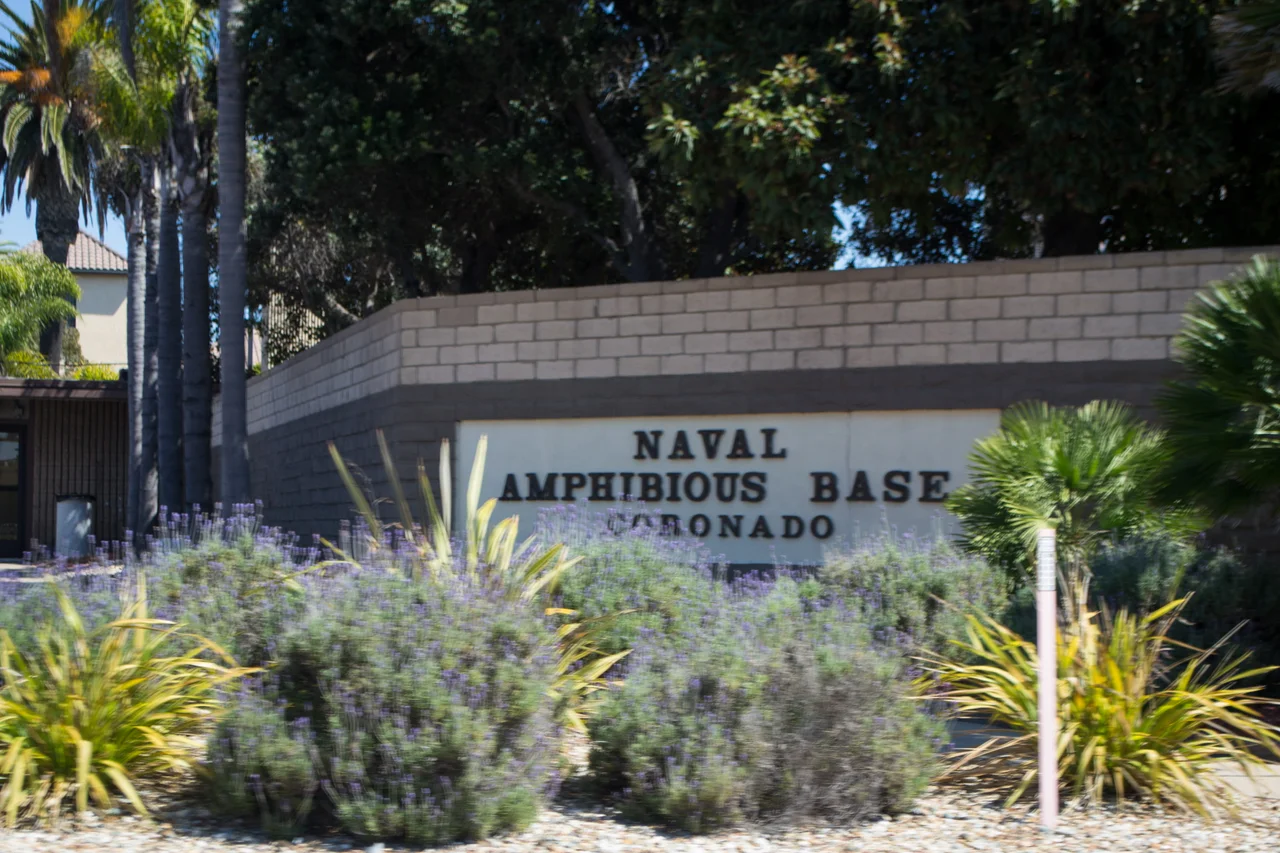

Naval Amphibious Base Coronado
The Silver Strand is the slender sandspit connecting Coronado Island to the mainland, four miles long and barely wide enough in places for a road and a beach. In 1944, the Navy built an amphibious training base there — a flat expanse of drills, warehouses, and training areas oriented toward the Pacific surf, where conditions suitable for amphibious landings could be found year-round. Naval Amphibious Base Coronado has been the center of American amphibious warfare training ever since, and since the 1960s the home of the Basic Underwater Demolition/SEAL training program that produces the Navy's special operations forces. The base is also the unwitting architect of one of the more remarkable accidental controversies in American military architecture.
The Amphibious Mission
The base was commissioned on November 1, 1944, with the explicit purpose of training sailors and Marines for amphibious operations — the complex, casualty-intensive business of landing military forces on hostile shores. The timing reflected the lesson of the Pacific War: amphibious assault was essential and its demands were specific, requiring specialized vessels, specialized training, and a place to practice. Coronado's beaches, sheltered from North Pacific storms by Point Loma but open to the training surf of the Pacific, provided that place. Through the end of World War II and into Korea, Vietnam, and subsequent conflicts, NAB Coronado trained the crews of landing craft and the coordination between ship and shore that amphibious operations require. Today it is the West Coast hub of Naval Special Warfare Command.
BUD/S and the SEALs
Basic Underwater Demolition/SEAL training — BUD/S — is conducted at NAB Coronado and is among the most demanding military training programs in the world. The six-month course begins with a Basic Conditioning Phase that includes Hell Week, a five-and-a-half-day continuous evolution with less than four hours of sleep, designed to test candidates' will to continue beyond physical exhaustion. Attrition rates are high: roughly 75 to 80 percent of candidates who begin BUD/S do not complete it. Those who do go on to further training and eventual assignment to SEAL teams. The beach at NAB Coronado — its cold water, its breaking surf, its sand that gets into everything — is not incidental to this training. It is the curriculum. The Pacific Ocean is an instructor.
The Barracks Problem
In 2007, a photograph taken via Google Earth showed that a complex of barracks buildings at NAB Coronado, when viewed from altitude, forms the shape of a swastika. The Navy had not noticed — or if it had, had not acted — because the shape is invisible from the ground. Once the image circulated online, the Navy announced plans to modify the complex. The alterations, completed at a cost of approximately $600,000, included landscaping changes, new structures in the central courtyard, and modifications to the building perimeter to break up the recognizable outline. The barracks had been built in the 1960s in a design that was, according to the Navy, not intentional. The design was a coincidence, a quirk of planning decisions made without the benefit of aerial photography. The internet's global viewing altitude made the problem visible in a way that previous generations of oversight could not.
The Silver Strand
NAB Coronado occupies most of the Silver Strand's military real estate, sharing the narrow sandspit with Silver Strand State Beach on the Pacific side and military facilities on the bay side. The strand itself — technically a tombolo, a sandspit connecting an island to the mainland — is a dynamic coastal feature maintained by littoral drift and periodically modified by storm erosion. Military construction has stabilized portions of it; the Pacific still rearranges the beaches at its margins. From the air, the Silver Strand's geometry is arresting: a thin line of sand separating the bay from the ocean, with the Pacific surf on one side and the quiet waters of the southern bay on the other, and military infrastructure occupying most of the space between.
From the Air
Naval Amphibious Base Coronado is located at approximately 32.67°N, 117.15°W on the Silver Strand between San Diego Bay and the Pacific Ocean. The base occupies most of the Silver Strand's width. The base is within Naval Base Coronado restricted airspace. San Diego International Airport (KSAN) is approximately 10 km north. The Silver Strand's thin sandspit geometry is highly distinctive from altitude. Naval Air Station North Island (KNZY) is at the northern end of the Coronado peninsula.
Nearby Stories
- Ché Cafe 0.7 km away
- Border 32 Fire 1.2 km away
- Cuyamaca Peak 14 km away
- Spanish Missions in Baja California 36 km away
- San Clemente Island 68 km away
- USS Atlanta (CL-104) 75 km away
- Off-roading in Baja 212 km away
- Guadalupe Island Biosphere Reserve 369 km away