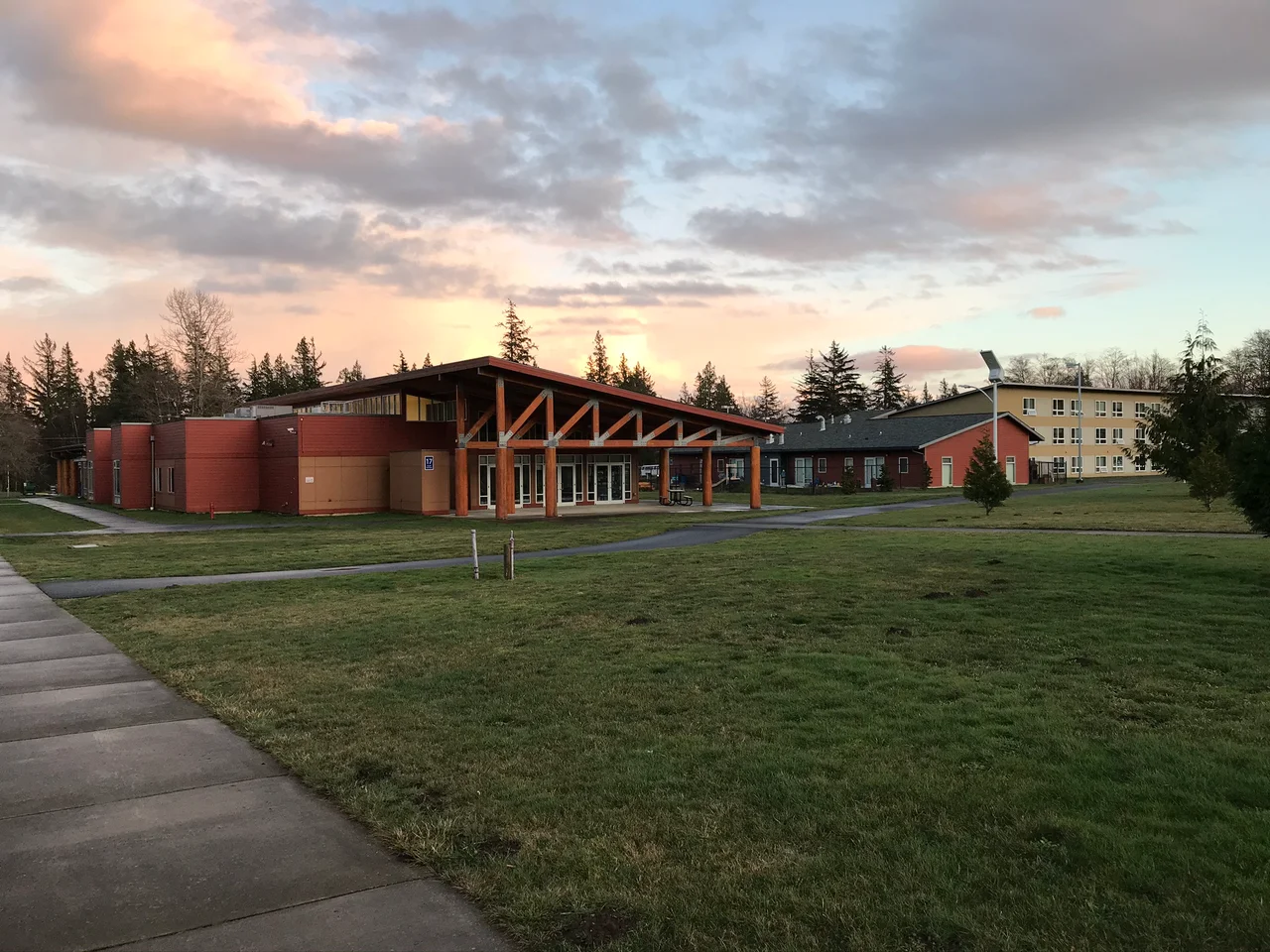

Northwest Indian College
In May 2025 the board of trustees of Northwest Indian College appointed Dr. Lexie Tom as president, and the announcement carried a detail worth pausing on: she is the first citizen of the Lummi Nation, and the first NWIC alumna, ever to hold the job. The Lummi Nation founded this college in 1973. It took half a century for one of its own graduates to come back and run it - and that is not a failure so much as the shape of a long project finally closing its loop. Tom had served as the college's interim president and, before that, as education director of the Lummi Nation School. She did not arrive from outside. She came up through the system the Nation built.
Built for the Places Buses Don't Reach
Northwest Indian College exists because the higher education system did not reach the students it serves. The college was created to meet the needs of American Indian students - in particular those in geographically isolated communities with no practical way to continue past high school at all. Reservations in this region are not always near a city, a campus, or a bus route, and for generations the only route to a degree was to leave, which for many students meant not going. Putting the college on the reservation inverted that equation. Its Lummi name, Xwlemi Elh>Tal>Nexw Squl, belongs to the place where it stands, on the Lummi Indian Reservation near Bellingham, Washington.
Climbing the Ladder of Accreditation
Accreditation is the unglamorous machinery that determines whether a degree counts, and the college worked at it for decades. In 1988, then operating as Lummi Community College, the institution campaigned for recognition from the Northwest Commission on Colleges and Universities. Years of steady program expansion followed, and in September 2008 the payoff arrived: accreditation as a four-year, baccalaureate degree-granting institution. That accreditation is what makes NWIC the only accredited tribal college or university serving the reservation communities of Washington, Oregon and Idaho - a region covering dozens of nations and an enormous amount of ground.
One College, Six Places
Rather than asking students to come to it, the college distributed itself. The main campus sits on the Lummi reservation, and five further sites operate at Tulalip, Port Gamble S'Klallam, Muckleshoot, Nisqually and Nez Perce - each hosted within a different nation's community, across Washington and into Idaho. A student can enrol without relocating, without leaving family responsibilities behind, and without stepping out of their own community to do it. NWIC is also a member of the American Indian Higher Education Consortium, the network of tribally and federally chartered institutions working collectively to strengthen tribal nations, which means the model here is shared and refined across the country rather than improvised in isolation.
No Test Scores Required
The college is open enrollment. No SAT, no ACT, no gatekeeping on a standardised score - a policy that matters enormously for students whose high schools were under-resourced through no fault of their own, and who might otherwise be filtered out before anyone read a word they wrote. What they can pursue once inside spans the range: Bachelor of Arts and Bachelor of Science degrees, Associate of Arts and Sciences, Associate of Science, Associate of Applied Science and Associate of Technical Arts. As of 2011 NWIC was one of only seven tribal colleges in the United States offering a degree in tribal administration - training, in other words, for the specific and demanding work of governing a sovereign nation. Predecessors matter here too: Dr. Justin Guillory of the Nez Perce Tribe led the college from 2012 to 2024 before going on to the presidency of nearby Whatcom Community College. That trajectory says something in itself. A tribal college is not a holding pen on the margins of American higher education; it is a place whose leadership moves into the mainstream system and takes what it learned along.
From the Air
Northwest Indian College's main campus lies at 48.7942 N, 122.6142 W on the Lummi Indian Reservation, on the Lummi Peninsula west of Bellingham in Whatcom County, Washington. From the air the orientation features are the peninsula itself jutting southwest into Bellingham Bay and Hale Passage, with Lummi Island lying just across that passage to the south and the delta flats of the Nooksack River spreading east of the reservation. Bellingham and its waterfront sit roughly 8 nm east across the bay, and Mount Baker dominates the horizon inland to the east on a clear day. Bellingham International (KBLI) is the nearest field, about 8 nm northeast; Orcas Island (KORS) and Friday Harbor (KFHR) lie west across the water in the San Juans, and Skagit Regional (KBVS) is about 20 nm south. A viewing altitude of 2,500 to 4,000 feet MSL takes in the peninsula, the bay and the San Juan channels beyond. This is reservation land - treat overflight with the same courtesy you would any residential community, keep altitude, and do not loiter. Marine fog off the bay is frequent in summer mornings and autumn.
Nearby Stories
- Naval Radio Section Aldergrove 5.2 km away
- Anacortes 6.8 km away
- Saturna Island 7.4 km away
- George Massey Tunnel 9 km away
- Mount Baker 13 km away
- Discovery Island (British Columbia) 17 km away
- North Cascades National Park 80 km away
- Manning Provincial Park 88 km away