
Nuclear Power in Taiwan
In the mid-1980s, nuclear reactors generated 52 percent of Taiwan's electricity. By May 2025, they generated none. The arc of nuclear power on this earthquake-prone island spans barely five decades, but it contains a full drama: cold war ambition, engineering hubris, indigenous communities forced to live with radioactive waste they never agreed to store, contaminated apartment buildings whose residents were not told for seven years, and the largest street protests in Taiwan's modern history. When the last reactor at Maanshan disconnected from the grid on 17 May 2025, it closed a chapter that had defined the island's energy politics for a generation.
The Atomic Bet
Taiwan's nuclear program began in the 1970s, driven by the same oil crisis fears that pushed countries worldwide toward atomic energy. Three plants were built in rapid succession: Jinshan (commissioned 1978) and Kuosheng (1981) used General Electric boiling water reactors, while Maanshan (1984) employed Westinghouse pressurized water technology. Taipower, the state-owned utility, operated all three. Performance improved steadily -- reactor availability climbed from 70 percent in the 1970s to 90 percent by the 1990s, and the annual number of emergency shutdowns, or scrams, dropped from 30 in 1984 to two or three. By any engineering measure, the plants were high performers, averaging 88.5 percent availability between 2005 and 2010.
Cracks in Confidence
The numbers looked good on paper, but the ground beneath the reactors told a different story. A 2011 report by the Natural Resources Defense Council placed all of Taiwan's nuclear reactors among the twelve most seismically endangered worldwide. A power outage at Maanshan Unit 1 in 2001 was classified as an INES Level 3 incident -- a serious event on the international nuclear scale. Then came the contaminated rebar scandal of the 1980s: radioactive scrap metal from power plant waste was melted into steel and used to build over a thousand apartments. More than 15,000 people were exposed to low-dose gamma radiation for years. High radiation levels were detected in one building in 1985, but the public was not informed until 1992. Trust, once broken, proved difficult to rebuild.
The Streets Say No
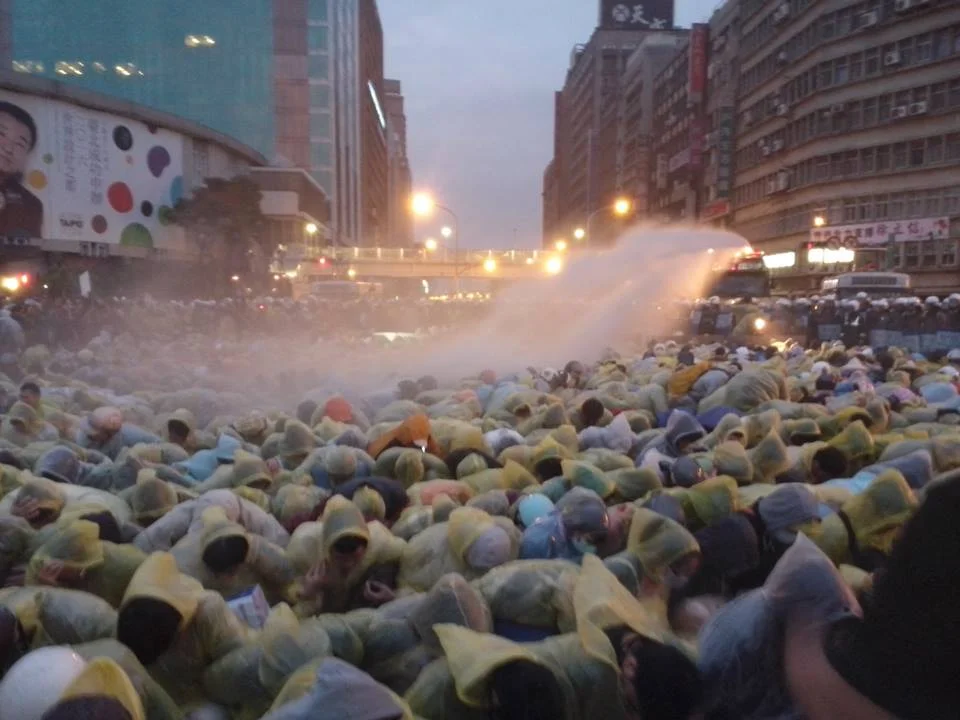
The 2011 Fukushima disaster in Japan galvanized Taiwan's anti-nuclear movement into a mass political force. In March 2013, 68,000 people marched across Taiwan's major cities. In March 2014, the number swelled to 130,000. Protesters carried signs reading "No Nuclear Power" and "We Don't Want Another Fukushima." They formed the word STOP in giant yellow letters in front of the Legislative Yuan. The movement's primary target was the Lungmen Nuclear Power Plant, a fourth facility under construction in Gongliao. Experts had identified roughly 40 design and construction flaws. In April 2014, the government halted construction permanently. The Democratic Progressive Party, which won the 2016 elections, made nuclear phase-out a central platform promise.
The Waste That Remains
On tiny Lanyu Island off Taiwan's southeastern coast, 100,000 barrels of low-level nuclear waste have sat in a storage facility since 1982. The indigenous Tao community was never consulted about the decision to locate it there. Repeated government promises to remove the waste have gone unfulfilled. In late 2019, President Tsai Ing-wen offered financial compensation; community elders rejected it as an attempt to buy their silence. Meanwhile, spent fuel from France that was supposed to be reprocessed at the La Hague facility still sits in temporary containment ponds on the main island. Taiwan's reactors may all be shut down, but the question of what to do with their radioactive legacy has no answer yet.
After the Last Shutdown
When Maanshan Unit 2 went offline on 17 May 2025 at the expiry of its 40-year operating license, Taiwan became one of the few industrialized nations to fully exit nuclear power. A referendum in August 2025 on restarting Maanshan won a majority of votes but failed to meet the turnout threshold required to pass. The island now relies on coal, natural gas, and a growing portfolio of renewables. Whether this was wisdom or folly depends on who you ask -- and the answer often splits along the same political lines that define so much else in Taiwan. What is not disputed is the scale of the shift: from 52 percent of the island's electricity to zero in four decades. The reactors are being decommissioned, the waste awaits a permanent home, and Taiwan faces its energy future without the atom.
From the Air
The story of nuclear power in Taiwan is centered around the northern coast, where Jinshan (25.29°N, 121.57°E) and Kuosheng (25.21°N, 121.66°E) plants sit near the shoreline. From the air, both facilities are visible along the coast northeast of Taipei. Maanshan (21.96°N, 120.75°E) is at Taiwan's southern tip. Nearest airports to the northern plants are Taipei Songshan (RCSS) and Taoyuan International (RCTP). Best viewed at 5,000-8,000 ft following Taiwan's northern coastline.
Nearby Stories
- Sanxia Car Attack 9.6 km away
- Dapu Incident 28 km away
- 2022 Chinese Military Exercises Around Taiwan 45 km away
- North Jiangsu Main Irrigation Canal 960 km away
- General Cliff Rock Paintings 1031 km away
- Sinking of MV Sewol 1042 km away
- Yellow Sea 1091 km away
- Twin Forts of Romblon 1377 km away