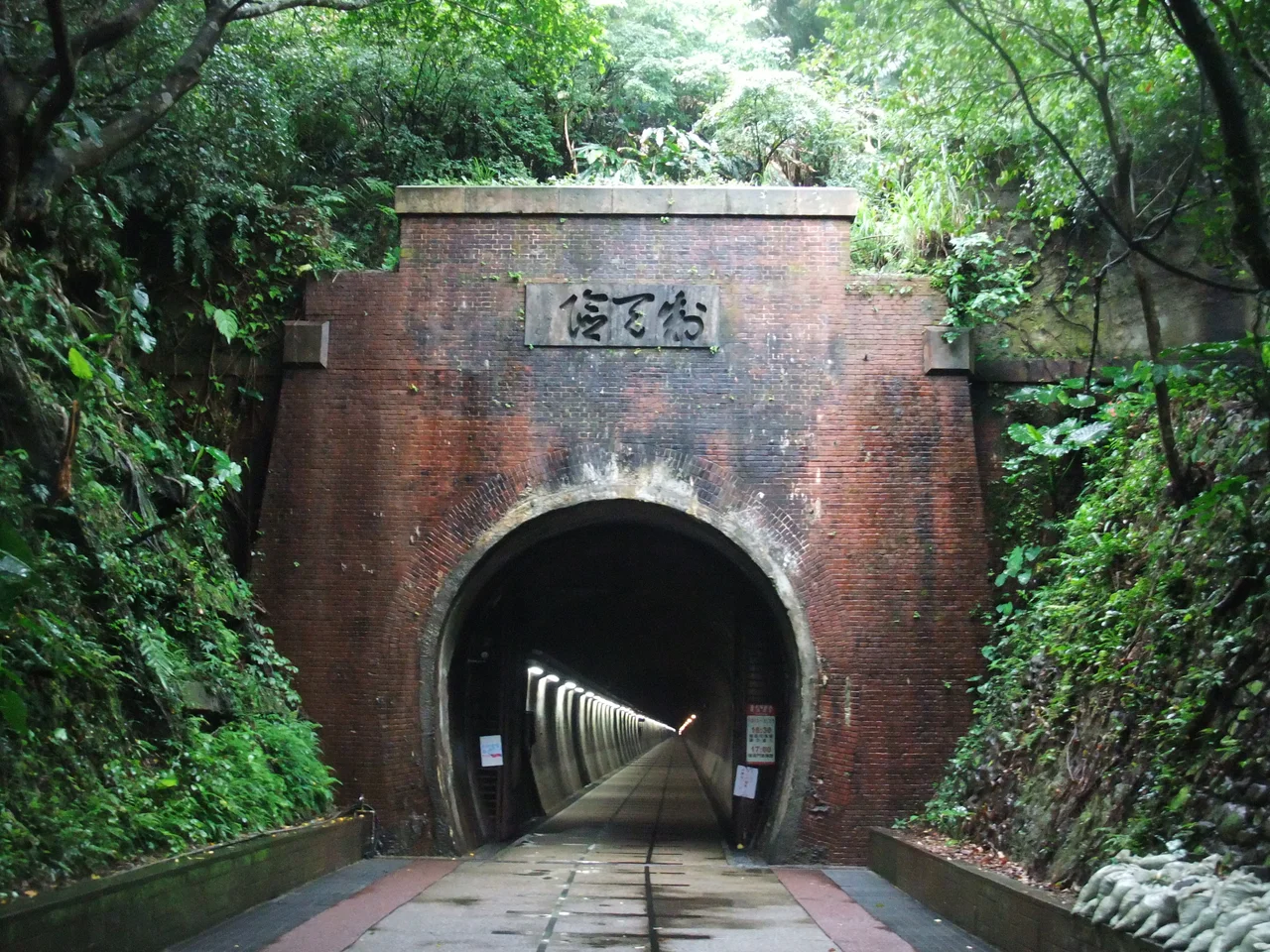

Old Caoling Tunnel
For sixty years, trains threaded through this hillside and no one thought to look closely at the rock. The Old Caoling Tunnel carried freight and passengers along the Yilan Line beginning in February 1924, bored through the coastal ridge that separates Gongliao from the Yilan plain. When a new tunnel opened alongside it in 1986, the old bore went dark — abandoned rather than demolished, sealed rather than erased. What followed was a slow transformation nobody planned in a hurry: decades of quiet, then a decision, then a reopening on 10 August 2009 as something the original engineers never imagined. Today cyclists enter where locomotives once did, and the mountain keeps its secret about which era it preferred.
Built for Coal and Speed
The tunnel was completed in 1924 as a single-track bore on the Yilan Line — the coastal railway that knit Taiwan's northeast together during the Japanese colonial period. Cutting through the ridge at Caoling, it allowed trains to bypass the headland where the coast becomes impassable cliffs, shaving time off the journey between Taipei and Yilan. For more than six decades it served that purpose without fanfare, carrying the rhythm of timetables and cargo through 2.167 kilometers of mountain. The engineering was practical, not grand — oil lamps for light, stone portal arches at each end, single gauge track down the center. When the parallel new tunnel opened in 1986, the old bore simply stopped. No ceremony, no closure event. The trains moved next door and the darkness moved in.
The Long Quiet
Abandoned infrastructure in Taiwan does not always disappear. The Old Caoling Tunnel sat dormant through the late 1980s and 1990s while the northeast coast developed as a scenic area. The Northeast Coast and Yilan National Scenic Area Administration eventually recognized what lay in the hillside: a ready-made corridor, already bored, already proven, needing a new purpose. Converting the old tunnel into a bikeway required lighting the interior and resurfacing the floor — the original track-bed design was echoed in the cycling path, which was laid out in the style of a rail track as a quiet nod to origins. Oil lamps gave way to fluorescent strip lights, with low-energy bulbs in replica lanterns spaced along the passage. After years of work, the tunnel reopened to cyclists in August 2009.
Two Kilometers of Immersion
Walking or cycling through 2.167 kilometers of tunnel is not a passive experience. The portals at each end frame daylight like painting borders; in between, the rock presses close and the air holds a different temperature than the hillside outside. The replica lanterns cast warm pools against the fluorescent wash, creating an atmosphere that is neither purely historical nor purely modern — something in between, where the memory of trains is half-present. Artworks at the entrance acknowledge the passage of time and purpose. The coastal setting makes the tunnel a natural waypoint on the Northeast Coast Cycleway, and riders who emerge from the Gongliao end look out toward the Pacific, blinking in the brightness after the long, lit dark.
Northeast Coast, Seen From Both Ends
The tunnel's geography is part of its meaning. It pierces the ridge that forms the spine of Taiwan's northeast corner, where volcanic hills drop sharply to a rocky coast lashed by the Pacific. On the Gongliao side, the land opens toward fishing communities and surf beaches. On the Fulong side, the scenery is gentler — the Shuangxi River valley and the sandy crescent of Fulong Beach, one of Taiwan's most popular. Cyclists who use the tunnel typically combine it with the coastal cycle route, making a loop that takes in the tunnel's interior drama and the ocean's exterior expanse. The contrast — dark corridor, bright sea — is the experience's defining rhythm.
A Tunnel That Outlived Its First Life
Most infrastructure that goes dark in the twentieth century stays dark. The Old Caoling Tunnel is a reminder that the reverse is possible — that a bore through a hillside can outlast its original purpose and find another. The railway that built it is gone from this stretch; the lanterns that once guided engineers are echoed in replicas that guide cyclists. The rock itself has not changed. A hundred years of trains and then a generation of bikes: the mountain accommodates both without complaint. For visitors arriving from Taipei, a short train ride to Fulong and then a pedal into the ridge, the tunnel offers something that coastal Taiwan provides only rarely — the sensation of going through rather than around, of understanding a landscape from its interior.
From the Air
The Old Caoling Tunnel sits at approximately 25.004°N, 121.958°E in Gongliao District on Taiwan's northeast coast, where a coastal ridge separates the Pacific shoreline from the Yilan plain. Flying southeast from Taipei Songshan Airport (RCSS) at around 2,500 feet, pilots can follow the northeast coastline toward Fulong and Gongliao — the ridge the tunnel pierces is visible as the first significant land barrier inland from the coast. At lower altitudes, the twin tunnel portals may be visible as dark openings in the hillside. The nearest major airport is Taipei Songshan (RCSS), approximately 30 kilometers to the northwest.
Nearby Stories
- Taoyuan Air Base 4.7 km away
- Min Ping Yu No. 5540 Incident 6.9 km away
- Neiwan 14 km away
- North Jiangsu Main Irrigation Canal 982 km away
- Sinking of MV Sewol 1049 km away
- General Cliff Rock Paintings 1058 km away
- Yellow Sea 1108 km away
- Sibuyan Island 1376 km away