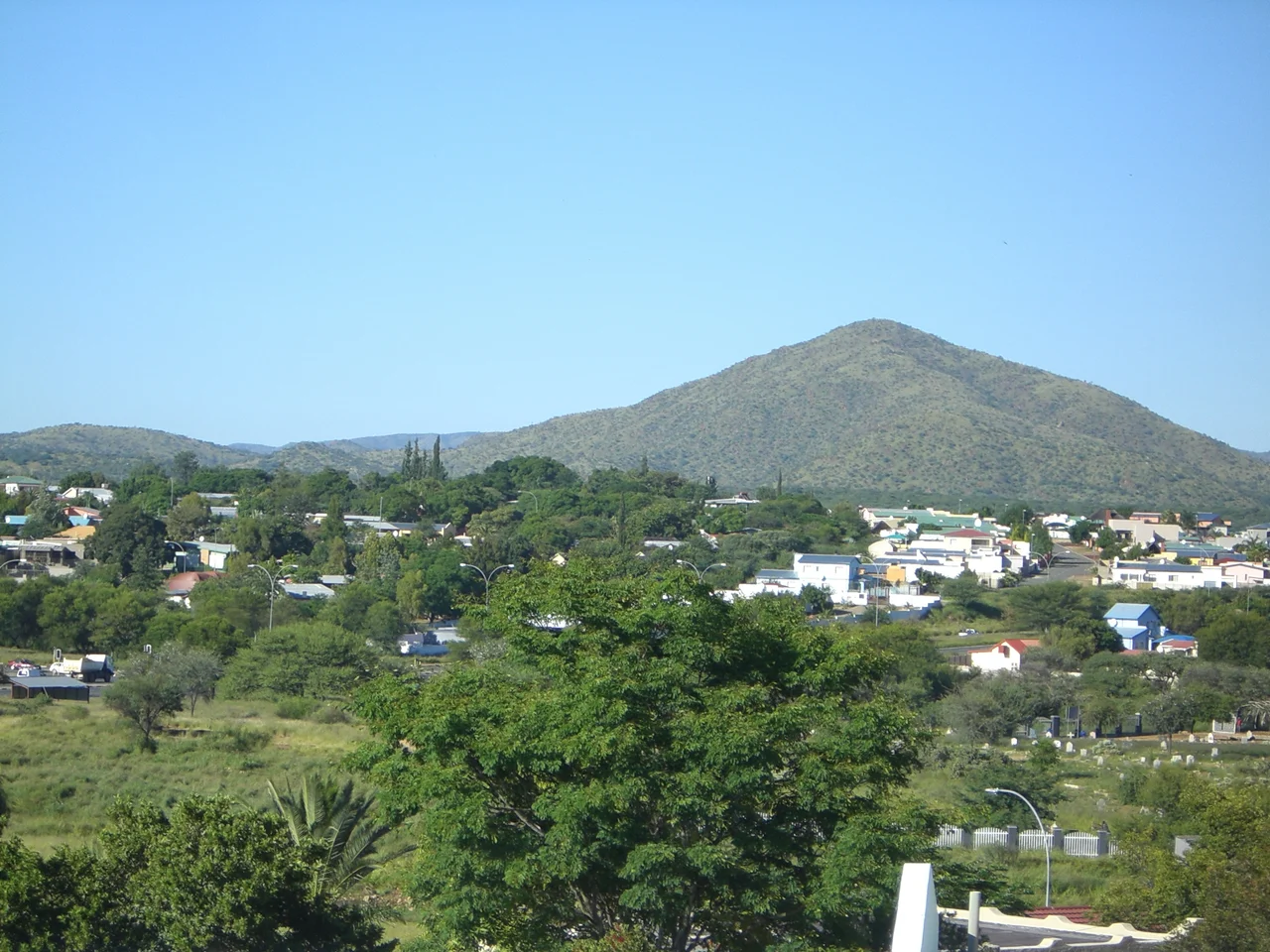

Old Location
They named the place they were being sent to *Katutura* — a word in Otjiherero that means, roughly, "the place where we do not want to live." The name was a verdict. For decades, the Black residents of Windhoek had made their lives in a neighborhood the authorities called the Main Location, and which history would remember as the Old Location: a place of crowded streets and a beloved church school, of people who owned their own plots and walked to work in the city. In the 1950s the apartheid administration decided to erase it and move everyone eight kilometers north. Most people did not want to go. On 10 December 1959, their refusal met gunfire.
A Neighborhood Made by Decree
The Old Location was never a place its residents had chosen freely. The Windhoek City Council created it in 1912 and ordered all the city's Black residents into it; a year later, officials laid out streets and split the population by ethnicity, forcing each group into a separate section. And yet, within those imposed lines, a real community grew. At its heart stood the St Barnabas Anglican Church School, whose pupils would go on to shape a nation — among them Clemens Kapuuo, Mburumba Kerina, Kuaima Riruako, and a young man named Sam Nujoma. People built homes here, raised families, and held title to their own erven. It was theirs in every way that mattered, and the school that anchored it would later be destroyed when the location was closed.
The Insult of the Move
When South Africa's National Party brought apartheid to South West Africa, then governed as its de facto fifth province, the plan for the Old Location followed the logic of segregation to its conclusion. But the residents had concrete reasons to resist beyond principle. In the Old Location they owned their land; in Katutura, every plot would belong to the municipality. The new plots were smaller, too cramped even for the gardens that had fed families. And where the Old Location sat within walking distance of work, Katutura's eight-kilometer remove meant paying daily bus fare on wages that were already meager. The move would make people poorer, more dependent, and further away. They understood exactly what was being done to them, and they said no.
The Tenth of December
The newly formed SWANU party helped organize the resistance, and the residents launched a boycott of municipal services. On 10 December 1959 the protest came to a head, and the South West Africa Police opened fire on the crowd. Eleven people were killed and forty-four wounded. Among the dead was Anna Mungunda — known as Kakurukaze — a domestic worker who, in the chaos, set fire to the car of the location superintendent and was shot down for it. Today she is honored as a National Hero of Namibia, her grave at the Heroes' Acre. The cruelty did not end with the shooting. At the city's hospitals, doctors turned the wounded away, telling them to "go to the United Nations for treatment, because these people are political patients."
The Spark That Did Not Die
Between three and four thousand people fled the Old Location and refused to return, afraid of further reprisals. The killings hardened resolve rather than breaking it. They drove community leaders — Sam Nujoma among them — into exile, and out of that exile grew SWAPO, the movement that would carry the fight for independence across the next three decades. Nujoma, who would later become Namibia's founding president and who died in 2025, never let the memory fade; he wrote of that day in his own account of the struggle. The transfer to Katutura ground on for years, and the Old Location was officially closed in 1968. Namibia did not become free until March 1990, thirty-one years after the shooting. The nation marks the anniversary still: every 10 December is Human Rights Day, a holiday born from the people who would not be moved.
From the Air
The Old Location occupied the ground between today's Hochland Park and Pioneers Park suburbs in western Windhoek, near 22.58°S, 17.06°E, at roughly 1,700 meters in the highland basin ringed by the Auas and Eros mountains. The site is now residential, with a cemetery preserving its memory; Katutura lies about 8 km to the north. The high elevation thins the air and lengthens takeoff distances. View western Windhoek at low level in clear daytime conditions, allowing for afternoon turbulence over the surrounding hills. Hosea Kutako International (FYWH) is about 45 km east; Eros Airport (FYWE) sits just southeast of the area.
Nearby Stories
- South West Africa 17 km away
- German South West Africa 36 km away
- Otjimbingwe 48 km away
- Spreetshoogte Pass 96 km away
- Leopard Cave, Namibia 130 km away
- Mukurob 300 km away
- Hoba Meteorite 306 km away
- Upingtonia 341 km away