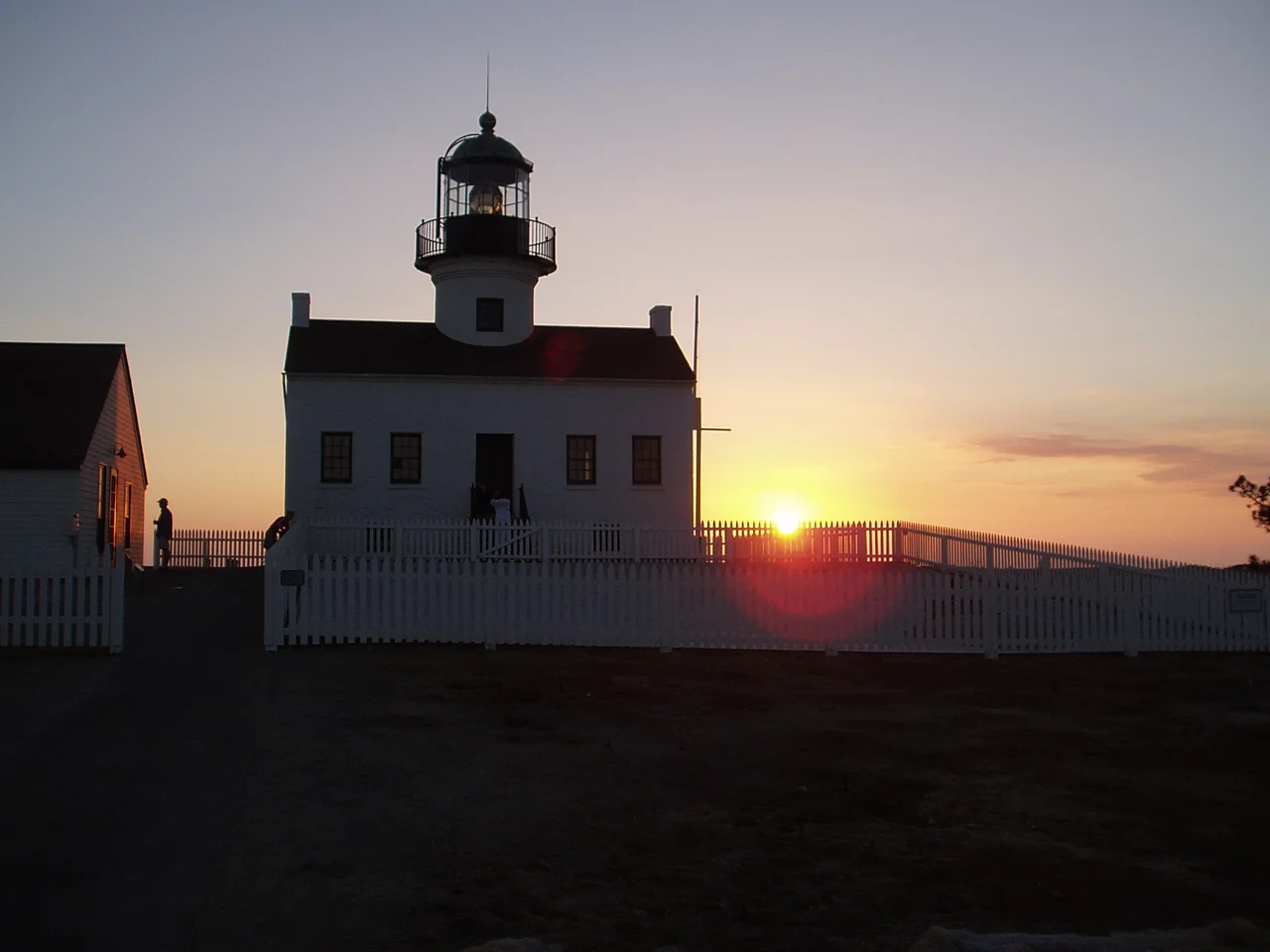

Old Point Loma Lighthouse
The lighthouse commission built it high, 462 feet above sea level on the spine of Point Loma, reasoning that a light placed high would be seen far. The reasoning was sound. The execution worked, for a while. The Old Point Loma Lighthouse was first illuminated on November 15, 1855, and for three decades it guided ships into San Diego Bay. Then the commission discovered the problem with building high on a coastal promontory: clouds and fog frequently fill in at exactly the altitude where the lighthouse stood, hiding the light from the ships below that needed to see it. In 1891, the lighthouse was deactivated and replaced by a new one 88 feet above sea level, down at the water's edge. The old lighthouse has been a museum ever since.
First Light on the Pacific
The Old Point Loma Lighthouse was one of eight lighthouses built simultaneously along the Pacific Coast under an 1850 congressional appropriation — part of the federal effort to provide navigational infrastructure for the surge of maritime traffic following the Gold Rush and California statehood. Construction began in 1854 using a design common to the Pacific Coast series: a one-and-a-half-story New England saltbox house with a tower rising from the center, topped by a Fresnel lens. The granite and brick structure was built by Gibbons and Kelly, a contracting firm responsible for several Pacific Coast lighthouses. When it was illuminated in November 1855, it was the highest lighthouse in the United States by elevation, and it remained the focal point for navigation into San Diego Bay for the next 36 years.
Robert Israel's Eighteen Years
The lighthouse's most significant keeper was Robert Israel, who served from 1873 to 1891 — nearly the entire remaining active life of the lighthouse. Israel maintained the light through the routine and isolation that characterized lighthouse service in the nineteenth century: trimming wicks, polishing lenses, keeping logs, watching weather. He cultivated a garden on the dry peninsula summit. He was responsible for the light that guided ships through the bay entrance on the thousands of clear nights when it worked perfectly, and he watched the fog roll in on the nights it was needed most and rendered invisible. When the lighthouse commission finally decided to relocate the light to a lower elevation, Israel was transferred to the new lighthouse. His name is attached to the old one's institutional history.
The Fog Problem
The decommissioning of the Old Point Loma Lighthouse illustrates a principle learned at considerable cost at multiple American lighthouse stations: elevation is not simply good for coastal navigation. A light that sits above the prevailing fog layer is invisible to ships below. The lighthouse commission documented the frequency with which Point Loma's high-elevation light was obscured by low clouds and marine layer — the same fog that makes San Diego's coastal summers cooler than visitors expect. The solution was straightforward: build a new lighthouse lower on the peninsula's slope, at an elevation where it would remain below the fog layer in most conditions. The New Point Loma Lighthouse opened in 1891 at the peninsula's western base, and continues to operate today. The old lighthouse's failure at its primary mission was the discovery that location matters as much as height.
Cabrillo National Monument
The Old Point Loma Lighthouse now sits within Cabrillo National Monument, the National Park Service unit that commemorates Juan Rodríguez Cabrillo's 1542 European discovery of the West Coast. The lighthouse is one of the monument's primary visitor attractions, preserved and interpreted as a living museum of nineteenth-century lighthouse life. The interior has been restored to its 1880s appearance. The monument's location — at the tip of Point Loma, with views of the Pacific, San Diego Bay, Mexico, and on clear days, the Channel Islands — makes it one of the most scenic vantage points in urban California. Military restrictions limit access to some adjacent areas, but the lighthouse and the monument's coastal views are accessible by road. The light that failed because it was too high is now, in retirement, simply high enough to offer one of the best views in San Diego County.
From the Air
The Old Point Loma Lighthouse is located at approximately 32.67°N, 117.24°W at the tip of the Point Loma peninsula within Cabrillo National Monument. The lighthouse and its characteristic saltbox silhouette are visible from altitude at the peninsula's western tip. The adjacent Naval Base Point Loma has restricted airspace (R-2503). San Diego International Airport (KSAN) is approximately 13 km northeast. Point Loma's distinctive peninsula configuration and the lighthouse make this an excellent visual landmark.
Nearby Stories
- Ché Cafe 0.7 km away
- Border 32 Fire 1.2 km away
- Cuyamaca Peak 14 km away
- Spanish Missions in Baja California 36 km away
- San Clemente Island 68 km away
- USS Atlanta (CL-104) 75 km away
- Off-roading in Baja 212 km away
- Guadalupe Island Biosphere Reserve 369 km away