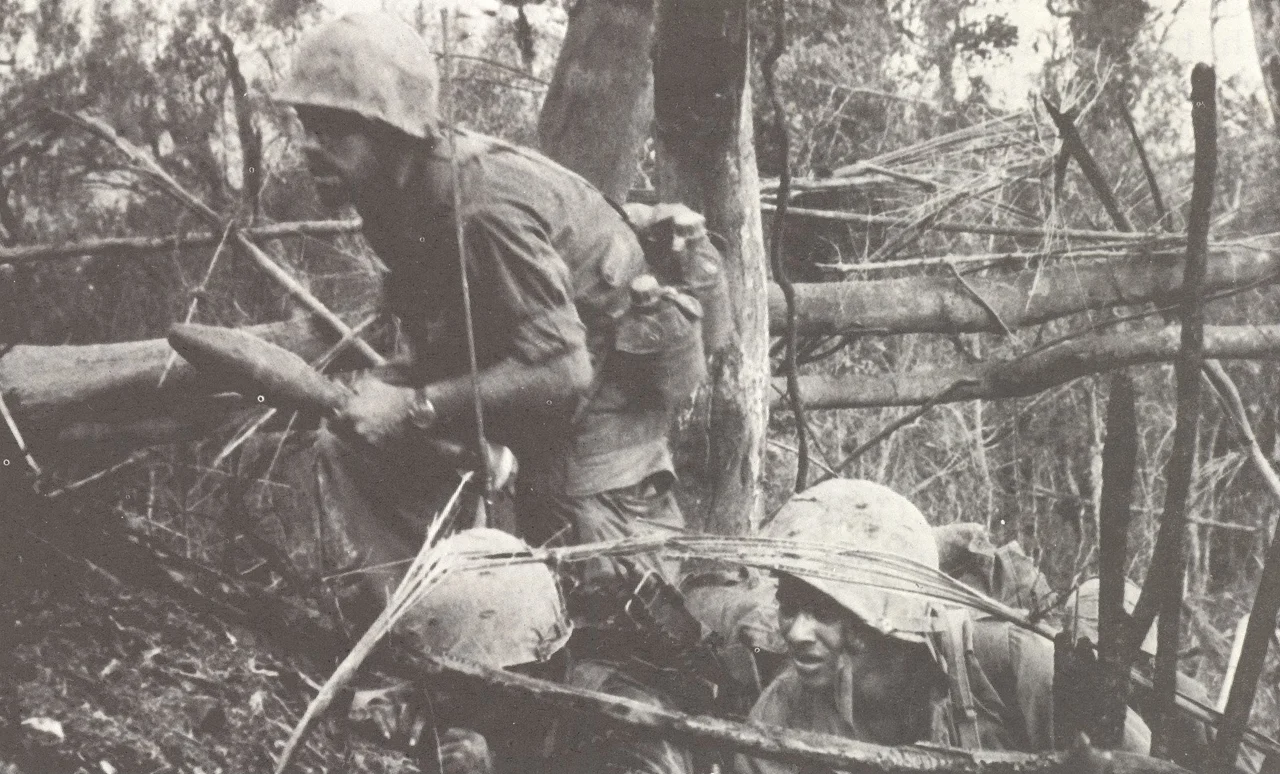

Operation Prairie
"When you're at Khe Sanh, you're not really anywhere." Brigadier General Lowell English said it plainly in the autumn of 1966, arguing against stationing Marines at a remote outpost in the western highlands. "It's far away from everything. You could lose it and you really haven't lost a damn thing." His commander overruled him. That exchange, preserved in the historical record of Operation Prairie, cuts to the heart of what the Marines were doing along the DMZ in 1966: fighting for terrain that mattered tactically, mattered symbolically, and whose ultimate strategic value no one could agree on.
The Border That Wasn't
The Vietnamese Demilitarized Zone was established by the 1954 Geneva Accords as a temporary partition between North and South Vietnam, running along the Ben Hai River at the 17th parallel. By 1966, North Vietnamese forces had turned it into an infiltration corridor, crossing south in strength through the highland passes and river valleys of Quảng Trị Province. The Viet Cong and the People's Army of Vietnam understood something the Americans were still learning: drawing U.S. forces into the remote border region pulled them away from the population centers in the coastal lowlands, leaving those cities and towns under-protected. Operation Hastings, launched in July 1966, was the Americans' first serious response to this pressure. After three weeks and significant enemy casualties — perhaps 800 North Vietnamese soldiers killed or captured — it ended. Operation Prairie picked up where it left off.
The Hunt for the 324B Division
Operation Prairie commenced on August 3, 1966, with the 3rd Marine Division conducting the bulk of operations in the Con Thien and Gio Linh regions. The primary objective was specific: find and destroy the PAVN 324B Division, which had crossed the DMZ and threatened to overrun Quảng Trị Province. The Marines used "stingray" teams — small, four or five-man reconnaissance units inserted deep into suspected enemy movement corridors — to locate the enemy and call in artillery from Cam Lộ or airstrikes from Da Nang and Chu Lai. When the reconnaissance teams found the 324B Division's main elements, larger infantry companies came in behind them. B-52 strategic bombers, then a relatively new addition to the tactical air support menu, flew Arc Light strikes against suspected concentrations. By November, the 324B Division had been battered badly enough to withdraw north of the DMZ. Other PAVN units replaced it, but they stayed quiet. The Marines declared the operation a success.
The Rockpile and Khe Sanh Enter the War
During the operation, two place names entered the American military vocabulary in ways that would echo for years. The Rockpile — a sheer karst outcropping rising 790 feet from the Cam Lo River bottom — became a Marine observation post with sight lines stretching from the South China Sea to the mountains of Laos. Its summit, barely 40 feet long and 17 feet wide, could support only a small contingent, but the intelligence it provided was invaluable. Further west, at the old French airstrip at Khe Sanh, the strategic debate that BG English had articulated played itself out in real time. On September 29, 1966, Marines landed at Khe Sanh by C-130 after intelligence indicated North Vietnamese forces nearby. They found little. But the commitment was made — and Khe Sanh would become, two years later, one of the most famous and controversial battles of the entire war.
What Success Looked Like
Operation Prairie ended with 226 Marines killed. Against that cost, American planners counted approximately 1,397 North Vietnamese soldiers killed and 27 taken prisoner. By the metrics of attrition warfare, the United States had won. The PAVN had been driven back, their division-sized offensive capability in Quảng Trị Province degraded. But the Marines' victory came with a structural problem that American commanders were beginning to recognize: every division and regiment tied down guarding the DMZ was a unit not available to protect Saigon, Da Nang, or Huế. The North Vietnamese strategy was working. The border war was exactly what Hanoi needed it to be — a drain on American resources, an argument for keeping U.S. forces away from the population, a long-term investment in strategic patience. Operation Prairie would beget Prairie II, Prairie III, Prairie IV. The ridge lines and firebases would keep their names and keep their costs.
From the Air
Centered at approximately 16.786°N, 106.842°E in Quảng Trị Province. The operation covered the DMZ region from Con Thien in the east to Khe Sanh in the west — a span of roughly 60 km along Route 9. The Rockpile is visible as a striking karst pinnacle just north of Route 9 at approximately 16.78°N, 106.85°E. From altitude, the geography that made this region so strategically critical — the valley routes from Laos, the ridgelines that provide observation and cover — reads clearly. Recommended viewing altitude: 4,000–8,000 feet. Nearest airports: Đồng Hới Airport (VVDH), approximately 80 km north; Phu Bai International Airport (VVPB), approximately 65 km southeast.
Nearby Stories
- Central Coast (Vietnam) 15 km away
- DMZ Campaign (1969–1971) 19 km away
- Southern Laos 39 km away
- Operation Delaware 48 km away
- National Route 9 (Vietnam) 56 km away
- Battle of the Gianh River (1643) 60 km away
- Tú Làn Caves System 79 km away
- Bach Long Vi Island 347 km away