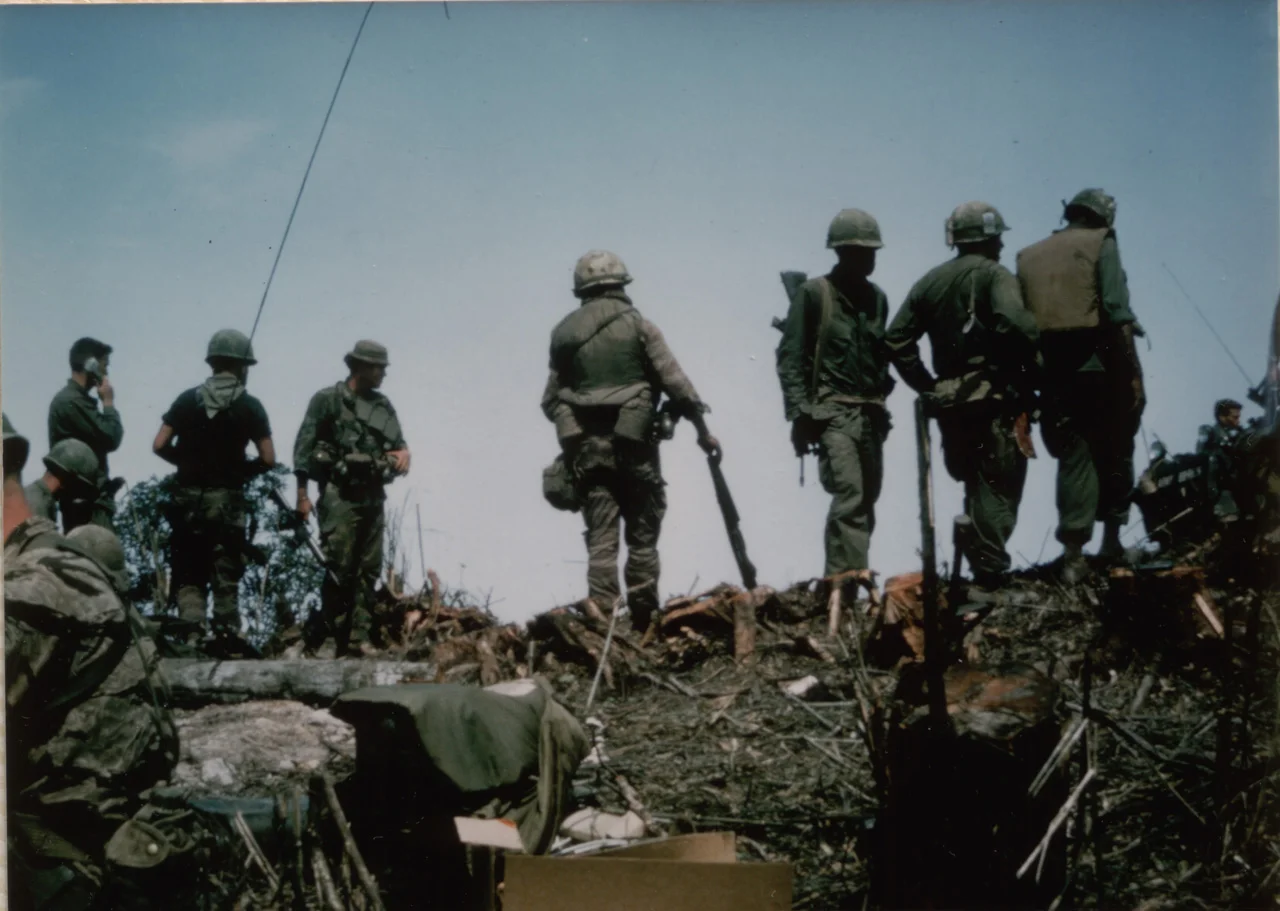

Operation Delaware
The last time American and South Vietnamese forces had entered the A Shau Valley in any strength, the result had been a disaster: a Special Forces camp overrun, its defenders evacuated under fire, the valley abandoned to the North Vietnamese Army in March 1966. For two years the People's Army of Vietnam (PAVN) had transformed that vacuum into something formidable — underground bunkers, fuel and ammunition depots, radar-controlled antiaircraft guns, and a hard-packed supply road running the valley's 40-kilometer length. Then, on April 19, 1968, just weeks after the Tet Offensive had shaken the entire American war effort, Operation Delaware sent two brigades back in.
After Tet, Into the Valley
The strategic logic was compelling even as the timing was difficult. By early April 1968, the PAVN had just taken more than 40,000 casualties in the Tet Offensive and at Khe Sanh — staggering losses that had degraded its immediate offensive capacity. But the A Shau Valley, running north–south along the Laotian border 30 miles south of Khe Sanh, remained an intact logistics base feeding forces into northern I Corps. If the PAVN was preparing for another major offensive, it would likely stage from the A Shau. The answer, MACV determined, was to disrupt that staging area before it could be used. The 1st Cavalry Division (Airmobile) — 20,000 men and nearly 450 helicopters, the most mobile division-size unit in Vietnam — was ordered north from the Central Highlands to do it.
Steel Against the Mountains
The operation began with B-52 Arc Light strikes and tactical bombing against the antiaircraft positions that made the valley so lethal to aircraft. Then helicopter assaults dropped troops into Landing Zones Tiger and Vicki at the valley's northern end, while the 1st Brigade of the 101st Airborne Division pushed west from Firebase Bastogne along Route 547, establishing Firebase Veghel at the junction of Routes 547 and 547A. The PAVN's antiaircraft network was the most sophisticated yet encountered in South Vietnam — radar-controlled 37mm cannons, twin-barreled 23mm guns, and heavy machine guns layered across the ridge lines. Despite the preparatory strikes, flying remained extremely dangerous. On April 26, a C-130B (serial 60-0298) was struck by antiaircraft fire on approach to A Lưới Airfield and crashed and burned on the runway. Five of the eight crewmen were recovered. Three were not.
Contact and Cost
For the most part, PAVN main-force units avoided a pitched battle and broke contact when engaged — the classic guerrilla response to an adversary with overwhelming firepower. But on April 29, Companies B and D of the 1st Battalion, 327th Infantry caught a PAVN company about a kilometer from Firebase Veghel and found themselves in a prolonged firefight against well-constructed bunkers and camouflaged positions. The PAVN attempted to encircle Company B; the Americans fought their way out, but not before 13 soldiers were killed and 16 wounded. When they returned the next morning, the bunkers were empty except for 15 PAVN dead. The enemy had chosen when to fight and when to withdraw. The official PAVN history later claimed more than 1,000 US and ARVN casualties during the operation — a figure that remains disputed but reflects the intensity of the fighting.
A Lưới and the Airstrip
One of Operation Delaware's concrete objectives was reopening and improving the A Lưới airstrip in the middle of the valley, turning it into a forward logistics point. A C-7 Caribou landed there on May 2 — the first fixed-wing aircraft to use the strip since 1966. By May 4, after engineers had graded and extended the runway, a C-130 Hercules landed, a milestone that transformed the operation's supply situation. Establishing Signal Hill — the 4,878-foot peak of Dong Re Lao Mountain on the valley's eastern flank — as a radio relay and fire support base was equally critical, allowing the dispersed brigades to communicate with Camp Evans on the coast and with inbound aircraft. That hilltop fight became its own story.
What Was Gained, What Was Not
Operation Delaware concluded in late May 1968. The 1st Cavalry Division suffered more than 130 dead and 530 wounded during the operation. PAVN losses were estimated at over 800 killed, along with a tank, 70 trucks, two bulldozers, 30 flamethrowers, thousands of small arms, and substantial quantities of supplies. American forces had disrupted the PAVN logistics network and briefly denied the valley — but bad weather had allowed a large portion of the PAVN to withdraw into Laos before they could be engaged. Within weeks of the American withdrawal, the PAVN began moving back. A year later, the 101st Airborne would return to the valley's northern end, and the mountain they called Hill 937 would give them the costliest ten days of the war.
From the Air
Operation Delaware's area of operations centers on the A Shau Valley at approximately 16.352°N, 107.109°E, in western Thừa Thiên Huế province. The valley runs north-south and is easily identified from altitude by its flat bottomland flanked by steep forested ridges. Firebase Bastogne was located near the valley's eastern approaches; A Lưới Airstrip (now a civilian airfield) is in the valley center. Nearest major airport: Phu Bai International (VVPB), approximately 60 km to the northeast. Approach from the east over the coastal plain. Valley floor elevation approximately 400 m; surrounding peaks reach 1,800 m. Cloud cover is frequent and can descend rapidly.
Nearby Stories
- Esplanade of Sacrifice to the Heaven and Earth 0.5 km away
- First Battle of Quảng Trị 9.7 km away
- Battle of Nam Dong 12 km away
- Saravan 38 km away
- Southern Laos 57 km away
- Grès supérieurs Formation 65 km away
- Bà Nà Hills 103 km away
- Bach Long Vi Island 382 km away