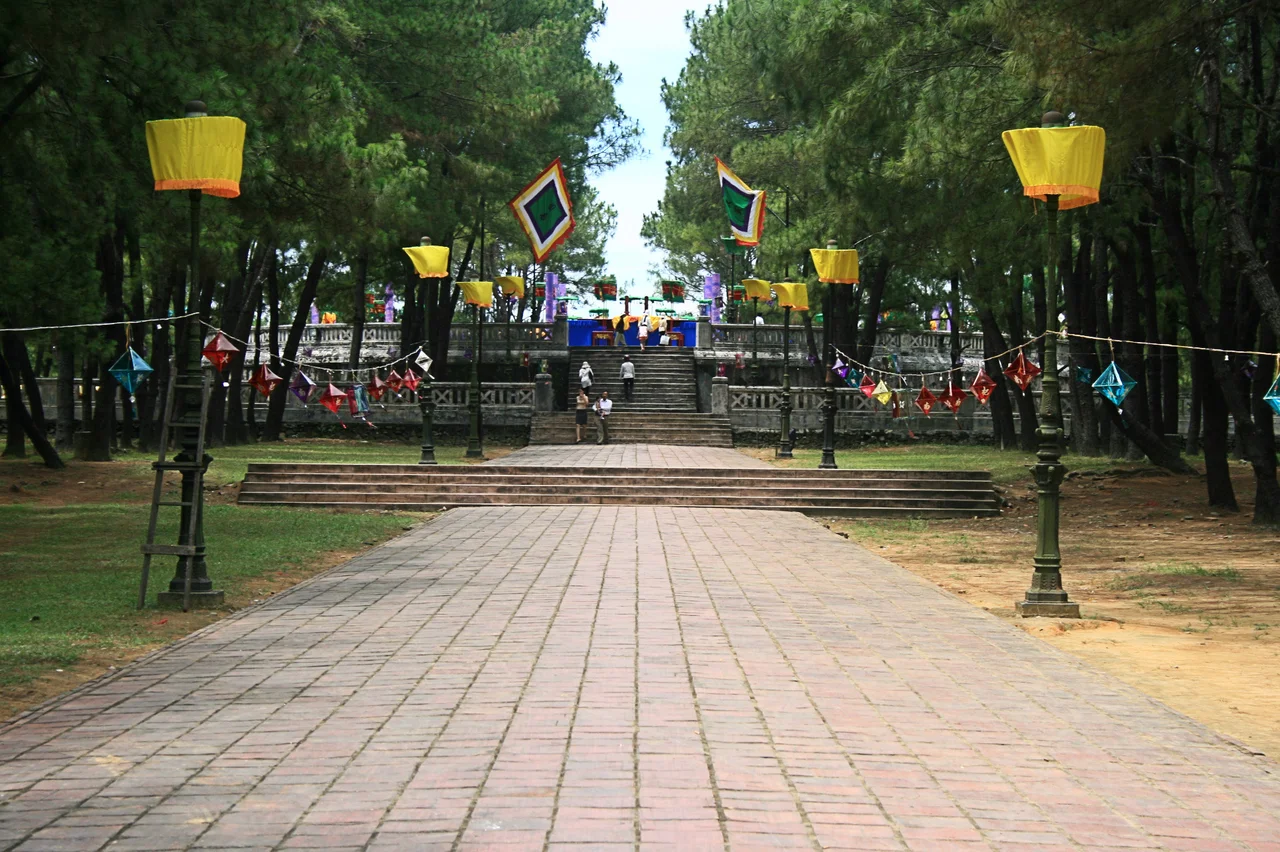

Esplanade of Sacrifice to the Heaven and Earth
Once a year, the Emperor of Vietnam would leave his citadel on an elephant and travel south through the city. The procession moved to the sound of a single anthem — the Đăng đàn cung, the Melody on the Ascent to the Esplanade — composed for this journey alone. At the far end of the road, a three-tiered altar waited: the Esplanade of Sacrifice to Heaven and Earth, known in Vietnamese as Nam Giao. Here, in the name of his people, the emperor would ask the gods of Heaven and Earth for good harvests, fair weather, and peace. The rite predates the Nguyễn dynasty; the Hồ dynasty was already performing it in the early 15th century. When the monarchy ended in 1945, the ritual fell silent. It has since returned.
Three Levels Between Earth and Sky
The esplanade's architecture encodes a cosmology. Three terraced levels rise from the surrounding landscape south of the city, each tier representing a step toward the divine: the lowest for the earth, the middle for human affairs, the uppermost for Heaven. The emperors approached it after a three-day fast at the Trai Cung Palace nearby, arriving in late evening when the ritual was performed under an open sky.
The altar complex was declared part of the UNESCO World Heritage Site "Complex of Hué Monuments" in 1993, protecting it under international heritage law. Before that recognition, decades of disuse after 1945 had left the site deteriorating. Restoration work in recent decades has stabilized the structure, and the altar was reinscribed into living practice when the offering ritual was revived in 2004 at the inaugural modern Huế Festival.
The Procession That Crossed the City
The ritual journey to Nam Giao was itself a spectacle, and the modern revival preserves much of that choreography. In today's biennial ceremony, the presiding official — typically the governor of Thừa Thiên-Huế Province — departs the Thái Hòa Imperial Palace in the late morning wearing silk robes modeled on imperial dress. The ancestral tablet travels in a government palanquin through the Meridian Gate of the old Purple Forbidden City complex.
The procession moves through the city, eventually reaching the Perfume River, where the presider boards a dragon boat and travels downstream to Da Vien Island. From there the party makes its way to Trai Cung Palace to rest before continuing south to the esplanade as drums and gongs sound the approach. By the time the ceremony begins, darkness has fallen. The original ceremonies were held only before a restricted audience of imperial family, government officials, and military leaders. The modern ceremony is open to the public and streamed online for the Vietnamese diaspora.
Silk, Wine, and Kneeling
At the esplanade, the ceremony proceeds in precise sequence. Silk and gem offerings contributed by citizens of the province are placed on the altar first. Then the pre-sacrificed animals — a pig, a goat, and a water buffalo — are brought forward along with a cup of wine. As the wine is offered, a military dance called My Thang Chi Chuong is performed, honoring the memory of the state's military heroes.
When the presider prays to the gods of Heaven and Earth in the name of the nation, the entire official party kneels. A civil dance follows, and then the presider partakes of the offered wine and meat — an act that in imperial times would have been performed by the emperor himself, representing his role as intermediary between the people and the cosmos. The prayer asks for peace, prosperity, good weather, and favorable harvests for the coming two years. The prayer paper and many of the offerings are then ritually burned.
Continuity Across a Century
The rite of Nam Giao is of Chinese origin — similar in structure to the Korean ceremony of Jongmyo jerye — but it became distinctly Vietnamese through centuries of practice. Emperors chose the date using royal astronomers who consulted Confucian, Buddhist, and Taoist traditions. The offerings came from provinces across the empire, a logistical expression of national unity.
The ceremony was interrupted in 1945 when Emperor Bảo Đại abdicated and the Nguyễn dynasty ended. It was revived at the inaugural modern Huế Festival in 2004 and has been held biennially since at each biennial Huế Festival. For the people of Huế, Nam Giao is an opportunity to remember the city's centuries as the spiritual and cultural center of all Vietnam — not as nostalgia, but as a living thread connecting a city's present to its deep past.
From the Air
The Esplanade of Sacrifice to the Heaven and Earth sits at 16.4377°N, 107.5826°E, about 3 km south of Huế's Imperial Citadel. From 2,500 feet, the three-tiered structure is visible within a wooded setting south of the main city grid, distinguishable from the surrounding landscape by its open, terraced form. The Perfume River curves through the city to the north. Nearest airport: Phú Bài International (VVPB), approximately 7 km to the south-southeast. Da Nang International (VVDN) lies roughly 90 km southeast.
Nearby Stories
- Battle of Fire Support Base Ripcord 4 km away
- Sơn Trà Mountain 5.8 km away
- Quảng Trị Citadel 7.3 km away
- Battle of Nam Dong 10 km away
- Hội An wreck 56 km away
- Battle of Cua Viet 65 km away
- Saravan 100 km away
- Hainan Island Incident 342 km away