
Hội An wreck
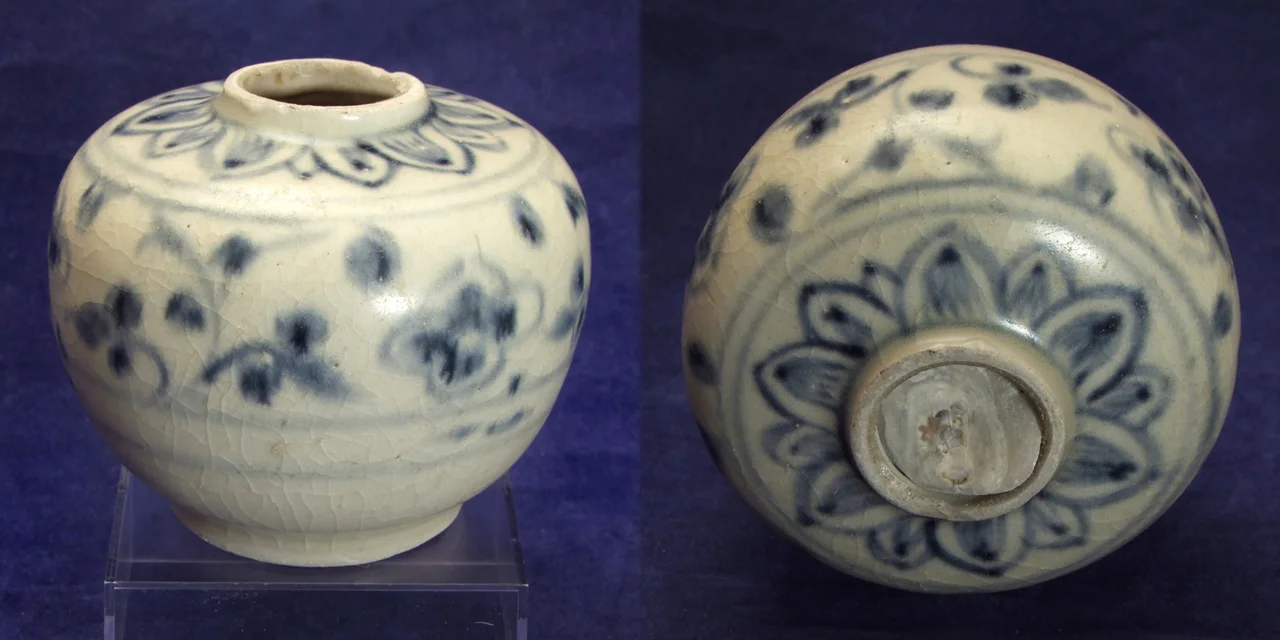
Two dealers were arrested at Da Nang International Airport in the early 1990s carrying suitcases full of pottery. The pieces were unusual — Vietnamese ceramics of exceptional quality, not the export ware flooding markets at the time but something finer, with a glaze and a finish that suggested a different origin. The authorities traced the pieces to a ship on the seafloor 22 nautical miles offshore, lying in 70 meters of water. It had been there since the mid-to-late 15th century. By the time anyone with the means to excavate properly arrived, the site had already been worked over by looters dragging hook-and-net rigs across the wreck to pull pottery from the mud.
Cargo from the Kilns of the Red River Delta
The ship had been loaded at the kilns of the Red River Delta — workshops around Chu Dau and nearby centers that supplied the export trade during Vietnam's Lê dynasty. Vietnamese ceramics from this period were among the finest produced anywhere in Asia, competing with Chinese wares on the same trade routes. But because the kilns exported nearly everything they made, keeping only defective pieces, intact examples were extraordinarily rare. Archaeologists excavating the kiln sites had found only broken and flawed goods. When the Hội An wreck surfaced — literally and figuratively — it offered something that had not existed before: an undisturbed cargo of Vietnamese ceramics en masse, a cross-section of what the workshops actually produced rather than what happened to survive onshore. The excitement in the scholarly community was immediate.
Plunder and the Race Against Time
The looters who found the wreck before the archaeologists used crude but effective methods. Weighted hooks dragged across the seabed with nets behind them dislodged artifacts and swept them up. The pieces that emerged — bowls, jars, ewers with intricate openwork panels — began appearing in antique markets from Hanoi to Europe to San Francisco. The Vietnamese government knew it had to act. The wreck lay below the depth limits of standard scuba diving, making a quick salvage impossible without specialist equipment. In 1996, businessman Ong Soo Hin partnered with Oxford University marine archaeologist Mensun Bound, and together they brought in Vietnam's National History Museum and the York Archaeological Trust. The project would run four years and cost an estimated US$14 million.
A Third of a Million Pieces
Over three field seasons, the team recovered nearly 300,000 artifacts — or, in the project's own accounting, a third of a million pieces of pottery. Most were everyday tableware: repetitive forms with practical rather than artistic intent, the mass production of a 15th-century export industry. But among the ordinary were pieces of real distinction — elaborate stoneware vessels with openwork panels, blue-and-white wares of delicate execution, pieces decorated with traced enamel and gilding. A committee of Vietnamese archaeologists and art historians selected the finest for the National Collection in Hanoi. Six museums across Vietnam received additional material. The remaining 90 percent — the bulk of the cargo — was auctioned by Butterfields in San Francisco in 2000, with proceeds divided among the salvage partners and used partly to fund the curation and study of the national holdings.
What the Wreck Revealed
The Hội An wreck is known formally as the Cu Lao Cham wreck, a name that anchors it to the islands that Hội An's maritime culture had always depended on. It is dated to the mid-to-late 1400s — a period when Vietnamese ceramic production was at or near its peak, and when Hội An was already established as a major regional port. The cargo tells a story of trade at scale: not exotic luxury goods for a handful of wealthy buyers, but hundreds of thousands of pieces destined for markets across Southeast Asia and beyond. The looters who dragged the site, the dealers caught with suitcases at Da Nang airport, the four-year international salvage effort — all of it reflects how much was at stake when a piece of that history surfaced from the seabed.
From the Air
The Hội An wreck site lies at approximately 16.04°N, 108.60°E, about 22 nautical miles (40 km) east of the Vietnamese coast in the South China Sea. There is nothing to see at the surface — the wreck sits on the seafloor at about 70 meters depth. Flying from Da Nang International Airport (VVDN) eastward over open water at 2,000–3,000 ft gives a sense of the distance the medieval merchants traveled. Cham Island (Hon Lao) is visible in clear conditions as a mountainous profile on the horizon before reaching the wreck coordinates. Conditions over the South China Sea can deteriorate rapidly during the northeast monsoon (October through March).
Nearby Stories
- Bach Ma National Park 15 km away
- Thạnh Mỹ Massacre 17 km away
- Tomb of Gia Long 36 km away
- 1968 Kham Duc C-130 Shootdown 45 km away
- Lý Sơn Island 51 km away
- Perfume River 91 km away
- Operation Masher / White Wing 173 km away
- Battle of the Paracel Islands 283 km away