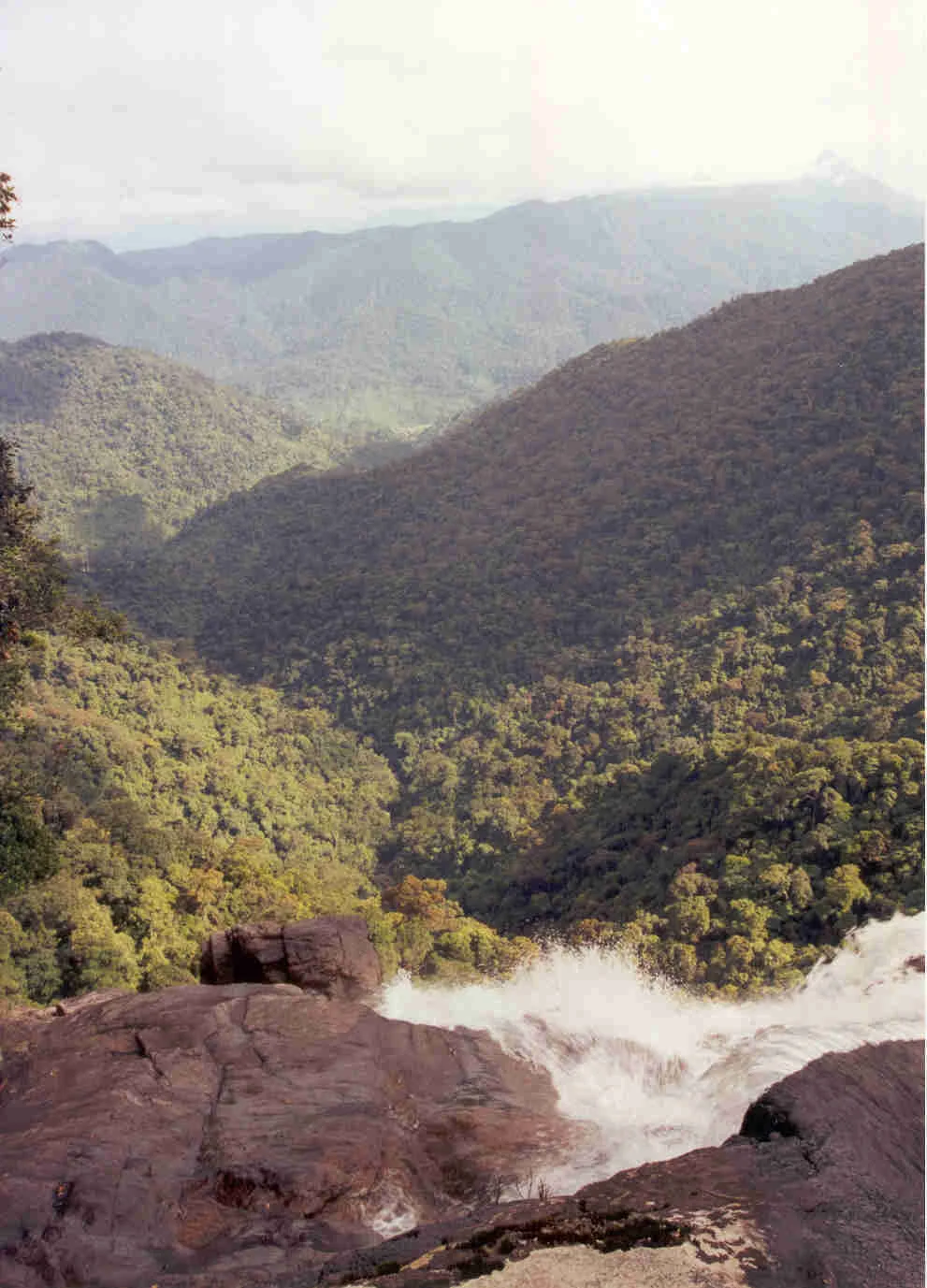

Bach Ma National Park
The name means White Horse, and on mornings when clouds pour over the summit ridge and tumble down through the forest canopy, you can almost see why. Bach Ma Mountain rises to 1,450 meters within a few kilometers of Vietnam's coastline, catching moisture off the South China Sea with such efficiency that it records 8,000 millimeters of rainfall annually — the wettest place in the country. Below the summit, 22,000 hectares of tropical and subtropical forest cascade toward the coastal plain, sheltering creatures so rare that some of them had no name until scientists found them here in the 1990s and early 2000s. Bach Ma National Park is not simply a piece of protected wilderness. It is a place that was nearly destroyed, then slowly, stubbornly reassembled itself.
Forest That Survived a War
The forests of Bach Ma carry the memory of the Vietnam War in ways that are still visible to the trained eye. American forces used Agent Orange and other herbicidal agents extensively across central Vietnam, and Bach Ma's forests were among those targeted. The damage was severe — whole canopy layers stripped, soil chemistry altered, wildlife populations collapsed. When South Vietnam's government first protected the area in 1962, it was a French-era hill station with colonial villas and walking tracks; when Vietnam formally established the national park around 1991, it was a recovering forest. Recovery is not the same as restoration. Some species never returned. Others persist in small, isolated populations, vulnerable to the pressures of illegal poaching and logging that 40 forest rangers work to suppress. The forest you see today is real wilderness, but it is also a document of what was taken from it.
The Rarest Animals in the World
Scientists exploring the Annamite Mountains in the early 1990s made one of the most extraordinary zoological discoveries of the twentieth century: the saola. Related distantly to cattle and antelopes, with long straight horns and a face marked by white patches, the saola had apparently escaped Western scientific notice entirely until 1992. Bach Ma and the Green Corridor forests to its west are believed to be among the best remaining habitat for this critically endangered animal. But the saola is only the most famous of Bach Ma's rare inhabitants. The park hosts over 363 bird species and 132 mammal species, including nine species of primates — among them the red-shanked Douc langur, whose vivid orange, black, and white coloring makes it look improbably tropical. Leopards and tigers may still move through the park's most remote sections. Muntjac deer browse the forest understory. It is, biologically, one of the most significant protected areas in Southeast Asia.
Waterfalls, Clouds, and the Summit Road
The park's 16-kilometer summit road climbs from the coastal lowlands through successive climate zones, passing five distinct waterfalls — one of which drops 300 meters in a single plunge. At the top, guesthouses and an ecotourism center sit above the clouds on most mornings, offering a particular Vietnamese mountain experience: cool air, mist, and the sound of water moving through forest. The summit gives way to trails into the forest, where the Pheasant Trail and the Five-Lake Cascades Trail are popular with guided groups. Motorcycles and bicycles are prohibited on the summit road, not for environmental reasons alone but because the gradient is genuinely dangerous. The park entrance lies 40 kilometers south of Huế on National Route 1, near the small coastal town of Cau Hai. Guides fluent in English and French can be hired at the entrance, a remnant perhaps of the French colonial era when the area first attracted European visitors.
A Living Laboratory
Between 2005 and 2006, researchers working in the Green Corridor forests near Bach Ma discovered eleven previously unknown species of animals and plants — two butterfly species, a snake, five orchids, and three other plant species. The snake, a white-lipped keelback (Hebius leucomystax), lives by forest streams and reaches about 80 centimeters in length, its body marked with red dots and a yellow-white stripe along its head. Three of the new orchid species were entirely leafless, containing no chlorophyll and surviving entirely on decaying organic matter. These discoveries, in forests that have been mapped and studied for decades, underscore a basic truth about the Annamites: much of what lives here is still unknown to science. The park's science department conducts ongoing research into the region's ecosystems, with particular attention to species that may yield future medicinal value.
From the Air
Bach Ma National Park is centered at 16.20°N, 107.87°E, approximately 40 km south of Huế and 65 km north of Da Nang. From the air at 5,000–8,000 feet, the Bach Ma massif is unmistakable — a steep mountain rising abruptly from the narrow coastal plain, often capped with cloud even on clear days. The Lagoon of Cau Hai (Đầm Cầu Hai) is a large coastal lagoon visible just east of the park, and National Route 1 runs along the coast below. Nearest airports: Phu Bai International (VVPB) approximately 40 km north, Da Nang International (VVDN) approximately 65 km south. The Hai Van Pass — a famous mountain crossing — lies between Bach Ma and Da Nang and is visible as a dramatic ridge running to the sea.
Nearby Stories
- A Sầu Valley 1.5 km away
- Perfume River 13 km away
- Japanese Bridge 14 km away
- Sơn Trà Mountain 16 km away
- Bà Nà Hills 26 km away
- Quảng Trị Citadel 26 km away
- Saravan 95 km away
- Hainan Island Incident 349 km away