
Bà Nà Hills
The name comes from the Cham language: Bà-nà, derived from Po Inu Nagar, the most important goddess of the Champa people. Before the French arrived in 1919 to build their hill station in the Trường Sơn Mountains, before the Sun Group transformed it into a resort, before the Golden Bridge became an icon shared across social media worldwide, this mountain 42 kilometers west of Da Nang was a place of worship. Three layers of history sit stacked on these ridgelines — Cham sacred geography, French colonial retreat, and a 21st-century theme park that holds a Guinness World Record — and the view from the top, out over the East Sea on a clear day, belongs equally to all of them.
Where the Cham Goddess Lived
Long before any French planner surveyed these slopes, the Cham people who built the temple complex at Mỹ Sơn — just 70 kilometers to the south — considered this mountain sacred to Po Inu Nagar, their most venerated goddess. The name Bà Nà, as it passed through the Kinh language, preserved a memory of that original significance. The Champa civilization, which flourished along central Vietnam's coast from the 4th to the 15th century, left sacred sites across the landscape, not only in river valleys but on high ground with commanding views of the sea. Bà Nà Hills is at 1,500 meters elevation, high enough that it creates its own weather — cooler, misty, distinctly separate from the coastal plain below. That quality of otherworldliness, the feeling of leaving one world and entering another, likely contributed as much to its sacred reputation as any formal theology.
The French Retreat
In 1919, French colonists established a hill station on the mountain. The concept was practical: the highlands of French Indochina offered relief from the enervating coastal heat, and the French built retreats from Dalat in the south to Sapa in the north. Bà Nà became the Dalat of Danang Province — local tourism authorities still use that comparison today. The station sat at 1,500 meters, where the temperature runs reliably cooler than the coast, and offered views of the surrounding mountains and, on clear days, a glimpse of the East Sea. Much of the original French-era infrastructure was damaged or abandoned during the wars that followed. What the colonists built is gone; what the French era left behind is the idea of the place as a destination — a mountain worth the journey.
The Record-Breaking Cable Car
The modern resort opened to the public in earnest after the Sun Group took over development, and on 29 March 2013 a new cable car began operating that rewrote the record books. The Ba Na Cable Car — manufactured by Austrian company Doppelmayr and managed by Sun World — runs 5,801 meters without interruption, claiming the Guinness World Record for longest non-stop single track cable car. It climbs from a valley station through forest and cloud to the resort at the summit, passing through distinct climate zones on the ascent. In 2021 Sun Group added a sixth cable car line to the park. The journey itself has become part of the experience: the forest canopy dropping away, the mountains receding into distance, Da Nang visible as a coastal shimmer to the east.
The Golden Bridge
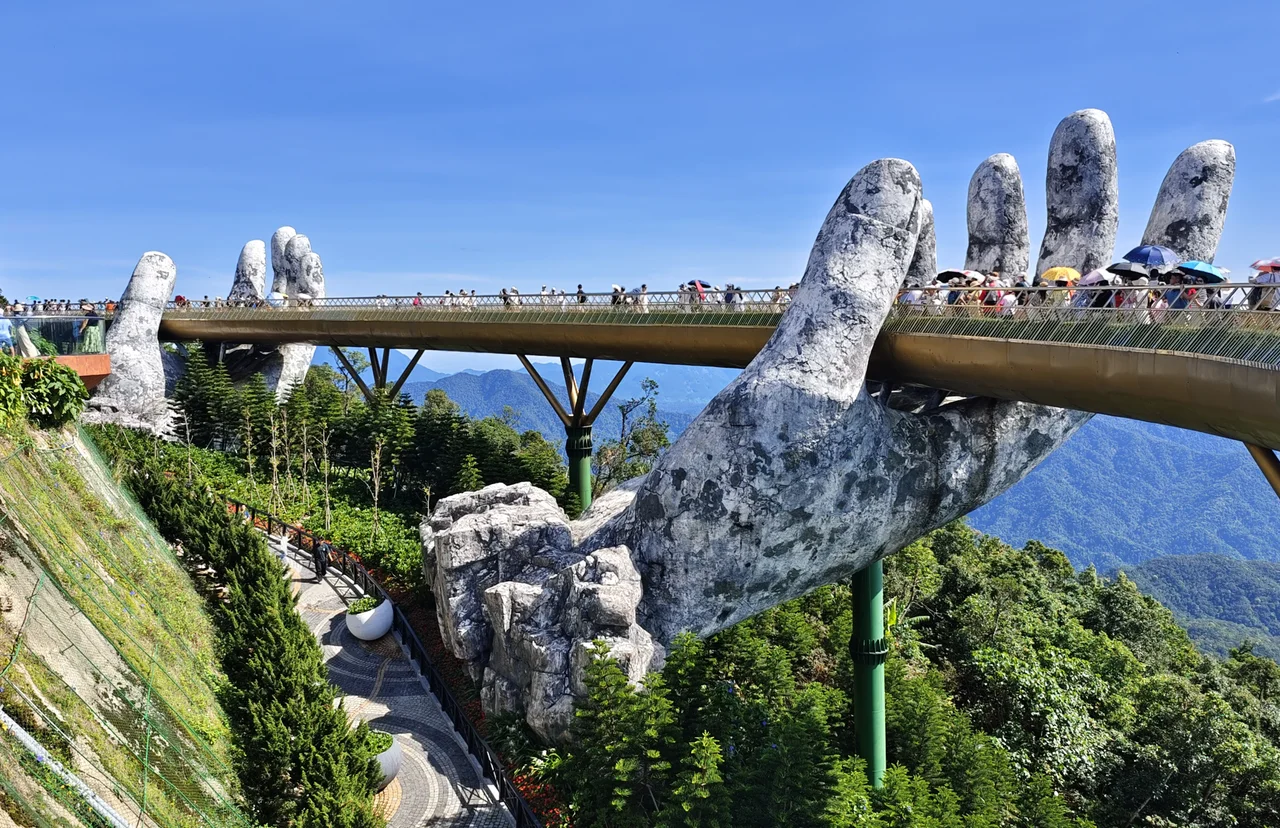
The resort's most photographed attraction is the Golden Bridge — Cầu Vàng in Vietnamese — a pedestrian walkway held aloft by a pair of giant stone hands emerging from the hillside. The image of visitors walking through the clouds, suspended between forested ridges, circulated widely online and brought international attention to the resort. Linh Ứng Temple, a working Buddhist temple situated near the station, grounds the hilltop in something older than any of the resort's constructed attractions. The coexistence of the ancient and the extravagant — temple incense and cable car departure boards, goddess names and Guinness certificates — is characteristic of the mountain. Bà Nà Hills has always been multiple things at once.
From the Air
Bà Nà Hills sits at 15.996°N, 107.994°E in the Trường Sơn Mountains, approximately 42 km west of Da Nang at an elevation of 1,500 meters. From the air, the resort complex is visible on a prominent ridge, with the cable car infrastructure running up the mountainside from the lower valley station. Da Nang International Airport (VVDN) lies 45–50 km to the northeast. The mountain creates its own weather: cloud cover is frequent, and the hilltop is often in cloud when the coast is clear. Approach from the east offers views of the coastal plain and Han River estuary before the terrain rises sharply into the Trường Sơn range. Best visibility is in the dry season, roughly March through August.
Nearby Stories
- Hải Vân Tunnel 1.7 km away
- Chàm Islands 7.1 km away
- War of the Flags 12 km away
- Chu Lai Air Base 28 km away
- Tomb of Tự Đức 29 km away
- A Sầu Valley 55 km away
- Dong Ampham National Biodiversity Conservation Area 62 km away
- Battle of the Paracel Islands 322 km away