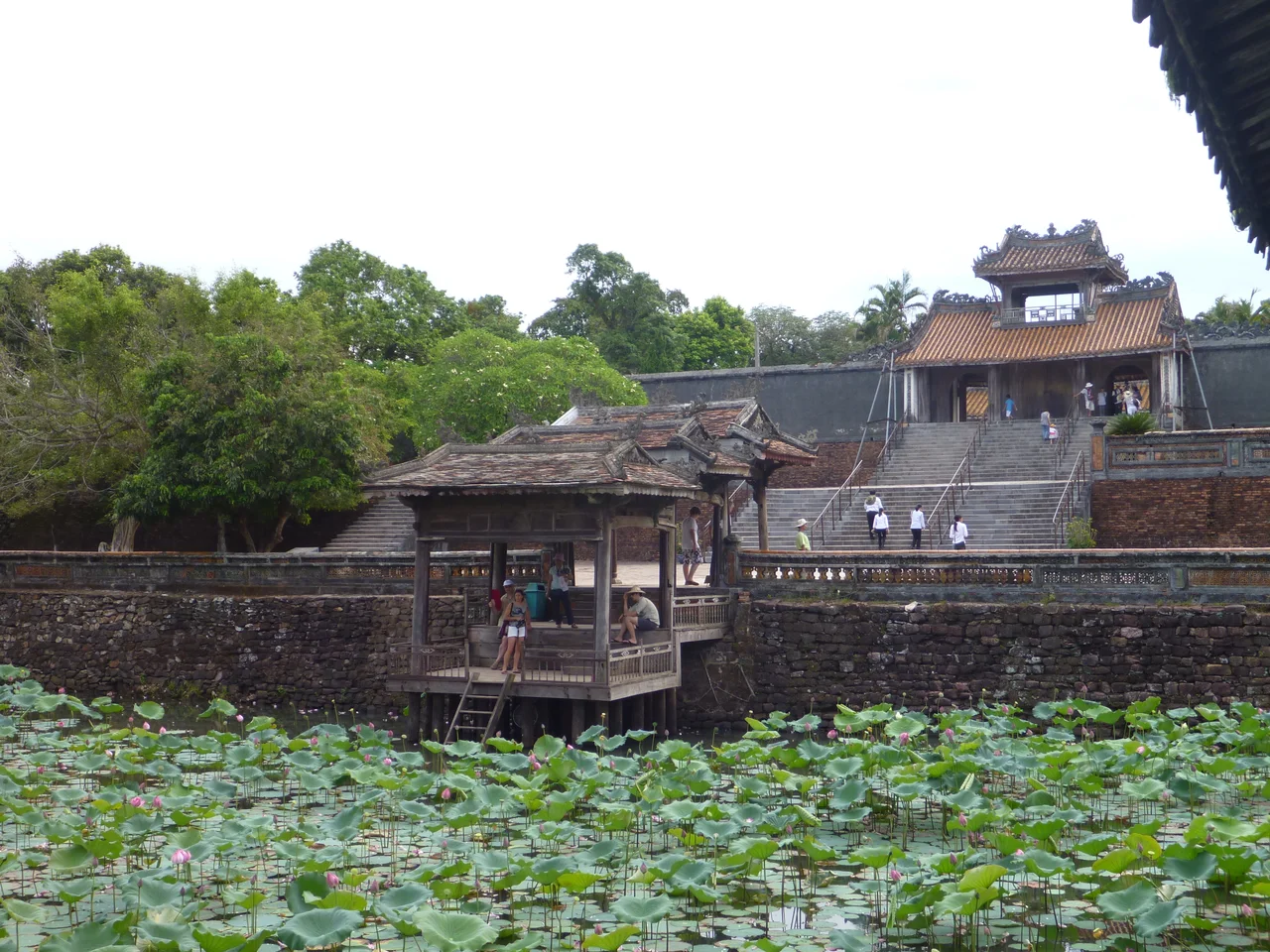

Tomb of Tự Đức
The emperor built his tomb and then lived in it. For years before his death in 1883, Tự Đức used the palace buildings of his own mausoleum as a retreat, boating on the lake, composing poetry at the lakeside pavilion, hunting small game on the tiny island in the water's middle. He wrote his own epitaph — a long, unflinching account of his reign, its achievements and failures — and had it carved on the largest stele of its kind in Vietnam, brought from a quarry more than 500 kilometers away on a journey that alone took four years. He considered writing one's own epitaph a bad omen. He did it anyway.
The Longest Reign
Tự Đức ruled the Nguyễn dynasty longer than any other monarch: 36 years, from 1847 to 1883. It was not an easy reign. Vietnam was already under pressure from French colonial ambitions when he ascended the throne, and by the time he died, the French had established a protectorate that reduced the empire to ceremony. He had 104 wives and concubines and fathered no children, possibly due to sterility caused by smallpox he contracted earlier in life. The dynasty would continue after him, but through adoption rather than direct succession.
His adopted son Kien Phuc succeeded him and ruled for only seven months before dying. There was no separate tomb for Kien Phuc — a reign that brief did not generate one. Instead, he was buried in a small corner of Tự Đức's own complex. Between father and son, also at the site, is the tomb of Empress Le Thien Anh, Tự Đức's primary wife.
A Palace of Contemplation
Construction of the Khiêm Mausoleum — officially named after the character for modesty or humility — took three years, from 1864 to 1867. The labor was extracted through corvée obligations and supplemented by heavy taxation, and the burden on the population was severe enough that in 1866, partway through construction, workers and dissidents staged a coup attempt against the emperor. It was suppressed. Work continued.
What emerged was unlike any other imperial tomb in Vietnam. The complex was divided into a Temple Area and a Tomb Area, but the distinction between monument and residence blurred immediately: Tự Đức used it as his private palace from the time it was completed until his death. Xung Khiem Pavilion sits on the lake's edge, a place where the emperor would recline with concubines and compose or recite poetry. After time on the water, boats would moor at Du Khiem Pavilion, and the imperial party could walk directly west into the palace precinct. The gardens, the lake with its small island, the theater building where court performances were staged — all of it was built to be used, not simply to be admired after death.
The Epitaph and the Stele
The stele pavilion just east of the tomb area holds the largest memorial stele in Vietnam. The stone itself — a single massive slab — was quarried more than 500 kilometers from Huế and transported over four years, an undertaking that speaks to the importance Tự Đức placed on the inscription it would carry. The text he wrote for it is a candid self-assessment: he acknowledged the hardships of his reign, the French encroachment he could not halt, the personal grief of childlessness. He wrote it himself because no adopted son would have known what to say, and because he believed it was the honest thing to do.
The Vietnamese literary tradition valued such self-composure in the face of fate. Tự Đức was a poet and a scholar, genuinely accomplished in both Chinese classical literature and Vietnamese vernacular verse. The epitaph was, in a sense, his final composition — an attempt to frame his own story before someone else did.
The Secret Grave
Here is what no one knows: where Tự Đức is actually buried. The tomb complex that bears his name, the stele that carries his words, the reliquary in the tomb area — none of these mark his actual resting place. According to the historical record, after he died in 1883, his body was taken by a secret route to a concealed location somewhere in Huế. The 200 laborers who carried out the burial and who knew the route were beheaded when they returned, so that the secret would die with them.
The reasoning was practical. Imperial tombs were targets for looters — grave goods, bronze objects, and valuables buried with emperors attracted the same criminal attention across cultures. By concealing the actual burial site and maintaining an elaborate decoy complex, Tự Đức's court tried to protect his remains from desecration. Whether they succeeded remains unknown. His real grave has never been identified.
From the Air
The Tomb of Tự Đức sits at 16.4325°N, 107.566°E, approximately 7 kilometers southwest of Huế's city center, set in a wooded valley among the hills that ring the city. From altitude, the tomb complex is not easily distinguished from the surrounding vegetation — it was designed to blend into its landscape, not dominate it. The lake within the complex and the pine-forested setting become visible at lower altitudes. Nearest airport: Phu Bai International (VVPB), approximately 8 kilometers to the east-southeast. The Perfume River flows between the city and the tomb hills; the citadel of Huế is visible to the northeast. A low pass at 1,500–2,500 feet from the west reveals the wooded valley setting and the lake's reflection among the trees.
Nearby Stories
- The Rockpile 9.4 km away
- Operation Texas Star 19 km away
- Bà Nà Hills 21 km away
- Quảng Trị Citadel 24 km away
- Lăng Cô 26 km away
- Battle of Nam Dong 30 km away
- Saravan 65 km away
- Hainan Island Incident 378 km away