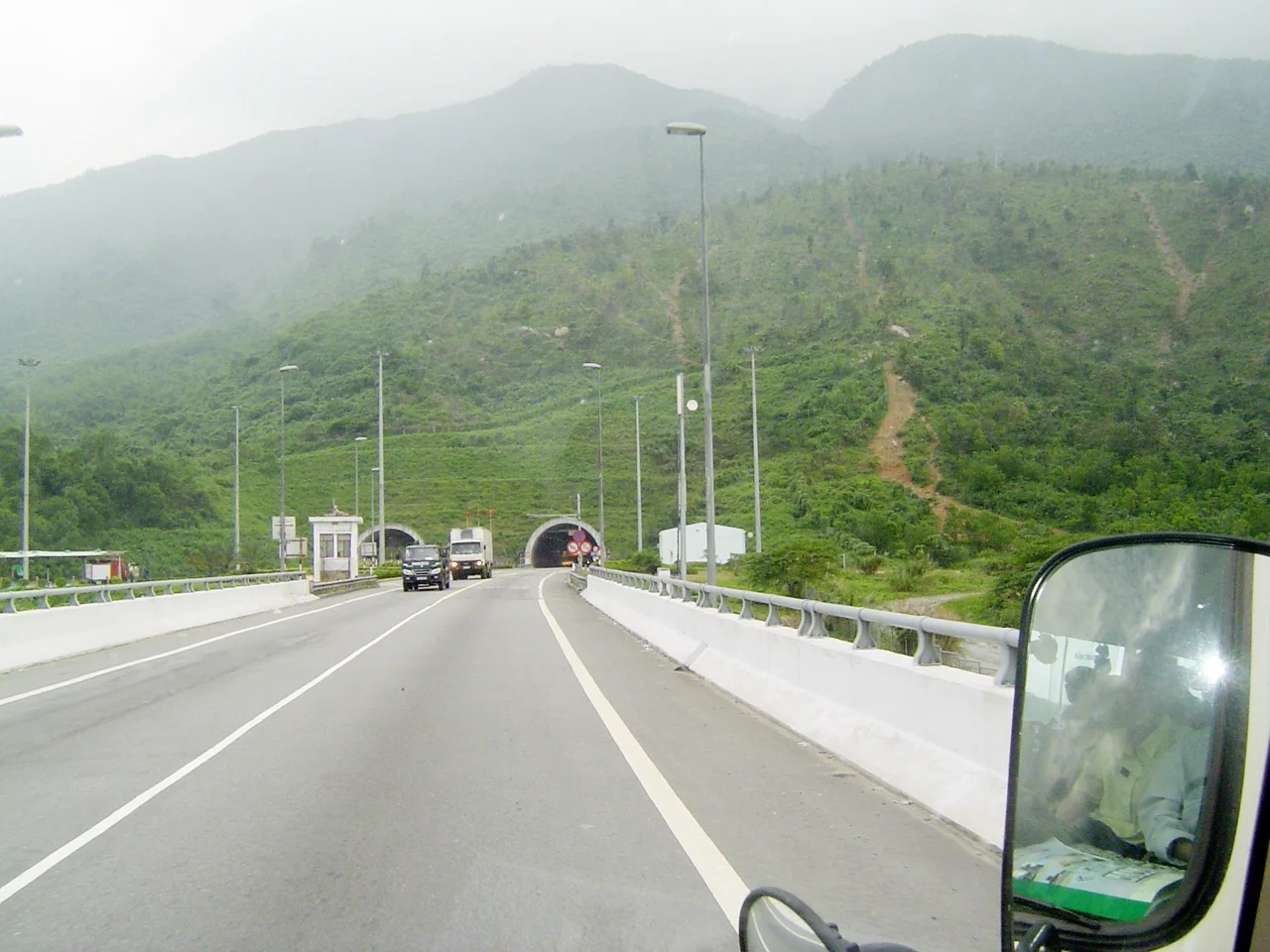

Hải Vân Tunnel
Six minutes. That's roughly how long it takes to drive the 6.28 kilometers of the Hải Vân Tunnel at the posted speed limit. On the other side of the mountain, the old road takes somewhere between 30 minutes and an hour — if the mist is light, the switchbacks are clear, and luck holds. For most of the 20th century, the Hải Vân Pass was a bottleneck on Vietnam's main north–south artery, its winding road and unpredictable weather slowing everything from passenger buses to military convoys. The tunnel that opened on June 5, 2005, didn't erase the pass. It simply offered an alternative: pass through the mountain rather than over it.
Planning a Path Through the Mountain
The idea of a tunnel through Hải Vân had been discussed for decades before work began. Route planning and design started in January 1998, led by a joint venture between Japan's Nippon Koei Company Limited and the United States firm Louis Berger International Inc., with the Vietnamese Transport Engineering Design Incorporated providing consultation. The project required a solution to both the geography and the engineering: the mountain rises steeply from the coast, and any tunnel would need to pierce several kilometers of hard rock while managing ventilation, drainage, lighting, and safety systems for a major arterial highway. The main tunnel was designed 11.9 meters wide — enough for one lane of traffic in each direction.
Built in Two Halves
Construction was divided into a southern section and a northern section, each built by a different international consortium. The 4-kilometer southern section was constructed by a Vietnam–Japan joint venture between Japan's Hazama Corporation and their Vietnamese partners, Cienco 6. The 2-kilometer northern section was built by a joint venture between Korea's Dong Ah construction company and Vietnam's Song Da Construction Corporation. Working from both ends simultaneously, the teams bored through the Annamite Range and eventually met in the middle. The completed tunnel is 11.9 meters wide, connected to a parallel emergency and maintenance tunnel by 15 cross-tunnels. Systems inside include lighting, fire alarms, ventilation fans, communication infrastructure, water supply and treatment, and a radio broadcast system that drivers can tune to FM 106MHz or AM 702KHz from the moment they enter. The tunnel subsequently received a quality award from the American Construction Management Association.
Rules of the Road, Underground
Driving the Hải Vân Tunnel requires attention to its specific regulations. The maximum speed is 70 km/h; the minimum is 45 km/h. Drivers must maintain at least 50 meters between vehicles and keep headlights on low beam throughout. Honking is prohibited. Stopping and parking are prohibited. Because there is only one lane in each direction with no overtaking possible, a slow vehicle at the front means everyone behind it slows down — a minor frustration in an otherwise efficient crossing. Motorcycles, cyclists, and pedestrians are not permitted in the tunnel, but a shuttle service has operated since November 2006, transporting them through on a carrier for a small fare. At each portal, a waiting area allows visitors to take photographs and watch a documentary about the tunnel's construction.
What the Tunnel Changed
Before 2005, National Route 1 crossed the Hải Vân Pass at the top — 21 kilometers of switchbacks above the South China Sea, prone to fog and fatal accidents. The tunnel reduces the distance between Da Nang and Huế by 20 kilometers and cuts travel time by 30 minutes to an hour, depending on conditions. Commercial vehicles, long-haul buses, and freight trucks shifted immediately to the tunnel route after it opened. The pass itself didn't disappear — motorcyclists and tourists still use the old road for the views — but it was relieved of the burden of being the only option. The tunnel is Vietnam's longest road tunnel at 6.28 km, and the second longest in Southeast Asia after Singapore's Kallang–Paya Lebar tunnel. For a country whose main north–south corridor runs the length of a long, narrow coastline, building it was not just infrastructure. It was a statement about connection.
From the Air
The Hải Vân Tunnel portals sit at approximately 16.187°N, 108.102°E (southern end) on the Da Nang side of the Hải Vân Peninsula. From the air at 3,000–5,000 feet, the tunnel portals are visible as small openings at the base of the mountain spur where it meets the coastal lowlands. The Hải Vân Pass road can be traced along the ridgeline above. Da Nang International Airport (VVDN) is approximately 18 km to the south. Phú Bài International Airport (VVPB) near Huế is approximately 48 km to the north. The contrast between the coastal plain of Da Nang to the south and the steeper terrain of the Huế side to the north is clearly visible from altitude.
Nearby Stories
- Chàm Islands 7.3 km away
- Cam Ne incident 7.4 km away
- Tomb of Tự Đức 19 km away
- Battle of the Mỹ Chánh Line 32 km away
- Operation Hong Kil Dong 32 km away
- Perfume River 50 km away
- Dong Ampham National Biodiversity Conservation Area 100 km away
- Hainan Island Incident 314 km away