
Cam Ne incident
The families living in Cam Ne 4 had seen soldiers before. The village, part of a cluster of six hamlets sharing the same name in Quảng Nam Province, had been contested ground since the French Indochina War. On the morning of 3 August 1965, Company D of the 1st Battalion, 9th Marines moved in as part of Operation Blastout, ordered to destroy Viet Cong fortifications including any structures from which fire had been received. A CBS news crew led by correspondent Morley Safer was with them. What the camera captured — Marines igniting thatched roofs with Zippo lighters while an elderly woman sat weeping — aired on CBS Evening News two days later, on 5 August 1965. The footage didn't simply report on the war. It changed how Americans understood what their military was doing in Vietnam.
The Village Before the Fire
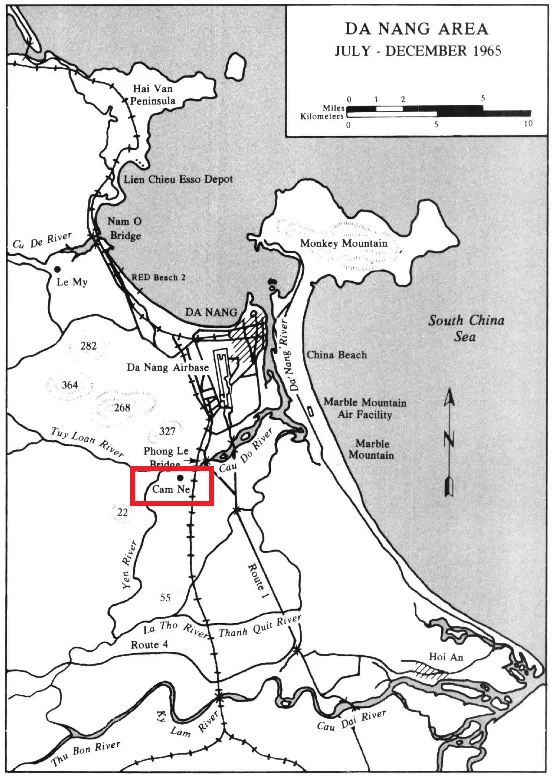
Cam Ne was not an innocent bystander in the war. The six-hamlet complex lay in an area that had been a Viet Minh stronghold during the French war and remained a Viet Cong stronghold a decade later. On 2 July 1965, following a VC mortar and sapper attack on Da Nang Air Base that destroyed or damaged six aircraft, the Marines extended their tactical area of responsibility south of the base. When units of 1/9 Marines began operating around Cam Ne in mid-July, they received fire from the hamlet. Throughout the weeks that followed, patrols continued through what the Marines described as a hostile area. When Company D arrived on 3 August, they found the village extensively entrenched and fortified — 267 punji stick traps, 3 grenade booby traps, and 6 anti-personnel mines. As the Marines entered, they came under sporadic fire that wounded one. The Viet Cong then withdrew, leaving the hamlet and its civilian residents behind.
What the Camera Saw
What followed was recorded. The Marines destroyed 51 huts and 38 trenches, tunnels, and fighting positions. Safer's camera documented the method: soldiers with cigarette lighters and flamethrowers moving through a hamlet of thatched structures, residents watching their homes burn. One Vietnamese child was killed during the fighting. The Marines' justification was operational — the huts would be reused by VC forces if left standing — and was consistent with standard procedures of the time for villages deemed uncooperative or hostile. But the footage did not show military necessity in the abstract. It showed specific people watching specific homes destroyed. When CBS News President Fred Friendly saw the footage, he confirmed its validity with Safer and approved its broadcast. The images were shocking, he acknowledged, but the story was important.
The Reaction in Washington
The day after the 5 August broadcast, President Lyndon Johnson called CBS President Frank Stanton. The report insulted the American flag, Johnson said. He ordered a background investigation of Safer, convinced the correspondent must be working for the communists — an investigation that found no such affiliation. He then ordered an investigation of the Marine officer in charge, certain that Safer must have bribed him to stage the burning. That inquiry also found nothing. The Pentagon asked CBS to replace Safer as its Vietnam correspondent. The Department of Defense began systematically monitoring the evening newscasts. Major General Lew Walt, commanding Marine forces in Vietnam, banned Safer from all of I Corps, an order later rescinded. None of these efforts succeeded in suppressing the story. They did succeed in demonstrating how unprepared official Washington was for the kind of journalism the war was generating.
The Village After
On 9 August, another Marine unit near Cam Ne came under fire; two Marines were killed and more than twenty wounded. On 18 August the Marines returned to the hamlet in force, this time with advance warning given to villagers. They searched the complex, found no Viet Cong, and built shelters for the civilians whose homes had been burned. The story continued its arc: CBS, which had broadcast the critical footage, subsequently aired reports presenting positive aspects of Marine operations in the area, seeking balance. Nearly three years after the incident, in September 1968, COMUSMACV General William Westmoreland published new guidelines on contact between U.S. forces and Vietnamese civilians — rules forbidding indiscriminate destruction of populated areas and requiring advance warning of assaults. The guidelines were a direct legacy of what a camera recorded in Cam Ne on an August morning in 1965.
What Cam Ne Meant
Historians of the Vietnam War place the Cam Ne incident among the handful of media events that genuinely shaped American public understanding of the conflict — alongside the self-immolation of Thích Quảng Đức in 1963 and Nick Ut's 1972 photograph of Phan Thị Kim Phúc. What made the footage so powerful was not its scale. Fifty-one huts in a fortified hamlet was, by the measures of what the war would become, a small event. What made it powerful was its specificity: not casualties as statistics but people as people, faces in firelight, a weeping woman whose home was gone. The villagers of Cam Ne 4 — whose names the historical record does not preserve — became, in those two minutes of television, the clearest image American viewers had seen of what the war cost people who had not chosen it.
From the Air
Cam Ne is located at approximately 15.986°N, 108.174°E, about 10 kilometers south of Da Nang's city center in the low-lying coastal plain of Quảng Nam Province. From a light aircraft at 3,000–5,000 feet, the area appears as flat paddy land intersected by rivers and irrigation channels; the Cầu Đỏ River runs to the north. Da Nang Air Base (VVDN, now Da Nang International Airport) is roughly 12 km to the north-northeast. The coast and Da Nang Bay are visible to the east. The Marble Mountains — five limestone outcroppings — are a distinctive landmark approximately 8 km to the northeast. Visibility in the coastal plain is typically good except during the northeast monsoon (October–January), when low cloud and rain are common.
Nearby Stories
- Hải Vân Tunnel 1.7 km away
- Chàm Islands 7.1 km away
- War of the Flags 12 km away
- Chu Lai Air Base 28 km away
- Tomb of Tự Đức 29 km away
- A Sầu Valley 55 km away
- Dong Ampham National Biodiversity Conservation Area 62 km away
- Battle of the Paracel Islands 322 km away