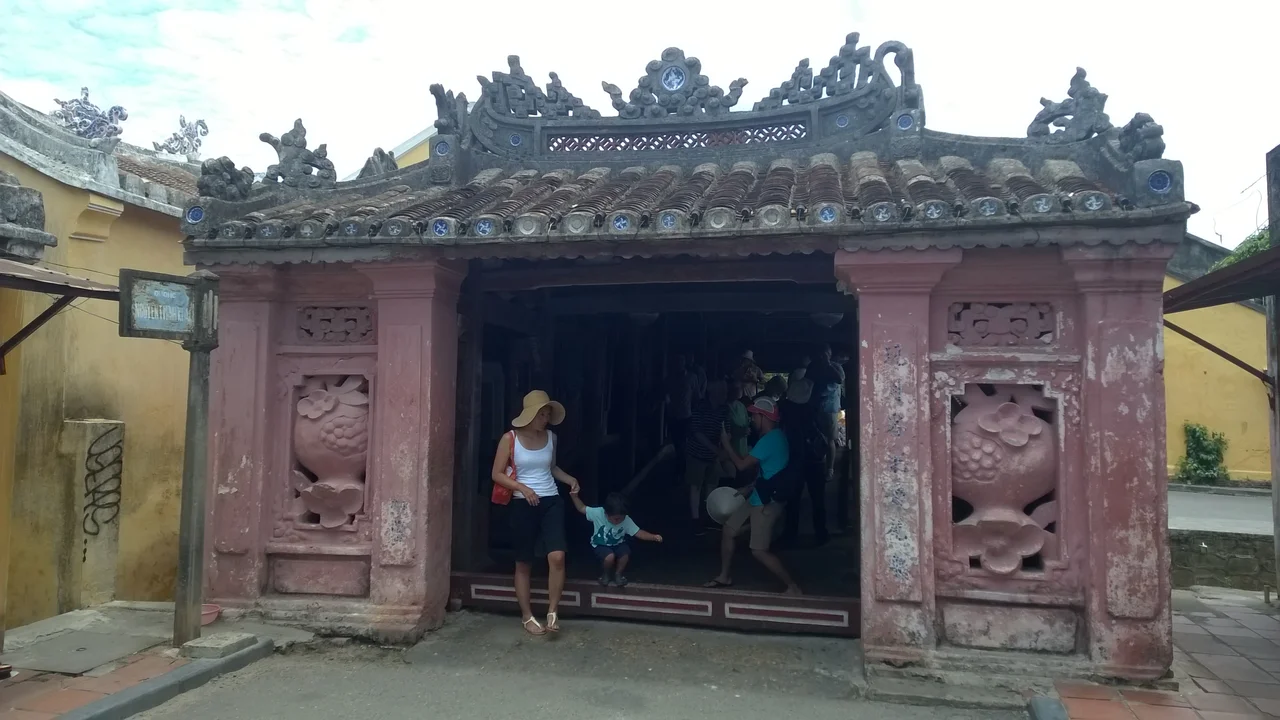

Japanese Bridge
The bridge was built to stop an earthquake. Or more precisely, it was built to placate the creature that causes them: Namazu, the giant catfish of Japanese folklore whose thrashing beneath the islands of Japan was understood to be the source of seismic destruction. Japanese merchants living in Hội An in the 17th century built a temple on top of a bridge they had already built for practical reasons, and they populated it with stone guardians — a monkey and a dog, the two animal gods whose task was to hold Namazu still. It is a building that does several things at once: crosses a canal, connects two neighborhoods, houses a shrine, and carries four centuries of accumulated repairs and renovations that have quietly transformed a Japanese structure into something that now belongs to everyone who has ever called Hội An home.
Built Between Two Worlds
During the 16th century, Japanese merchants arrived in the port city then known as Faifo — now Hội An — and established a commercial enclave on the western side of a neighborhood canal. Chinese merchants had their own enclave on the other side. Trade between the two communities required crossing the water, and in 1593, a group of Japanese merchants began building a covered bridge to make that crossing easier. Construction finished in 1595. The bridge was 18 meters long, 3 meters wide, and covered — a practical decision in a town where monsoon rains fall hard and often. The frame was built from wood, with brick bridgeheads at each end. Five spans crossed on brick pillars set into the water, with two additional spans at each bridgehead. The result was a structure that served the immediate needs of commerce while becoming the most recognizable piece of architecture in the old port. Even before anyone added a temple, Chùa Cầu was the bridge that defined the neighborhood.
The Temple on the Water
In 1653, Japanese residents added a temple to the north end of the bridge — positioning it, according to tradition, above the point where Namazu was believed to rest. The logic was literal: if the monster lay beneath the ground here, weight above would keep it still, and a temple would add the authority of the gods. Stone statues of a monkey and a dog — the two animal deities responsible for controlling Namazu in Japanese cosmology — guard the bridge's entrances to this day. The temple's interior held an altar to Trấn Vũ, a deity honored with an annual festival on the 20th day of the 7th lunar month. Throughout the bridge and temple, inscriptions in Chữ Hán (Chinese characters) record dedications and dates. The main inscription above the temple entrance reads Lai Viễn Kiều — "a bridge to welcome guests from afar" — a name given by Vietnamese lord Nguyễn Phúc Chu during a visit in 1719. The original Japanese name, whatever it was, has not survived. The bridge was renamed by the people who inherited it.
Four Centuries of Renovation
Nothing in Hội An stays purely what it started as. The Japanese merchants who built the bridge withdrew from the city in the 17th century, along with the Dutch East India Company traders who had also been present. Chùa Cầu was left behind in the neighborhood they had built, and subsequent generations maintained and changed it. The bridge was rebuilt in 1817 — a date recorded on the roof beam and in an inscription at the bridgehead. Further renovations followed in 1865, 1915, and 1986. Each round of repairs brought new hands, new materials, new aesthetic sensibilities. Vietnamese and Chinese architectural elements gradually replaced the original Japanese ones: the roof lines shifted, the ornamentation changed, the details accumulated. What stands today is not a Japanese bridge so much as a Hội An bridge — a structure whose origins are Japanese but whose four centuries of lived use have made it something entirely local. The porcelain bowls capping the roof tiles, the blend of structural systems covering the three sections, the worn stone guardians at each end: all of it reflects the layered identity of the city it serves.
A Symbol at Risk
Chùa Cầu appears on the 20,000 Vietnamese đồng banknote — a measure of how thoroughly it has come to represent not just Hội An but Vietnam's relationship to its own heritage. In February 1990, it was designated a National Historic-Cultural Relic. Visitors cross it daily, pause to photograph the temple entrance, and look down through the wooden slats at the canal below. The bridge is also sinking. Underground erosion beneath its foundations is causing the structure to settle, and ongoing conservation work aims to arrest the process before it becomes irreversible. The bridge was taken apart for restoration as recently as 2023. Whether the fixes will hold, and for how long, is the kind of question that honest engineers answer cautiously. Chùa Cầu has survived monsoons, neglect, war, tourist pressure, and four centuries of repair. Its next repair may be its most consequential.
From the Air
The Japanese Bridge (Chùa Cầu) sits at 15.877°N, 108.326°E in the heart of Hội An's Old Town, just a few hundred meters west of the Thu Bồn River waterfront. From the air the Old Town's dense historic streetscape is visible as a compact cluster of tile rooftops amid the coastal plain, approximately 28 km south of Da Nang. The bridge itself is too small to distinguish at altitude, but the Thu Bồn River delta provides a clear geographic reference. Da Nang International Airport (VVDN) is the nearest major airport. Best viewed at low altitude on approach — the Hội An coastline and river mouth are striking from 1,500–3,000 feet.
Nearby Stories
- Bach Ma National Park 7.4 km away
- Tam Kỳ 9.1 km away
- 1968 Kham Duc C-130 Shootdown 27 km away
- Lý Sơn Island 33 km away
- Hue–Da Nang Campaign 33 km away
- Hải Vân Pass 35 km away
- Operation Masher / White Wing 153 km away
- Battle of the Paracel Islands 285 km away