.jpg)
Tam Kỳ
Most travelers blow through Tam Kỳ without stopping. It sits on Highway 1, Vietnam's great north-south artery, squarely between Hoi An to the north and Quy Nhon to the south — and that position, sandwiched between a World Heritage city and a beach destination, has made it nearly invisible on every itinerary. Quảng Nam's third city doesn't seem to mind. It has a beach that is almost always empty of foreigners, a fishing village whose homes have been painted with striking murals, and the particular calm of a provincial city that is neither trying to be something it isn't nor apologizing for what it is.
A City Built Along Three Roads
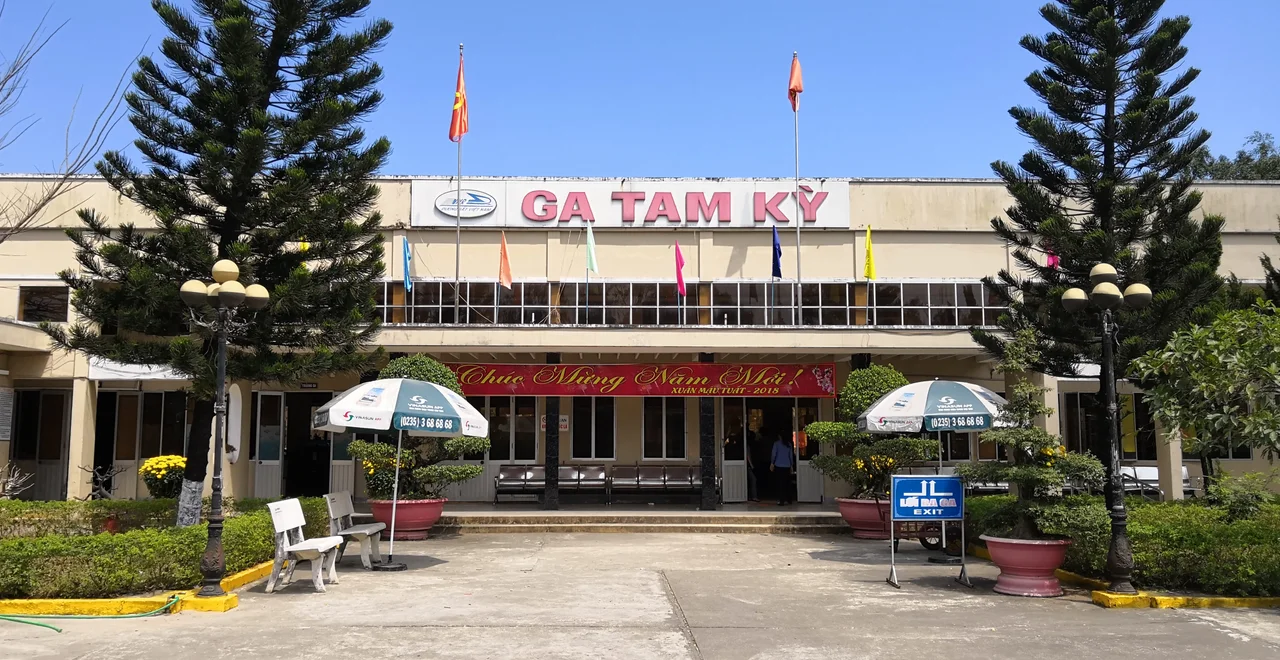
Tam Kỳ has an unusual shape for a Vietnamese city: it is linear, spreading along three major roads that run northwest to southeast rather than clustering around a central core. The effect is a city that feels elongated, never quite dense, always slightly more spread out than expected. Highway 1 passes through it on its way to everywhere else, and the presence of that road has shaped the city's economy and its relationship to the wider country. There are two major bus stations — one at each entrance and exit — and virtually every northbound or southbound bus either stops here or passes through. The reunification rail line also runs through, and Ga Tam Kỳ station is a real stop, served by trains running the full Hanoi–Ho Chi Minh City route. This is how a provincial capital sustains itself: not as a destination, but as a node in a network, a place where the country passes through and sometimes pauses.
Painted Walls, Fishing Village
About two kilometers north of the main intersection at Ha Thanh beach lies Lang Chai Tam Thanh — a fishing village where a Portuguese NGO helped transform the community by commissioning murals on the walls of village homes. The images range across styles and subjects: seascapes, abstract forms, portraits, local scenes. Walking through the village, the murals give each alley its own character, turning an otherwise unassuming coastal settlement into something that rewards exploration. The project reflects a broader pattern in Vietnam of using public art to support tourism and community identity simultaneously. Entrance to the village is free, and residents appreciate visitors who stop for a snack or pay for parking — small gestures that direct money into the community rather than past it. Nearby, Ha Thanh beach stretches long and largely uncrowded, with fresh seafood available at shoreside stalls.
The Beach Nobody Crowds
Tam Thanh beach, roughly 11 kilometers from the train station, offers something increasingly rare along Vietnam's developed coastline: room. The water is clear, the sand is pale, and on most mornings the only people present are locals — swimmers, fishermen returning from overnight trips, children. Getting there from the station is straightforward by taxi or xe om (the motorbike taxi that functions as the country's informal transit system), and buses numbered 7 and 8 make roughly hourly runs. The beach is not polished or resort-developed in the way of Da Nang's shoreline; it is a working coast that happens to have pleasant swimming. That combination — accessibility without the machinery of mass tourism — is becoming harder to find the further south you go from Da Nang.
Adjacent to Wilder Country
What Tam Kỳ lacks in historical monuments, it makes up for in proximity to the unusual. Phú Ninh Reservoir sits just 7 kilometers to the south — a large artificial lake surrounded by protected forest, 15 islands, and populations of rare primates. Tam Hai Island, about an hour southeast of the city, is described even by its admirers as underwhelming in its specific sights (a hill, an abandoned cemetery, a cement well), but genuinely pleasant in its unhurried atmosphere and friendly residents. The Chu Lai International Airport operates about 15 kilometers to the east, handling both domestic flights and the occasional charter. Hoi An is roughly an hour's drive north. Quảng Nam is a province that rewards lateral movement — the things worth seeing are rarely on the main road, but they're rarely far from it either.
From the Air
Tam Kỳ sits at approximately 15.57°N, 108.48°E on Vietnam's central coast, in Quảng Nam Province. The city's linear shape along three northwest-to-southeast roads is visible from altitude. Chu Lai International Airport (VVCA) lies approximately 15 km to the east and is the nearest commercial airport. Da Nang International Airport (VVDN) is roughly 70 km to the north. Phú Ninh Reservoir is visible 7 km to the south, a distinctive oval of water set against forested hills. The coastline and Tam Thanh beach are visible to the east-southeast. A viewing altitude of 5,000–7,000 feet offers a clear picture of the city's coastal position and its relationship to both the reservoir and the beach.
Nearby Stories
- Hoi An 14 km away
- 1968 Kham Duc C-130 Shootdown 19 km away
- Lý Sơn Island 24 km away
- Operation Utah 28 km away
- Battle of Nam Dong 43 km away
- Operation Hawthorne 53 km away
- Operation Masher / White Wing 85 km away
- Battle of the Paracel Islands 293 km away