
Hue–Da Nang Campaign
On March 5, 1975, North Vietnamese commanders launched what they expected to be the first phase of a two-year plan to reunify Vietnam. Twenty-eight days later, they held Huế and Da Nang — South Vietnam's two largest cities north of Saigon — along with every province of I Corps. It was not the war ending; it was the war accelerating beyond anyone's model of it. The Hue–Da Nang Campaign was the fastest large-scale military collapse in modern Southeast Asian history, and its speed came not only from North Vietnamese strength but from the disorder sown within South Vietnamese command by contradictory orders, a presidential directive to abandon the north, and the terror that spread among soldiers and civilians alike when they understood what was happening.
The Orders That Unraveled a Defense
Lieutenant General Ngô Quang Trưởng commanded what was considered South Vietnam's strongest corps. His three infantry divisions, the Marine Division, the Airborne Division, four Ranger groups, five armored squadrons, and 21 artillery battalions gave him, on paper, the resources to defend I Corps. On March 13, however, President Nguyễn Văn Thiệu summoned Trưởng to Saigon and ordered him to abandon most of the northern provinces and pull his forces to the coast. Trưởng protested, believing he could hold. He returned to his headquarters and began quietly reshuffling his forces rather than executing a full withdrawal, hoping to convince the president that the situation was still salvageable. Thiệu then changed his orders again on March 17, approving Trưởng's defensive plan. The next day, he reversed course once more, ordering Huế abandoned and Da Nang held. By the time Trưởng's subordinates understood what they were supposed to do, North Vietnamese units had already moved into the gaps.
The Fall of Huế
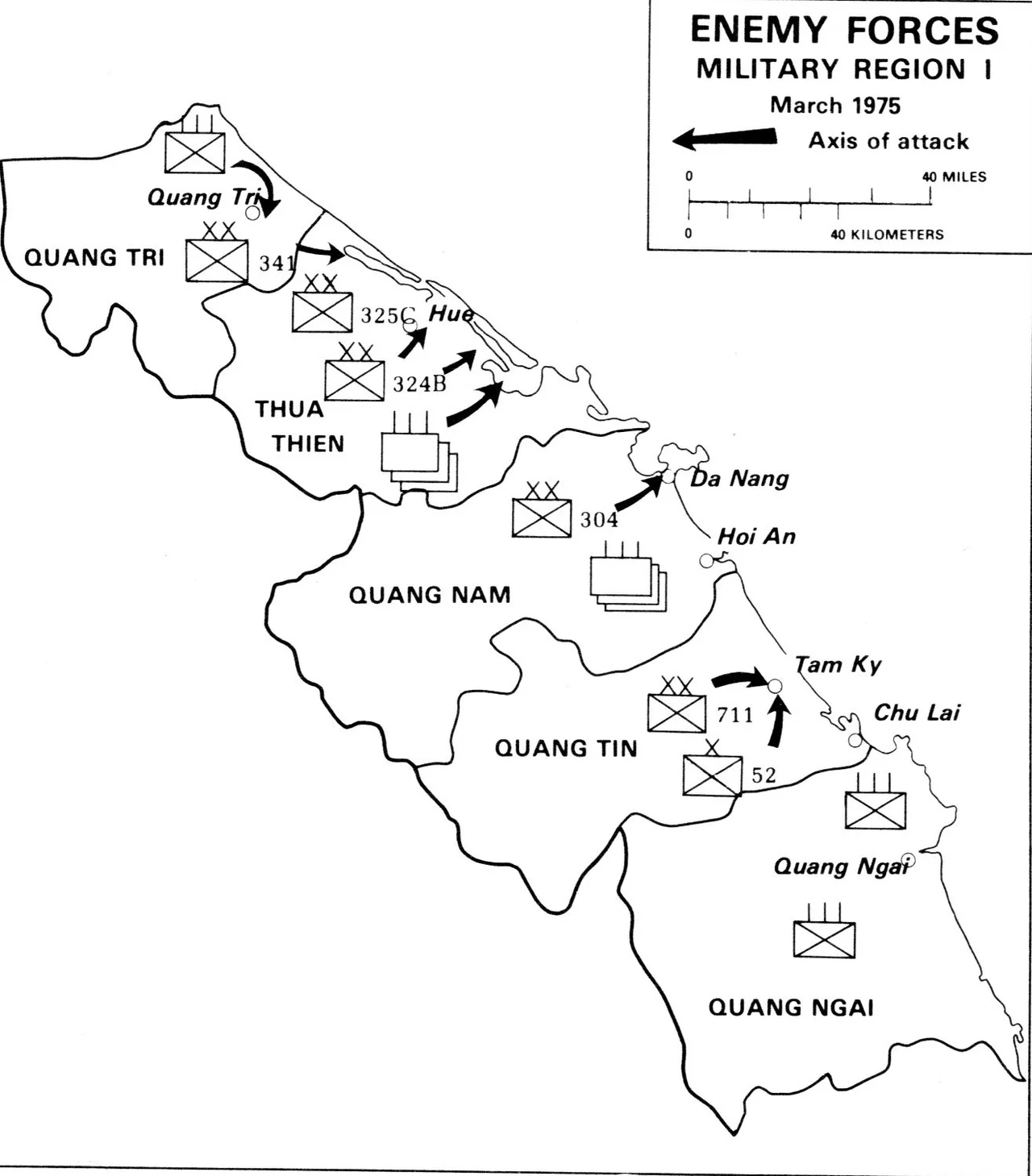
Huế — the former imperial capital, the city that had witnessed a brutal 26-day battle just seven years earlier during the 1968 Tet Offensive — fell on March 25, 1975. The North Vietnamese 324th and 325th Divisions attacked South Vietnamese positions on Highway 1 before dawn on March 21, while a special forces unit destroyed Thua Luu Bridge, severing the road connection between Huế and Da Nang. Thousands of civilians and soldiers trying to reach Da Nang found the road cut. The only escape route was a narrow coastal corridor to the east, where navy transport vessels waited offshore. The 147th Marine Brigade and the 15th Ranger Group — among South Vietnam's finest units — were destroyed trying to reach those ships. By the evening of March 25, North Vietnamese forces had secured every approach to Huế. According to Vietnamese official history, 58,722 South Vietnamese soldiers became prisoners of war when the city fell, along with approximately 14,000 government officials and employees. They left behind 140 tanks and armored vehicles.
Da Nang: A Million People and Collapsing Order
By 1975, Da Nang held close to a million inhabitants and was South Vietnam's second-largest city, its military infrastructure capable of sustaining an entire theater of war. Four seaports, two major airports, stockpiles of weapons and ammunition, the headquarters of I Corps — it should have been defensible. Instead, as Huế fell and refugees and retreating soldiers flooded south, military discipline in Da Nang began to disintegrate. On March 28, approximately 6,000 soldiers from the 2nd Infantry Division simply left the battlefield. The 3rd Infantry Division's retreat exposed the Marine Division's rear. The evacuation plan developed by the CIA and the U.S. Embassy — aircraft and ships, coordinated and orderly — collapsed into chaos as tens of thousands of people fought to board any vessel leaving the harbor. On the afternoon of March 29, soldiers of the North Vietnamese 2nd, 304th, 324th, and 325th Divisions entered the city. Da Nang had fallen in four days of fighting.
The Cost and Its Human Weight
The Hue–Da Nang Campaign cost South Vietnam two entire army corps. According to Vietnamese official history, more than 120,000 South Vietnamese soldiers were killed, wounded, or captured after the fall of Huế and Da Nang — with only about 16,000 managing to escape. Those numbers are not abstractions. They represent soldiers from farming families in Quảng Trị and Thừa Thiên, Marines who had fought at Khe Sanh and in the Tet Offensive, young men who had grown up knowing nothing but war. Many of those taken prisoner spent years in re-education camps. The civilians who fled — on foot, on bicycles, on overcrowded boats — faced their own losses: homes abandoned, families separated, lives upended by the speed of events no one had prepared them for. General Trưởng himself, having done what he could with contradictory orders and evaporating forces, was evacuated by helicopter as Da Nang fell. By April 2, South Vietnam had lost all territories north of Khánh Hòa Province. The end, which Hanoi had planned for 1976, would come in weeks.
From the Air
The Hue–Da Nang Campaign unfolded across the coastal plain and mountains of central Vietnam. Huế lies at 16.47°N, 107.59°E; Da Nang at 16.07°N, 108.22°E — roughly 100 km apart along the coast. From the air, the Hai Van Pass is the dramatic geographical boundary between the two cities: a mountain ridge running almost to the sea, with Highway 1 threading through it. The Perfume River winds through Huế below, and the wide Da Nang Bay opens to the south. Phu Bai International Airport (VVPB) serves Huế, 15 km south of the city center. Da Nang International Airport (VVDN) sits within the city itself, on the western edge of the bay — during March 1975 it was one of the last points held before the final collapse. Recommended viewing altitude 5,000–8,000 feet for the full coastal panorama.
Nearby Stories
- A Sầu Valley 1.5 km away
- Perfume River 13 km away
- Japanese Bridge 14 km away
- Sơn Trà Mountain 16 km away
- Bà Nà Hills 26 km away
- Quảng Trị Citadel 26 km away
- Saravan 95 km away
- Hainan Island Incident 349 km away