
Thạnh Mỹ Massacre
The village of Phú Thạnh was the kind of place that tried to stay alive in wartime by being useful to everyone who came through. Straddling Highway 1 about five kilometers north of Landing Zone Baldy, its residents included the families of South Vietnamese militiamen, government officials, and ordinary farmers who passed along information about guerrilla movements in the area. The Ba Ren Bridge crossed the highway just north of the village — a vital link in the supply line between LZ Baldy and Da Nang — and so the village was protected: a U.S. Marine squad lived there under the Combined Unit Pacification Program, alongside local Popular Force platoons and a Regional Force company whose mission was specifically to guard the bridge. Rumors had circulated for weeks that the Viet Cong intended to attack it. No one expected them to come for the village itself.
Before Dawn on 11 June
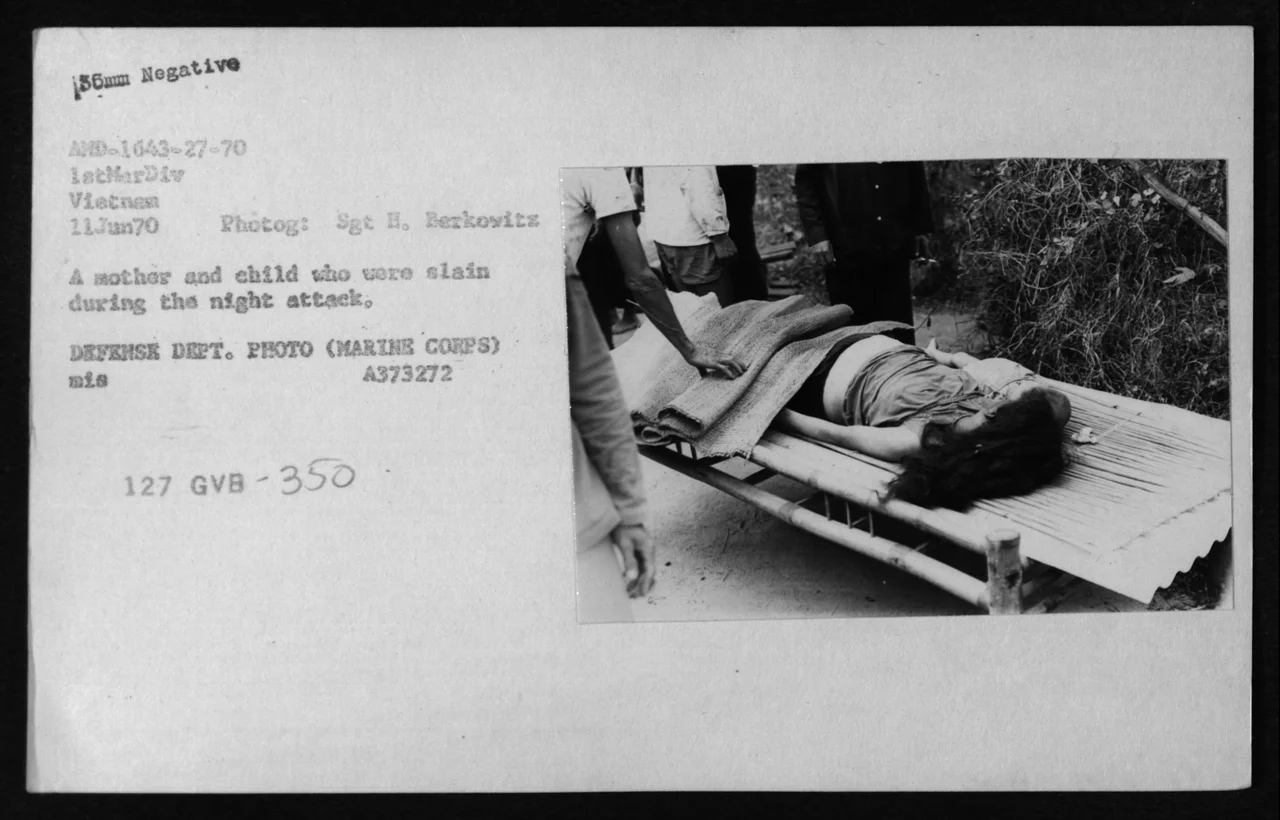
In the early hours of 11 June 1970, Viet Cong forces opened with a mortar barrage and moved in under the smoke. Sappers moved through the hamlet of Thạnh Mỹ, lighting houses on fire. Where residents had taken shelter — in bunkers, in rooms, wherever families huddled together against the noise — the attackers threw explosives in after them, or shot those who tried to flee. The U.S. Marines and South Vietnamese forces in and around the village engaged immediately, calling in artillery support. By 3:15 in the morning, the attackers began pulling back. The Marines reoccupied the village and began evacuating the wounded. What they found in the darkness was devastating: 156 houses destroyed, 35 more damaged. Four South Vietnamese militiamen had been killed, two wounded. Ten U.S. Marines were wounded. Among the civilian population — the families who lived in those houses, the people who had nothing to do with the Ba Ren Bridge — 74 were dead. Many of them were women and children. Another 60 were severely injured, and more than 100 others lightly wounded.
A Village That Chose a Side
Phú Thạnh's vulnerability came partly from the choice its residents had made. This was a pro-government village in contested territory — a place where people had aligned themselves with Saigon and the Americans, and where the presence of military forces made that alignment visible. The families of Regional Force and Popular Force soldiers lived here. A 22-member Revolutionary Development team worked in the village. A People's Self-Defense Force unit of 31 members provided a further layer of protection, though only eight of them had weapons. The village straddled a road that both sides needed. The Ba Ren Bridge was the kind of infrastructure that changed hands and mattered militarily. None of this made the civilian residents combatants. They were people who lived near a bridge, people whose husbands or sons were in the militia, people trying to stay alive through a war they did not start and could not end. The Viet Cong later claimed they had been trying to capture the bridge and that civilians had merely been caught in the crossfire. The evidence of the attack — the house fires, the explosives thrown into shelters — tells a different story about what the assault was.
The Weight of What Happened
The 74 people who died in Thạnh Mỹ on 11 June 1970 were not soldiers. They were villagers — people whose names were not entered into military records, whose individual lives have largely disappeared from the written history of the war. Some of them were children. Their deaths happened in the middle of a night, in a hamlet that appears in historical accounts mainly as a tactical location — its proximity to the Ba Ren Bridge more prominent in the records than its residents. Journalist William Broyles later wrote that the communist massacre of civilians at Huế and at Thạnh Mỹ had been "airbrushed" out of Vietnamese history — inconvenient evidence of atrocities committed by the side that eventually won. Whether or not that observation is complete, the people who died that night deserve to be remembered as what they were: civilians in a village, caught in a war that came for them while they slept.
Quảng Nam and the Long Shadow
Quảng Nam Province carried a particular weight during the Vietnam War. The Quế Sơn District, where Thạnh Mỹ hamlet stood, saw some of the sustained fighting in the war's middle years — Operation Colorado swept these same valleys in 1966, four years before the Thạnh Mỹ attack. Marine units from Da Nang rotated through these paddyfields season after season. By 1970, as the United States began withdrawing forces under Vietnamization, the Combined Unit Pacification Program that had stationed Marines in villages like Phú Thạnh was in its final phase. The Marines and South Vietnamese forces who responded to the attack that night, who evacuated the wounded and counted the dead, were themselves part of a war effort entering its long unwinding. The village of Phú Thạnh — now Bà Rén village in Quế Xuân 1 commune — is still there, along a highway that no longer carries military convoys, beside a bridge that no longer needs guarding by armed men through the night.
From the Air
Thạnh Mỹ hamlet stood near what is now Bà Rén village in Quảng Nam Province, centered around 15.818°N, 108.296°E, approximately 5 km north of the former Landing Zone Baldy. From altitude, Highway 1 is visible running through the coastal lowlands — the Ba Ren Bridge crossing is along this route, roughly 45 km south of Da Nang. Da Nang International Airport (VVDN) lies to the north-northeast; Tam Kỳ Airport (VVTK) is approximately 30 km to the south. The flat paddyfield terrain of the Quế Sơn coastal plain is distinctive from the air, with the mountains of the Trường Sơn range rising sharply to the west.
Nearby Stories
- Operation Lamar Plain 11 km away
- 1968 Kham Duc C-130 Shootdown 15 km away
- Hội An wreck 16 km away
- Lý Sơn Island 17 km away
- Bach Ma National Park 24 km away
- Battle of Nam Dong 51 km away
- Operation Masher / White Wing 134 km away
- Battle of the Paracel Islands 288 km away