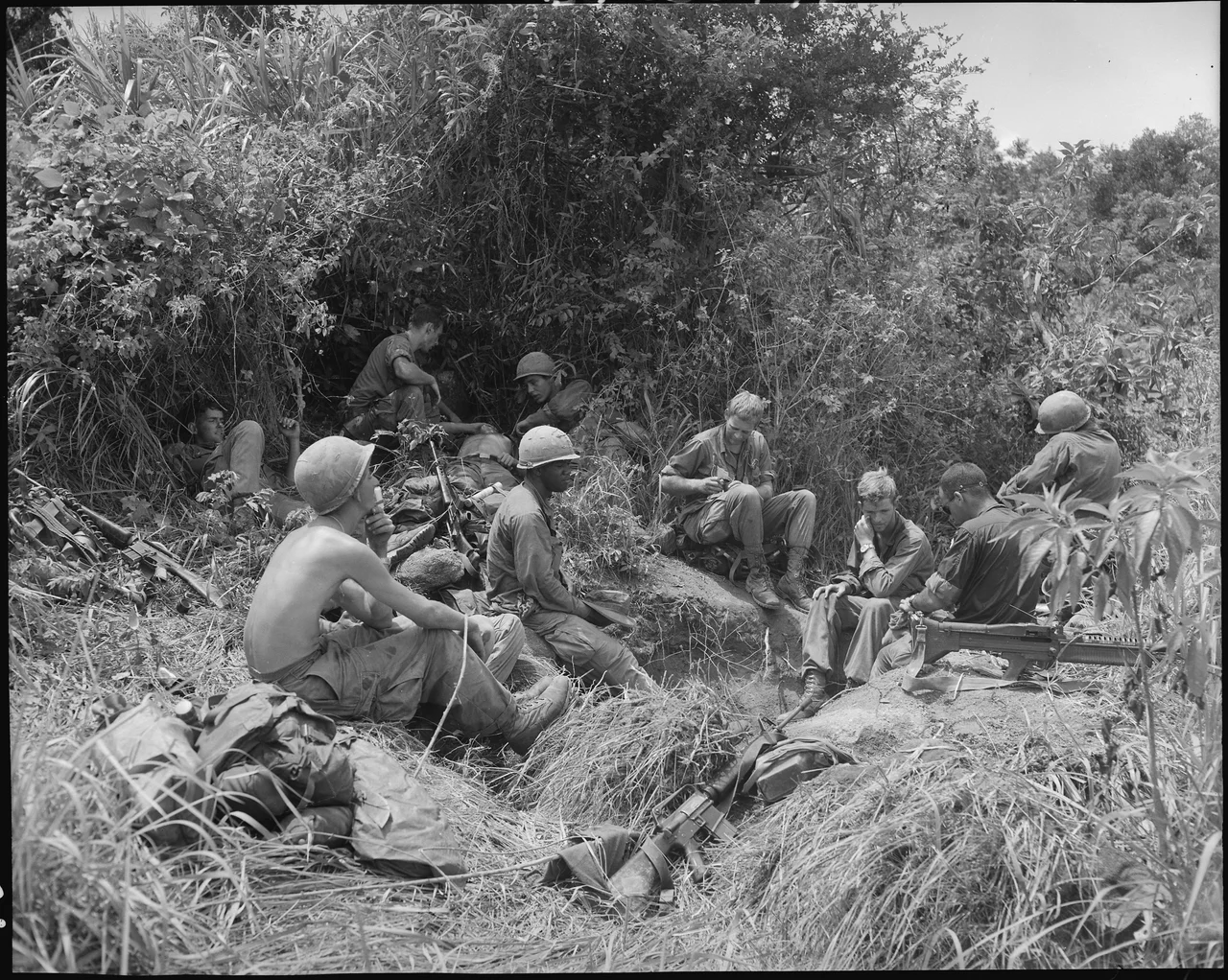
Operation Lamar Plain
The daily log of Operation Lamar Plain reads like a metronome of violence: an LOH engages two PAVN, killing one. A company-sized ambush erupts and nine Americans die. A reconnaissance team finds graves. Artillery is called in on sixty soldiers seen in the open. Then more graves. The summer of 1969 in Quảng Tín Province was not the war of dramatic pitched battles — it was the war of patrol-by-patrol attrition that defined Vietnam's most exhausting phase, and Lamar Plain captured that reality in full.
A Brigade Moves South
In May 1969, the 1st Brigade of the 101st Airborne Division — the legendary Screaming Eagles — was pulled from their normal operational area near Phu Bai and placed under the control of the 23rd Infantry Division, the Americal, with orders to relieve enemy pressure on Tam Kỳ, the provincial capital of Quảng Tín. The brigade brought three maneuver battalions, an artillery battalion, and an air cavalry troop built around light observation helicopters, the nimble little LOHs that became the eyes of the operation.
The terrain they were entering — river valleys, forested ridgelines, and scattered hamlets between the coast and the central highlands — was territory where People's Army of Vietnam (PAVN) and Viet Cong (VC) forces had operated for years. They knew the ground. They had built bunker networks, hospital complexes, and supply caches into it. The Americans were moving into a landscape already prepared for their arrival.
The Shape of the Fighting
For most of the ninety-day operation, the fighting came in fragments. An LOH crew spots movement and calls in artillery. A platoon walks into a bunker line and trades fire until dark. A B-52 Arc Light strike shakes the jungle at 4 a.m., and the troops air-assault in at first light for bomb damage assessment, finding craters and bodies and, sometimes, nothing at all.
The largest single engagement came on 8 July, when a brigade unit was ambushed by an estimated PAVN and VC company in the hills southwest of Tam Kỳ. The Americans fought back with small arms and automatic weapons fire while their commanders called in an AC-47 Spooky gunship — the old converted transport plane bristling with side-firing miniguns that could saturate a football field with fire — along with artillery and tactical air strikes. The PAVN withdrew after eleven hours, leaving two dead behind. Nine Americans died. The ratio tells the story of an enemy that could choose when to stand and when to slip away, and that summer, they mostly chose to slip away.
Small Things Found, Small Things Lost
Between the firefights were the finds: base camps built into ravines, hospital complexes with graves alongside, bunker systems that took days to fully search. On 18 July, Company B of the 1st Battalion, 501st Infantry discovered a base and hospital complex with fifteen graves nearby — the dead already buried by the people who had built this place. On 31 July, a large bunker complex yielded 42 detained Vietnamese and nine destroyed bunkers. Two 12.7mm heavy machine guns, the anti-aircraft weapons that had already downed or damaged several American helicopters, were captured on 7 August.
The helicopters took a steady toll throughout. LOHs were shot down and crash-landed with enough regularity that the aero-rifle platoons who went in to rescue them became their own recurring element of the operation. A Marine F-4C suffered mechanical failure over the area on 25 July; its crew ejected and was pulled out by cavalry helicopters. The air war and the ground war were inseparable.
The Final Count
The operation ended on 14 August 1969. By the official accounting, 116 Americans were killed and one was missing. The PAVN and VC lost 524 killed and 21 captured, along with 256 individual weapons and 62 crew-served weapons.
What those numbers cannot convey is the weight of a summer spent in this landscape — the daily ambushes, the helicopter crashes, the slow accumulation of names on casualty lists. Nor can they measure what the PAVN and VC forces endured over the same three months. The 1st Brigade withdrew by air to Camp Eagle in mid-August, leaving Quảng Tín Province to continue a war that would grind on for six more years. Among the Americans who served in these valleys was Specialist Four Santiago J. Erevia, who would be awarded the Medal of Honor for his actions during this operation — one of 24 veterans whose recognition, long delayed, finally came in 2014, 18 of whom were Hispanic American.
The Ground Now
The river valleys of what is now Quảng Nam Province have long since returned to agriculture and daily life. The Song Than and Song Vang river valleys that gave the operation's final phase its name are rice-farming country, mountain ridgelines shadowed by the Trường Sơn range to the west. The province's capital at Tam Kỳ, the city whose security the operation was designed to protect, is a modern Vietnamese city of more than 130,000 people. The bunker complexes and base camps are overgrown or gone. The graves — on both sides — are the most lasting legacy of a summer that cost so much and changed so little.
From the Air
Located at approximately 15.46°N, 108.36°E in Quảng Nam Province, central Vietnam. The operational area covered the river valleys and forested ridgelines west and southwest of Tam Kỳ city, roughly between the coast and the Trường Sơn Mountains. Viewing altitude of 5,000–8,000 feet provides good orientation to the valley systems. The nearest airfield is Chu Lai (VVCA), approximately 30 km to the southeast. Da Nang International Airport (VVDN) lies about 60 km to the north. The terrain mixes flat coastal agricultural land with rugged highland ridgelines — the transition zone where most of the fighting occurred.
Nearby Stories
- Indrapura (Champa) 8.3 km away
- Lý Sơn Island 14 km away
- 1968 Kham Duc C-130 Shootdown 16 km away
- Operation Hawthorne 34 km away
- Ngọc Linh 51 km away
- Battle of Nam Dong 59 km away
- Operation Masher / White Wing 65 km away
- Battle of the Paracel Islands 299 km away