.jpg)
Tomb of Gia Long
Empress Thừa Thiên died in 1814, four years before the man she had married would follow her. Emperor Gia Long — the ruler who had spent years in exile, survived the destruction of his family, fought his way back to power, and unified all of Vietnam under a single throne in 1802 — outlived her by eight years. When the mausoleum was first built, it was built for her. He joined her there in 1820. What began as one woman's resting place became a necropolis for a dynasty: the emperor, the empress, a second empress, his mother, his elder sister, and other members of the Nguyễn royal family, all gathered on the slopes of Thiên Thọ mount, twenty kilometers south of Huế.
The Emperor Who Built a Unified Vietnam
Gia Long's path to the mausoleum was anything but peaceful. Born Nguyễn Ánh in 1762, he was a member of the Nguyễn lords — the family that had ruled central and southern Vietnam for generations. The Tây Sơn rebellion of the 1770s destroyed that arrangement, killing much of his family and forcing him into exile. He spent years in the Mekong Delta, in Siam, and at sea, building alliances and military force before beginning the long campaign that ended in 1802 when he took Phú Xuân and declared himself emperor of a unified Vietnam from the northern border to the southern tip.
He renamed the capital Huế and renamed the country, and spent the next eighteen years constructing the institutions and architecture of a centralized state. The Imperial City he built within Huế remains the most visible monument to that project. The mausoleum on Thiên Thọ mount, begun for his empress in 1814, was the last great construction of his reign.
The Shape of the Mausoleum
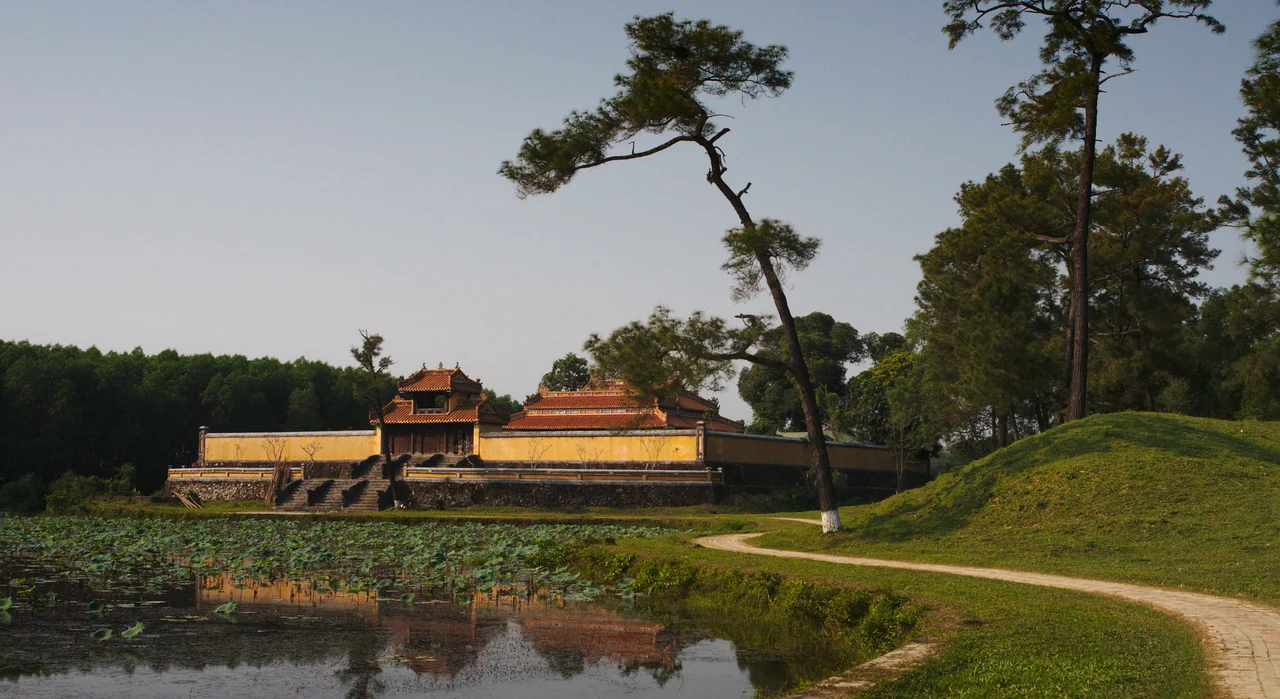
The Thiên Thọ Mausoleum is not a single tomb but a complex of tombs spread across two hillsides. At the center of the main complex sits the double-grave tomb of Gia Long and Empress Thừa Thiên, flanked by Minh Thanh Temple — the dedicated memorial temple for the imperial couple — to the right, and the emperor's stele monument to the left. All of this was built on the broad hill of Thiên Thọ mount.
On the adjacent foothills of Thuận Sơn mount lies a separate cluster: the tomb of Empress Thuận Thiên, Gia Long's second empress, and her dedicated memorial, the Gia Thanh Temple. Further tombs on the complex grounds hold the remains of Gia Long's mother — interred in the Thoại Thánh Tomb — and his elder sister, in the Hoàng Cô Tomb. The entire perimeter of the burial grounds extends to approximately 11,234 meters. The scale reflects both the dynasty's sense of its own importance and the wealth available to a newly unified Vietnamese state.
Stone Guardians on a Forest Hill
Photographs taken in 1898, within living memory of the mausoleum's construction, show the complex as a formal ceremonial space: stone elephants and stone guardians standing in rows along the approach paths, the main gate framed by trees, the hill rising behind. The style drew on Chinese imperial funerary traditions while incorporating Vietnamese elements — the same synthesis that shaped the Imperial City in Huế itself.
The stone figures that lined the paths to the burial chambers were a standard feature of imperial Vietnamese tombs: pairs of stone mandarins, stone horses, and stone elephants flanking the approach, their scale carefully calibrated to the rank of the person interred. For Gia Long, the largest and most elaborate of the Nguyễn royal tombs, the procession of stone figures was correspondingly grand. A bronze gate once guarded access to the coffin chambers. The stone coffins of Gia Long and Empress Thừa Thiên remain within.
Damaged but Not Gone
The mausoleum today is described as badly damaged, with several structures in deteriorated condition. The destruction came in stages across the twentieth century — war, neglect, the long period when heritage preservation was not a priority for a government focused on reconstruction and development. Some of what was lost can be read in comparison to the photographs from 1898: the formal avenues, the pristine ceremonial approaches, the careful maintenance that a royal court would have provided.
Yet the core of the complex survives. The double grave, the placement of the hillside temples, the basic relationship between the tombs and the landscape they occupy — these remain readable even in the site's current condition. Gia Long chose this location carefully, as Vietnamese emperors did, consulting geomantic principles about the orientation of hills, water, and wind. The Perfume River runs through the valley below. The mountains frame the view. Whatever the state of the individual structures, the mausoleum still sits exactly where it was built to sit, in a landscape that the emperor believed would sustain his dynasty in death as it had in life.
From the Air
The Tomb of Gia Long sits at 16.375°N, 107.596°E in the Hương Thọ commune, Hương Trà district, approximately 20 km south of central Huế. At 2,000–3,000 feet, the complex is set into forested hillsides in a valley south of the city; the Perfume River is visible winding through the landscape to the north. The site is substantially more isolated and wooded than the later royal tombs closer to Huế. Phú Bài International Airport (VVPB) is approximately 8 km to the northeast of the mausoleum. From the air, the forested hillsides and the geometric clearings of the tomb complex create a distinctive pattern against the surrounding vegetation.
Nearby Stories
- Battle of Fire Support Base Ripcord 4 km away
- Sơn Trà Mountain 5.8 km away
- Quảng Trị Citadel 7.3 km away
- Battle of Nam Dong 10 km away
- Hội An wreck 56 km away
- Battle of Cua Viet 65 km away
- Saravan 100 km away
- Hainan Island Incident 342 km away