
First Battle of Quảng Trị
They came at midday on March 30th, 1972, with a ferocity that shook the ground. North Vietnamese artillery opened a preparatory barrage across Quảng Trị Province, and then the tanks came — T-54s rolling south through the DMZ in mass formation, backed by three full infantry divisions. What followed in the next few weeks would become the largest conventional military operation of the entire Vietnam War, and it ended with North Vietnamese forces holding the provincial capital for the first time in the conflict's history.
A Province on the Edge
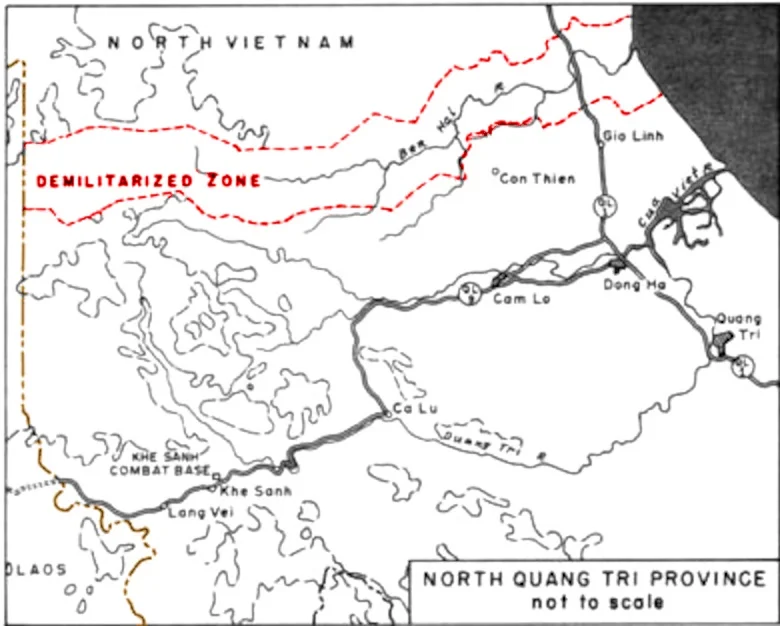
Quảng Trị was always the most exposed province in South Vietnam — a narrow coastal strip pressed between the DMZ to the north, the Lao border to the west, and the sea to the east. When American forces began withdrawing under Nixon's Vietnamization program, the ARVN 3rd Division was tasked with defending this exposed frontier. The division was newly formed, its 56th and 57th Regiments recently activated and deployed across a chain of fire support bases and strongpoints from the coast to the mountains. Brigadier General Vũ Văn Giai commanded from Ái Tử Combat Base. The critical anchor of the western defense line was Camp Carroll, positioned on Route 9, the main road running toward the Lao border. It was these men — many of them inexperienced, stretched thin across difficult terrain — who would face what was coming.
The Easter Offensive Unleashed
General Văn Tiến Dũng had prepared three divisions for the assault: the PAVN 304th, 308th, and 324B. Their opening artillery barrage was devastatingly accurate, the 130mm guns outranging anything the ARVN defenders could bring to bear. The psychological shock was as powerful as the physical destruction. South Vietnamese soldiers who had held positions for months found themselves under fire of an intensity they had never experienced — and many began to break. Firebase after firebase fell in the first days. On the morning of April 1st, the 4th Vietnamese Marine Corps Battalion abandoned Firebase Sarge and pulled back to Mai Loc Camp. The cascade had begun. Camp Carroll, the lynchpin of the entire defense line, fell on April 2nd when its commander, Colonel Phạm Văn Đính, made the decision to surrender rather than continue a defense he believed hopeless. The white flag over Camp Carroll sent a shockwave through the entire defensive system.
The Fall of the Province
With the western anchors gone, the ARVN lines collapsed northward and then southward. By late April, North Vietnamese forces were pressing toward the provincial capital, Quảng Trị town. The ARVN 3rd Division, already battered and disorganized, could not hold. On May 1st — the same day the PAVN 308th Division entered the city — General Giai ordered a withdrawal that quickly became a rout. Soldiers and civilians alike streamed south on Highway 1, a column that came under artillery fire and became known in Vietnamese memory as "the Road of Horror" — Đại Lộ Kinh Hoàng. Hundreds of civilians died on that road, caught between an advancing army and their own desire to reach safety. The province had fallen. It was the first time North Vietnam had captured and held an entire province of the South.
The Human Cost of Collapse
The military defeat was also a human catastrophe for the people of Quảng Trị. The province had a particularly dense concentration of Catholic communities, many of them deeply anti-communist — families with generations of roots in the land they were now abandoning. A survey of Vietnamese refugees conducted after 1975 estimated that 41 percent of those who fled the province did so in fear of communist reprisals, while 37 percent fled the direct threat of continued fighting, shelling, and bombing. Others left because of their connection to the ARVN — a husband, a father, a brother who had served. They left behind property, graves, everything that had defined their lives. The North Vietnamese administration that replaced the southern government imposed collective farming and strict political controls on those who remained. Many families were permanently scattered.
The Stage Is Set
The fall of Quảng Trị was not the end of the story — it was the hinge on which the rest of 1972 turned. South Vietnamese General Ngô Quang Trưởng was already drawing up the plan that would become Operation Lam Son 72, the counteroffensive to reclaim the province. The Second Battle of Quảng Trị, which would last from June 28th to September 16th, would be even more brutal than the first — and at its center would be a 19th-century citadel on the bank of the Thạch Hãn River, besieged for 81 days in what Vietnamese on both sides still call one of the most devastating battles of the entire war. The province was retaken, though the northern reaches remained under PAVN control until 1975. For the people who lived through it — soldiers and civilians alike — Quảng Trị 1972 was the kind of year a generation carries to its grave.
From the Air
The battle was fought across Quảng Trị Province, centered around 16.73°N, 106.97°E. Camp Carroll lies roughly 30 km west of the coast along Route 9. The provincial capital, Quảng Trị town, sits near the Thạch Hãn River at approximately 16.75°N, 107.19°E. From altitude, the province's vulnerability is apparent: a narrow coastal plain flanked by mountains on the west and the open DMZ to the north. Highway 1 runs the full length of the province along the coast — the road that became "Đại Lộ Kinh Hoàng" during the collapse. Nearest airport: Phú Bài International (VVPB), Huế, approximately 60 km south. Best viewed at 8,000–12,000 feet to grasp the full geographic context of the province.
Nearby Stories
- Diệu Đế Temple 5.2 km away
- Battle of Fire Support Base Ripcord 17 km away
- Tam Giang–Cau Hai Lagoon 26 km away
- Lệ Thủy 32 km away
- Ban Karai Pass: The Gap They Could Not Close 46 km away
- Grès supérieurs Formation 61 km away
- Southern Laos 63 km away
- Bach Long Vi Island 343 km away