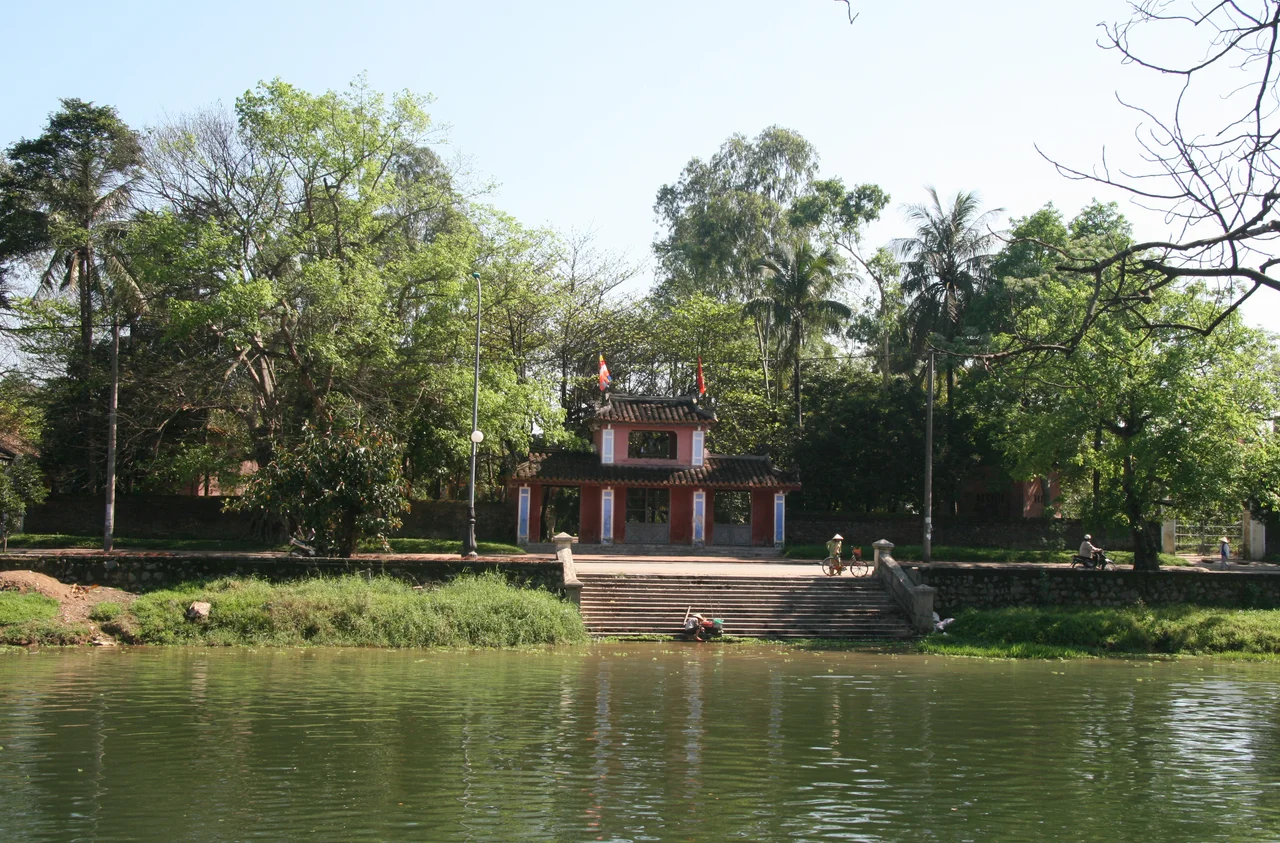

Diệu Đế Temple
The name means "Four Noble Truths" — Tứ Diệu Đế in Vietnamese — and Emperor Thiệu Trị chose it deliberately when he ordered this pagoda built in the mid-19th century. He also declared it a national pagoda, placing it under direct imperial patronage alongside only two other temples in Huế. For a century the temple stood peacefully on the bank of the Dong Ba canal, its four low towers framing a Buddha flanked by bodhisattvas. Then, shortly after midnight on 21 August 1963, it became a place where ordinary people chose to stand between armed soldiers and a place of worship — and paid for that choice with their lives.
Stone, Bell, and Canal
Diệu Đế Pagoda's entrance faces southwest across the Dong Ba canal, with the Dong Ba gate of the Citadel of Huế directly opposite. The symmetry was intentional: a national pagoda sitting in deliberate conversation with the imperial headquarters. Emperor Gia Long had built the citadel at the start of the 19th century; Thiệu Trị completed the pagoda a generation later, giving the dynasty a spiritual counterweight to its political heart.
The pagoda's most recognizable feature is its four low towers — one on each side of the main gate, two flanking the sanctuary. Two contain bells whose tones carry across the canal; the others hold a bell and a stele respectively. Inside the main ceremonial hall, a statue of Gautama Buddha sits flanked by the Bodhisattvas Samantabhadra and Manjushri. The arrangement is traditional, but the scale is intimate, built for daily devotion rather than grand ceremony.
The Night of the Barbed Wire
In August 1963, South Vietnam was in crisis. For months, the government of President Ngô Đình Diệm had moved against Buddhist institutions — banning flags, arresting monks, closing pagodas. The Buddhist crisis had been building since May. Then, shortly after midnight on 21 August, Diệm's brother Ngô Đình Nhu unleashed his Special Forces in coordinated raids on pagodas across the country.
At Diệu Đế, troops attempted to string a barbed wire barricade across the bridge leading to the pagoda. A crowd of laypeople and protesters tore it down with their bare hands. What followed was a five-hour battle: people armed with rocks, sticks, and fists against soldiers with rifles and tear gas — grenades thrown at the crowd, grenades thrown back. By dawn, armored cars drove through the crowd to seize the bridge. An estimated thirty people died defending it. Two hundred more were wounded. Ten truckloads of people were taken to jail, and roughly five hundred were arrested across the city. The full number of dead and disappeared was never established; estimates reach several hundred.
A Temple as Focal Point
After Diệm's assassination in November 1963, Diệu Đế did not return to quiet obscurity. The temple became a gathering place for anti-American and anti-war protests by Buddhist monks and students as the Vietnam War deepened. The same geography that had made it a flashpoint in 1963 — its visibility, its canal-side position facing the old imperial center, its status as a nationally recognized pagoda — made it a natural focal point for dissent.
In 1966, during a period of turbulent protests, the temple was stormed again. This time it was police and military forces under General Tôn Thất Đính, acting on orders from Prime Minister Nguyễn Cao Kỳ. Monks, supporters, and student protesters were arrested. The temple had twice, within three years, been the site where the state turned force against the people it claimed to govern.
What the Four Towers Hold
Today Diệu Đế still stands on the Dong Ba canal, its four towers intact, its gates facing the old Citadel across the water. Visitors who come for the architecture — the graceful bell towers, the ceremonial hall, the traditional arrangement of statues — are standing in a space that has held both prayer and resistance.
The temple's dual history is not a contradiction. In Vietnam's 20th century, Buddhist institutions were repeatedly the spaces where civil society organized, where people who had no other public forum gathered to insist on their dignity. Diệu Đế was a national pagoda not only in the imperial sense — designated by an emperor — but in a deeper sense: a place where people came to defend something they considered worth defending, at considerable cost to themselves.
From the Air
Diệu Đế Temple sits at 16.4779°N, 107.5875°E on the south bank of the Dong Ba canal in central Huế. At 2,000–3,000 feet, the Perfume River (Hương Giang) is clearly visible running east–west through the city, with the walled Citadel of Huế visible on its north bank. The pagoda's four characteristic towers are visible near the Dong Ba bridge. Nearest airport: Phú Bài International (VVPB), approximately 12 km south-southeast. Da Nang International (VVDN) lies roughly 90 km to the southeast.
Nearby Stories
- Battle of Fire Support Base Ripcord 4 km away
- Sơn Trà Mountain 5.8 km away
- Quảng Trị Citadel 7.3 km away
- Battle of Nam Dong 10 km away
- Hội An wreck 56 km away
- Battle of Cua Viet 65 km away
- Saravan 100 km away
- Hainan Island Incident 342 km away