.jpg)
Operation Quyet Thang 202
General Do Cao Tri spent weeks designing the plan for Chiến dịch Quyết Thắng 202 — 'Operation Sure Win 202' — and took extraordinary precautions to keep it secret. Deception measures were put in place. Troop movements were disguised. The Viet Cong stronghold at Do Xa, deep in the highlands on the northern border of II Corps, would be hit from multiple directions simultaneously by a force of five thousand soldiers, supported by U.S. Army and Marine Corps helicopters. The plan was sound. The secrecy, it turned out, was not.
The Do Xa Stronghold
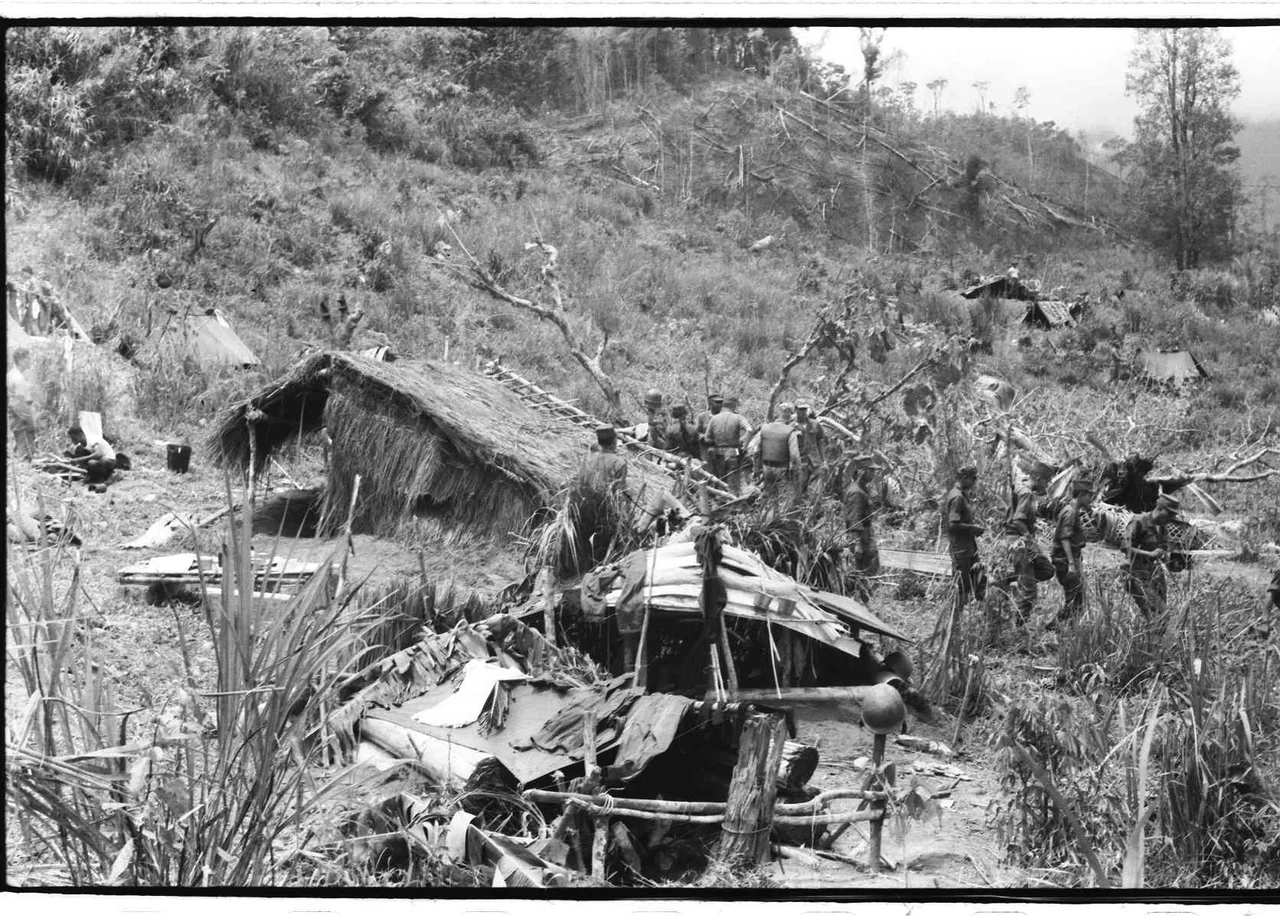
Do Xa was not a single location but a concept — a network of bases, tunnels, caches, and support infrastructure that the Viet Cong had built in the remote mountains straddling Quảng Ngãi and Kon Tum Provinces. The terrain protected it as effectively as any fortification: forested ridgelines, narrow valleys, limited approach routes. By 1964, early in the American advisory phase of the war, it had become a significant problem. It served as a rear area, a training ground, and a logistics hub for VC operations across II Corps. General Tri's plan to clear it was among the most ambitious operations attempted by South Vietnamese forces up to that point, bringing together airborne, ranger, and infantry battalions along with the Vietnamese 77th Special Forces Group — supported by six U.S. Army helicopter companies and a Marine Corps helicopter squadron, HMM-364.
The Day the Landings Began
On the morning of April 27th, Republic of Vietnam Air Force A-1 Skyraiders struck both designated landing zones ahead of the assault. Then Captain John W. Woodmansee's UH-1B gunships went in to reconnoiter — and ran straight into Viet Cong machine gun fire at Landing Zone Bravo. The gunships engaged until they exhausted their ammunition, returned to rearm, and the airstrikes resumed. When the transport helicopters finally began landing at 12:25, the Viet Cong were still firing. Fifteen of the nineteen Marine UH-34s were hit that day; by nightfall only eleven helicopters remained airworthy between the Marines and the South Vietnamese. At Landing Zone Alpha, to the west, conditions were no better: a narrow valley, VC gunners positioned on the overlooking hills, and a fratricide incident in which an Army gunship opened fire on South Vietnamese troops by mistake, killing 14 and wounding 21 — lives lost to the chaos of a battle that had not gone as planned.
Intelligence That Arrived Before the Soldiers
What went wrong with the secrecy? Prisoners captured in the operation later revealed that the Viet Cong had received several days' warning before the assault began. How the information leaked was never fully established. What is clear is the particular irony: Tri's security precautions had been so stringent that they backfired on his own side. ARVN troop commanders received just 48 hours' notice before deployment, leaving insufficient time for preparation. The enemy, meanwhile, had days to prepare their positions. By the time the helicopters came in low over the landing zones on April 27th, VC gunners were waiting with their weapons pre-sighted. The elaborate planning that was supposed to produce a decisive advantage had been rendered partly academic.
A Limited Result in a Long War
The main phase of Operation Quyet Thang 202 concluded on May 27th when the regular ARVN units withdrew from Do Xa. The third phase — a planned six-month Special Forces harassment campaign — was cut short to two weeks. The final accounting was sobering: 53 Viet Cong killed, six wounded, six captured, and one who came over under the Chieu Hoi amnesty program. Against that, the Allies had lost one aircraft and five helicopters destroyed, with 22 South Vietnamese soldiers killed and 91 wounded, plus two Americans wounded. The Do Xa stronghold remained largely intact. This kind of result — costly effort, limited territorial gain, an enemy that dispersed and returned — became a recurring pattern of the early ground war. The highlands were vast, the Viet Cong patient, and operations that looked decisive on a planning map often looked different in the after-action reports.
From the Air
Operation Quyet Thang 202 was centered on the Do Xa area at approximately 15.177°N, 108.078°E in the mountains between Quảng Ngãi and Kon Tum Provinces, Vietnam. The operational area spans rugged highland terrain with elevations ranging from valley floors around 300 metres to ridgelines above 1,200 metres. Landing Zone Bravo was located approximately 30 miles west of Quảng Ngãi Airfield (VVQN); Landing Zone Alpha was a further 8 miles southwest. Quảng Ngãi Airfield (VVQN) served as the primary staging base for the Marine helicopter operations. Đà Nẵng International (VVDN) lies approximately 100 km to the north. The terrain in the Do Xa region is heavily forested, with narrow valleys that restrict approach and departure headings — the same geography that made it a valuable VC stronghold. Afternoon convective activity builds reliably in the dry season; monsoon-season visibility is frequently poor in mountain valleys.
Nearby Stories
- Operation Utah 8.9 km away
- War of the Flags 16 km away
- Dong Ampham National Biodiversity Conservation Area 20 km away
- Operation Hawthorne 26 km away
- Chàm Islands 54 km away
- Operation Masher / White Wing 62 km away
- Virachey National Park 93 km away
- A Sầu Valley 96 km away