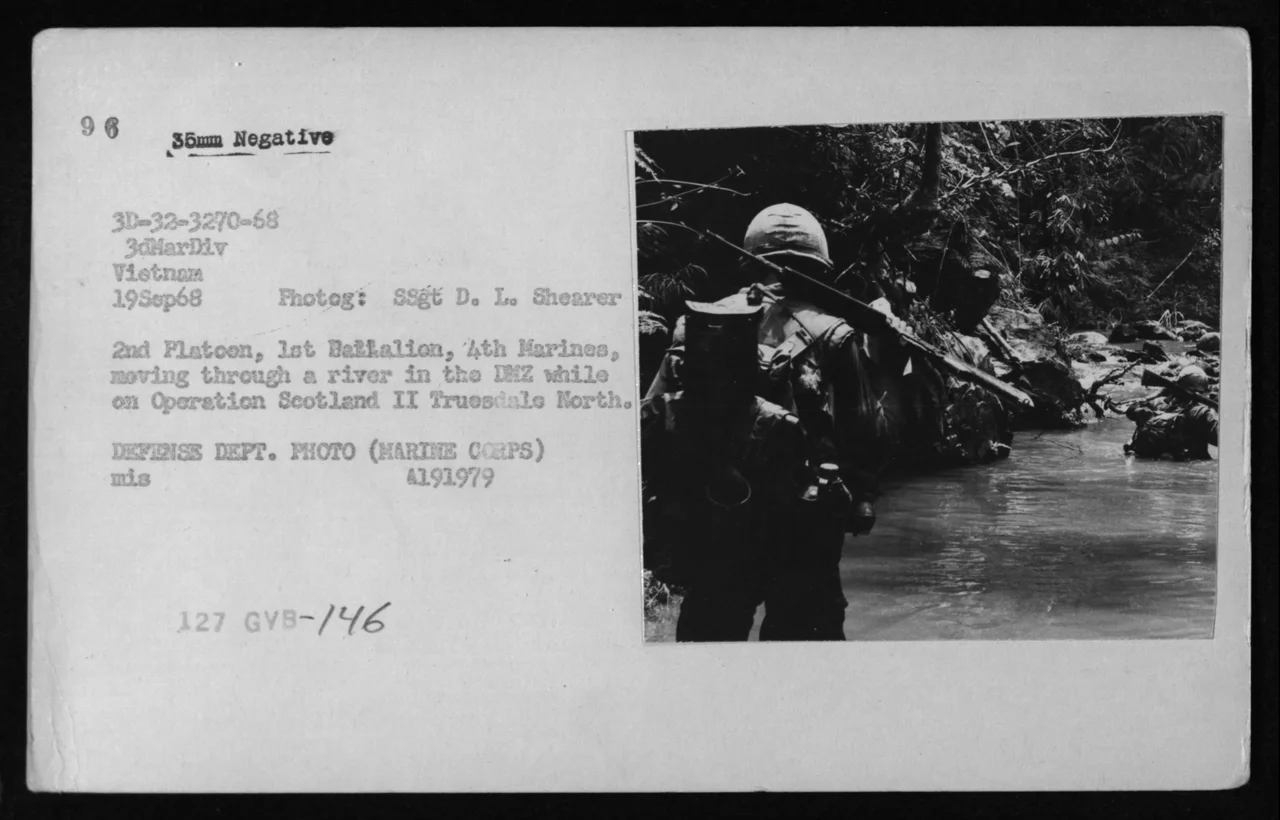

Operation Scotland II
Operation Pegasus ended the siege of Khe Sanh on April 14, 1968. The 1st Cavalry Division had fought its way up Route 9, broken through the North Vietnamese encirclement, and the 77-day ordeal that had transfixed American television audiences was officially over. The next morning at 08:00, the 3rd Marine Division resumed control of the combat base, and Operation Scotland II began. The Marines were not celebrating. They were heading back into the hills.
Task Force Glick
Major General Rathvon M. Tompkins, commanding the 3rd Marine Division, sent his deputy commander, Brigadier General Jacob E. Glick, to Khe Sanh to organize the forces assembling there. What Glick found was a patchwork of units: the 1st Marine Regiment was arriving to relieve the exhausted 26th Marines, the 1st Battalion, 9th Marines was in place, and elements of the 2nd Brigade, 1st Cavalry Division were still present from the relief operation. This combined force was designated Task Force Glick.
The tactical picture was spread across the highland terrain. The Task Force headquarters and 2nd Battalion, 1st Marines occupied the base itself. The 1st Battalion, 1st Marines fanned out onto the surrounding hilltops — Hills 558, 861, 881 South, and 950 — the same high ground that had been fought over repeatedly since 1967. The 2nd Battalion, 3rd Marines provided security along Route 9. The 3rd Battalion, 4th Marines deployed to Hill 689. It was a substantial force, and the PAVN, it would quickly become clear, was still there.
The Ambush at Hill 689
One day after Scotland II began, on April 16, Company A of the 1st Battalion, 9th Marines set out on patrol southwest of Hill 689. The terrain was typical of the Khe Sanh highlands: dense vegetation, difficult visibility, narrow trails through jungle that concealed almost everything. PAVN soldiers were waiting in bunkers dug into the hillside, camouflaged and hidden. The ambush was thorough.
Two more companies from 1st Battalion, 9th Marines were sent to help. They became caught in the same complex, unable to disengage until the early morning of April 17. When the fighting was over, 38 Marines and three Navy Corpsmen had been killed; three more Marines were missing and 32 were wounded. The battalion commander, Lieutenant Colonel John Cahill, was relieved of command. The Marines withdrew to evacuate their dead and wounded, then returned with air and artillery strikes before going in again — and Company H, attacking from the north, eventually forced the PAVN to pull back, at a further cost of 13 Marines dead.
Through the Long Months
The pattern of Scotland II was months of grinding patrol operations punctuated by violent contact. The PAVN generally avoided pitched battles when they could, content to inflict casualties through ambushes and harassment, then withdraw before American firepower could be fully brought to bear. Marines swept ridgelines and valleys, discovering bunker complexes and supply caches but rarely achieving the decisive engagement the operations were designed to force.
In January 1969, a large bunker complex was found north of Firebase Neville, indicating PAVN preparation for renewed operations. On February 1, the 3rd Reconnaissance Battalion and 2nd Battalion, 4th Marines swept the southern DMZ north of Neville, uncovering more caches. The intelligence picture suggested something was building — but the shape of it remained unclear.
It came on the foggy morning of February 25. Two hundred sappers from the PAVN 246th Regiment hit Firebase Neville before dawn, killing 12 Marines and two Navy Corpsmen. Simultaneously, the PAVN 27th Regiment struck Firebase Russell, 10 kilometers to the east, killing 29 Marines and Corpsmen. In a single morning, 43 American servicemen died across two firebases in the hills above Khe Sanh.
What Control Looked Like
Operation Scotland II concluded on February 28, 1969 — ten and a half months after it began. In early April, Major General Raymond G. Davis, the outgoing 3rd Marine Division commander, told reporters that "we totally control Quảng Trị Province." The statement reflected the military reality of the moment: no PAVN force held any significant ground, no fixed positions remained in their hands.
But control, in this war, was a complicated thing to claim. The Marines had fought through two seasons of operations in the same hills, over the same terrain, against an adversary that absorbed losses and returned. The cumulative cost was paid by the young men who had climbed those ridges — American Marines, Navy Corpsmen, and the North Vietnamese soldiers fighting on the other side — people with names and families and lives they had left behind. The hills are still there, still covered in jungle. The firebases have vanished into the vegetation.
From the Air
Operation Scotland II's area of operations is centered on the Khe Sanh plateau at approximately 16.579°N, 106.753°E, with Firebase Neville to the southeast and Firebase Russell further east along the Route 9 corridor. From 5,000–8,000 feet, the plateau and surrounding ridgelines are clearly visible, with the hilltop outpost positions rising above the general terrain. The old Khe Sanh airstrip serves as the primary ground landmark. Dong Hoi Airport (VDH) is approximately 70km to the northeast. The DMZ is visible to the north, roughly 15–20km distant. Morning fog frequently fills the valleys between ridges, sometimes leaving only the hilltops visible — the view the Marines in their outposts would have recognized.
Nearby Stories
- Battle of Signal Hill (Vietnam) 5.4 km away
- DMZ Campaign (1969–1971) 7.5 km away
- Southern Laos 22 km away
- Grès supérieurs Formation 23 km away
- Hoằng Phúc Temple 34 km away
- Battle of Hamburger Hill 52 km away
- National Route 9 (Vietnam) 54 km away
- Bach Long Vi Island 366 km away