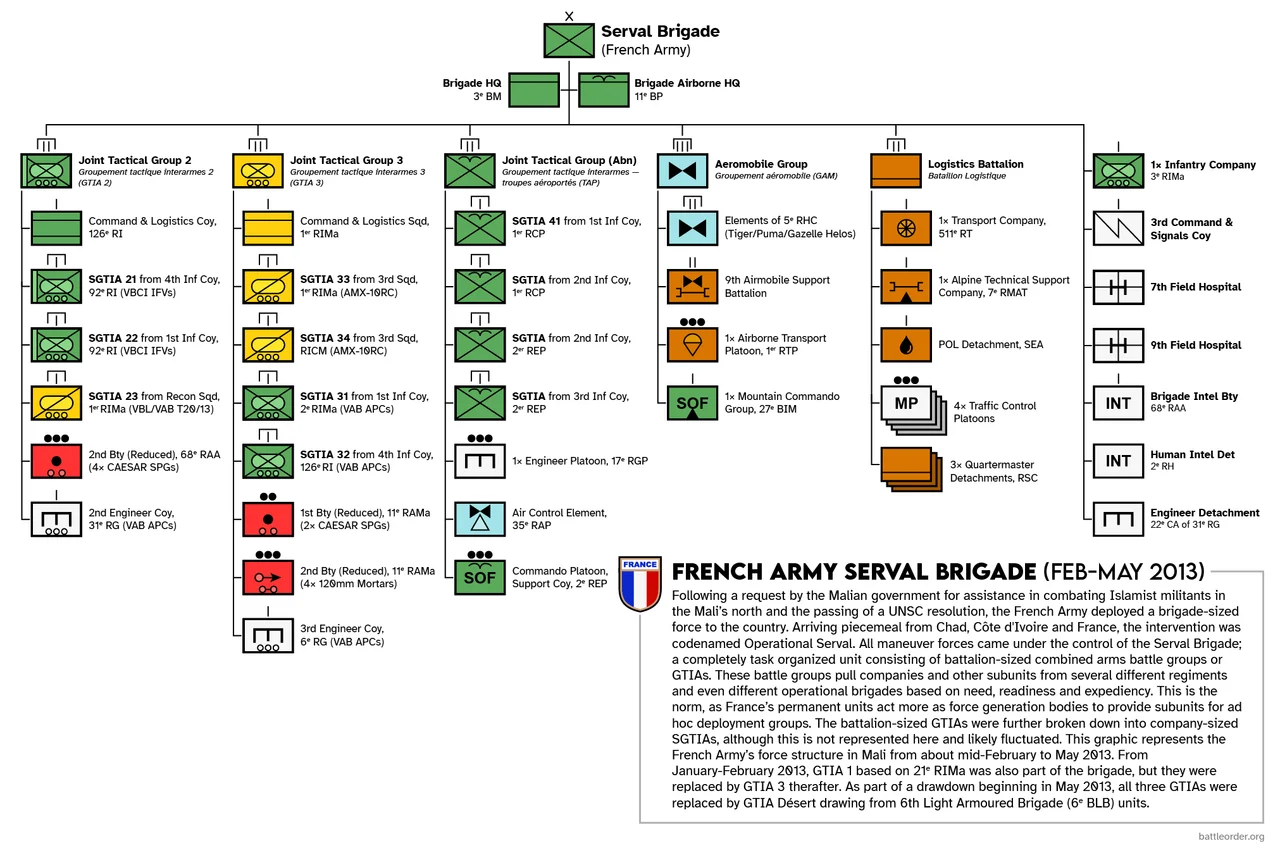

Operation Serval
On the morning of 11 January 2013, the question facing Mali was simple and terrible: would the state survive the month. Armed Islamist groups that already held the entire north had pushed south and seized the strategic town of Konna, opening the road toward Bamako. The Malian president, fearing his army could not hold, asked France for help. The intervention that followed was named Operation Serval, after a small, fast desert wildcat, and within weeks it would reach Gao and the other towns of the Niger Bend.
A Country at the Brink
The crisis had been building for a year. In early 2012, a flood of weapons from the collapsed Libyan state had armed a Tuareg rebellion that declared northern Mali independent as Azawad. But the secular rebels were soon pushed aside by harder forces, the Islamist groups Ansar Dine and the Movement for Oneness and Jihad in West Africa, who imposed a severe rule across the region. The people of Gao, Timbuktu, and Kidal lived under that authority for months, and it was their towns, their homes, and their futures that hung in the balance when the fighters turned south in January 2013.
The First Casualty
The operation opened in the air. On that first day, French helicopters struck a rebel column near Sevare, and the cost of the intervention was clear within hours. Lieutenant Damien Boiteux, piloting a Gazelle helicopter, was hit by small-arms fire. His co-pilot managed to fly the damaged aircraft back, but Boiteux died of his wounds, the first French soldier killed in the campaign. Over the months that followed, more would die, in the fighting around Gao, in the brutal mountain battles of the Adrar des Ifoghas near the Algerian border, and to roadside bombs. They were not statistics. Each was a name carried home.
Retaking the River Towns
The advance was rapid. French airstrikes blunted the rebel push, and a ground offensive moved north through January. Konna was recovered with Malian forces on the 18th. On 26 January, French troops took the airport at Gao and seized the Wabary bridge over the Niger, then assaulted the town itself with air and helicopter support; the Islamist fighters who had melted into the population were driven out. Timbuktu followed, and on 30 January, Kidal, the last major town held by the militants, was taken without resistance. Roughly half of the estimated two thousand fighters were killed or captured. But the victory was never clean. Suicide bombings struck Gao and Kidal in the weeks after, and soldiers and civilians alike kept dying in a war that the capture of the towns did not end.
What Came After
Operation Serval formally ended on 15 July 2014 and gave way to Operation Barkhane, a broader and longer counter-insurgency effort across the Sahel, an acknowledgment that the underlying conflict had not been resolved. A 2013 poll found overwhelming support for the intervention among residents of Bamako, and many Malians credited it with saving the state. Yet the years that followed brought continued insurgency, fragile politics, and further violence, including the 2017 suicide bombing near Gao that killed 77 people. Operation Serval is best understood not as a tidy triumph but as one urgent chapter in a long and unfinished struggle, fought across the towns and rivers of a country whose people have borne its weight far longer than any foreign army.
From the Air
Operation Serval's key actions ran along the Niger Bend in Mali, with Gao at roughly 16.27 N, 0.05 W a central objective; the capture of the city's airport and the Wabary bridge over the Niger on 26 January 2013 was a turning point. From altitude the river, the bridge, and the surrounding Sahel orient the geography of the campaign. Nearest airport is Gao International (GAGO). Other major points, Konna, Timbuktu, and Kidal, lie along and beyond the river to the west and northeast.
Nearby Stories
- Askia Daoud 15 km away
- Agacher Strip War 124 km away
- Mount Hombori 132 km away
- Hombori 152 km away
- Liptako 197 km away
- Pendjari National Park 564 km away
- Oti-Keran National Park 675 km away
- Tin Hinan Tomb 850 km away