.jpg)
Operation Shufly
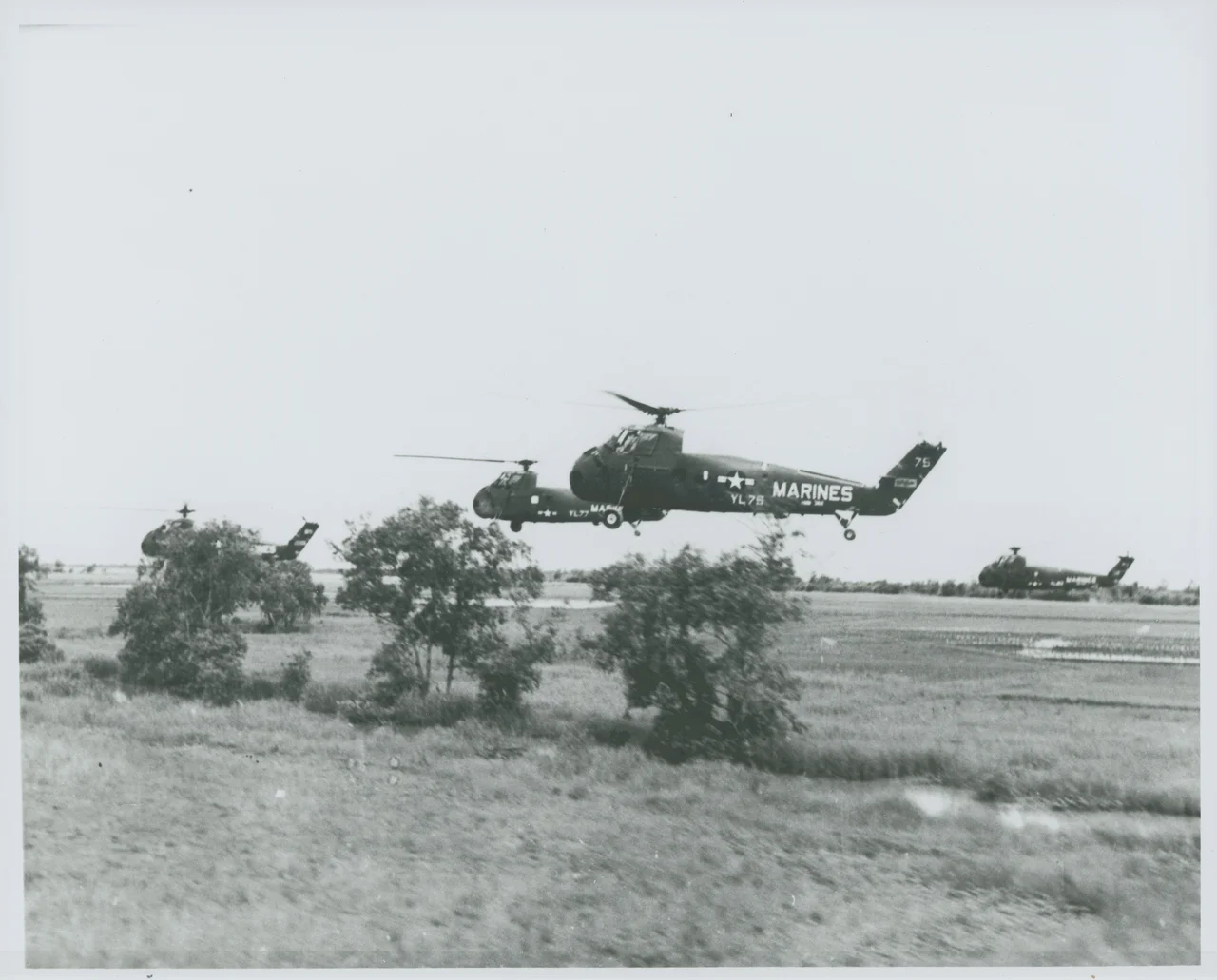
Before the marines waded ashore at Da Nang, before the draft numbers came up for a generation of young Americans, there was a quieter beginning: a handful of UH-34D helicopters touching down on an old Japanese airstrip in the Mekong Delta, 85 miles southwest of Saigon. The date was April 15, 1962. The place was Sóc Trăng. The operation was codenamed Shufly, and it would mark the first sustained deployment of U.S. Marine Corps aviation into Vietnam — not as combat units, not yet, but as advisors moving South Vietnamese soldiers across a country that was already at war with itself.
A Mission in Motion
The path to Sóc Trăng began in Washington, not Saigon. After General Maxwell D. Taylor delivered his assessment to President Kennedy in late 1961, the Joint Chiefs pressed for additional helicopter capacity to support South Vietnamese forces. The Army already had units in-country, but more were needed. After months of deliberation, the assignment fell to Marine Aircraft Group 16, stationed at Marine Corps Air Station Futenma in Okinawa. Marine planners from the 1st Marine Aircraft Wing built Task Unit 79.3.5 around a medium helicopter squadron — codenamed "Shufly" — and assigned it to that rusting Japanese-era airstrip in the delta. The mission was defined as assault support and casualty evacuation: lift ARVN soldiers into the field, pull the wounded out. The rules, at least officially, kept Marines out of direct combat.
The Costs of the Advisory War
The rules, of course, did not keep the helicopters safe. On April 14, 1962 — the day before the official deployment began — a UH-34D from the first Shufly squadron was shot down on a medical evacuation mission some 40 miles west of Da Nang, near the Laos border. The crew was rescued; the helicopter was destroyed. It was a preview of what the rotations would bring. Over the next three years, eight Marine medium helicopter squadrons took turns in the Shufly commitment, rotating every four months from Okinawa. HMM-362 was first; HMM-365 was last. By 1965, half of the Marine Corps' medium helicopter force had cycled through a Shufly deployment. Each crew that flew those missions carried the same weight: they were advisors in name, but the skies over the delta and the highlands did not distinguish between advisors and combatants.
The Long Rotation
Squadron after squadron arrived, flew, and handed the mission to the next unit. HMM-163 under LtCol Robert Rathbun. HMM-162 twice. HMM-261, HMM-361, HMM-364, HMM-365. The commanding officers changed every four months; the war did not. The operation eventually shifted its base north from Sóc Trăng to Da Nang Air Base as the conflict moved and deepened. Each rotation brought fresh crews into a situation that was anything but fresh — a landscape of rice paddies, forested ridgelines, and insurgency that had been burning for years before the first American helicopter landed. The men who flew those missions existed in a strange liminal state: officially support personnel, practically something else entirely.
The End of the Beginning
Operation Shufly ended not with a formal conclusion but with an absorption. On March 8, 1965, the 9th Marine Expeditionary Brigade came ashore at Red Beach, Da Nang — the first large-scale deployment of U.S. ground combat troops into Vietnam. HMM-163 was still serving as the Shufly squadron when those marines walked up the beach. Within weeks, Marine Aircraft Group 16 deployed fully to Da Nang, and Shufly operations dissolved into a much larger and more openly declared war. What had begun as a quiet advisory mission in the Mekong Delta became the opening chapter of an American military commitment that would stretch nearly a decade further. The men who flew the early rotations carried something the later arrivals did not: they had been there when it was still possible to believe it might stay small.
What Remains
Sóc Trăng Airfield still exists today, now used for civilian and light commercial traffic in the Mekong Delta. Da Nang's former air base is now Da Nang International Airport, one of the busiest in Vietnam. The landscape the Shufly crews flew over — the paddies, the rivers braiding through the delta, the forested ridgelines to the north — is largely peaceful now. Vietnam has been at peace for fifty years. The ghost of that old Japanese airstrip, the UH-34Ds circling over the delta, the crew of that first downed helicopter rescued near the Laos border — these persist only in the historical record. But Shufly mattered: it proved that Marine helicopter forces could sustain a prolonged advisory commitment, and that knowledge would be applied, again and again, in the years that followed.
From the Air
Operation Shufly's primary bases were Sóc Trăng Airfield (approximately 9.61°N, 105.97°E, in the Mekong Delta) and Da Nang Air Base (16.05°N, 108.20°E), now Da Nang International Airport (IATA: DAD, ICAO: VVDN). The article's geohash coordinates (15.177°N, 108.078°E) correspond to coastal central Vietnam in Quảng Nam province, near the Da Nang region. Overflying Da Nang at 3,000–5,000 ft MSL provides a clear view of the coastal lowlands, the Marble Mountains to the south, and the Hai Van Pass to the north — the geographic chokepoint that defined the military significance of this region throughout the war. Nearest modern airports: Da Nang International (VVDN), Phu Bai (VVPB, near Hue), and Chu Lai (VVCA) to the south.
Nearby Stories
- Operation Utah 8.9 km away
- War of the Flags 16 km away
- Dong Ampham National Biodiversity Conservation Area 20 km away
- Operation Hawthorne 26 km away
- Chàm Islands 54 km away
- Operation Masher / White Wing 62 km away
- Virachey National Park 93 km away
- A Sầu Valley 96 km away