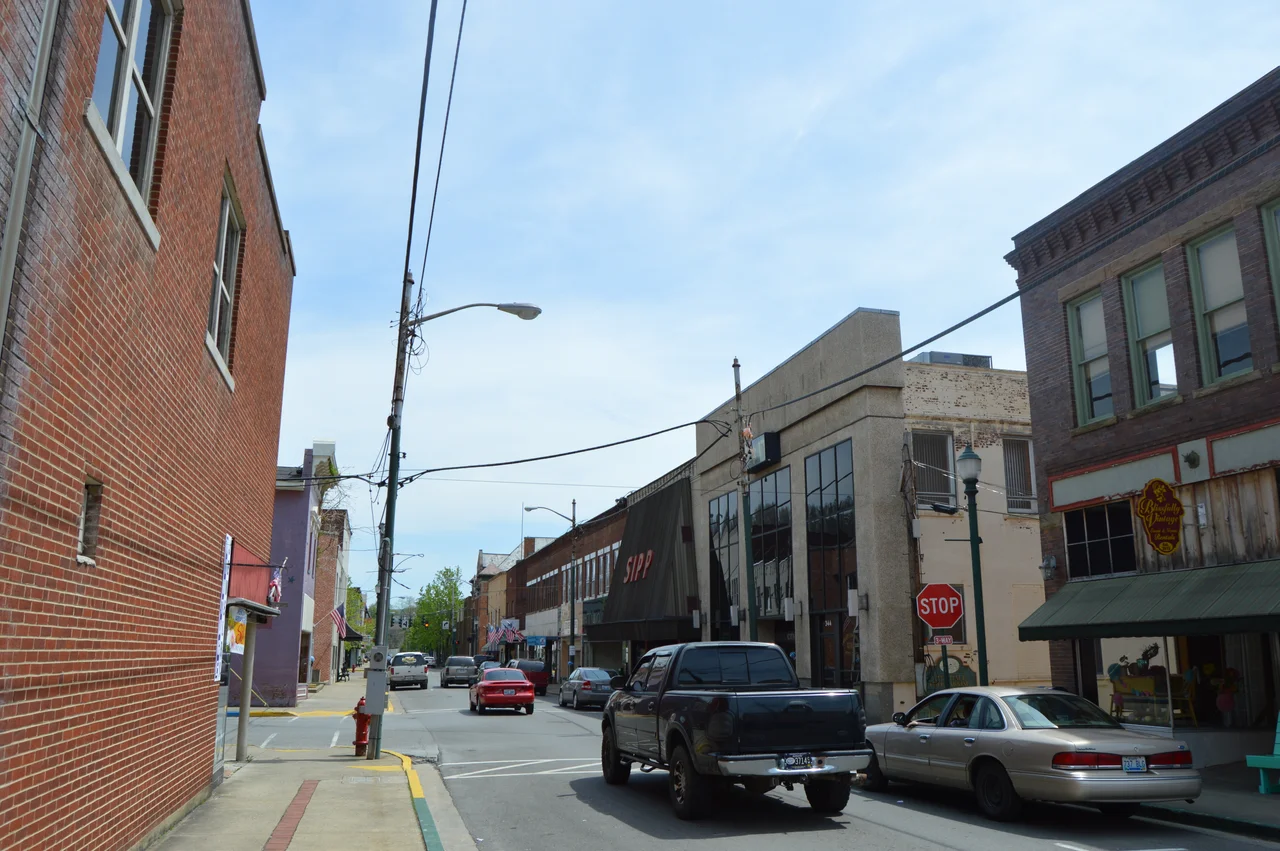

Paintsville, Kentucky
Long before there was a town here, the Shawnee came to the salt lick where Paint Creek empties into the Levisa Fork. They debarked the trees nearby and painted on the pale wood - images of game, of clan, of the hunting grounds these mountains held. When the first white settlers found the place in the 1780s, the paintings were still there, faded but unmistakable. The settlers called the spot Paint Lick. The town that grew around it became Paintsville. The art is gone now, weathered off the dead wood centuries ago, but the name remembers what was here.
Paint Lick Station
United States Army dispatches reference a Paint Lick Station as early as 1780, which would have made it one of the western-most outposts of European settlement during the Revolutionary War. The site sat inside a 19,050-acre tract owned by George Lewis, a Virginia speculator. Cabins went up along the creek through the 1810s. The town was formally chartered as Paintsville in 1834. In the early twentieth century, books and news reached outlying hollers via the Pack Horse Library Project - women on horseback who carried libraries into communities that had no other access to print. The project began in Paintsville in 1913, was revived by the WPA in 1935, and ran until 1943. The road did not come in for decades. The river was the road, and the river ran high and brown most springs.
John C. C. Mayo's Mansion
John C. C. Mayo, the schoolteacher who quietly bought up the mineral rights to vast swaths of eastern Kentucky in the 1880s and 1890s, built his forty-three room mansion on Third Street between 1905 and 1912. Across the street, he built the Mayo Memorial United Methodist Church, hiring a hundred Italian masons to do the stonework. Andrew Carnegie himself donated the pipe organ. The first service was held in the fall of 1909. Mayo died in 1914 at age fifty - young enough that the mansion had barely been broken in. It became a Catholic school, Our Lady of the Mountains, which still occupies it. The church next door still holds services. Walking Third Street feels like walking through the brief, sharp moment when Appalachian coal money had nowhere to go but up and Italian masons could be airlifted into a Kentucky river bottom.
Country Music Stars and a Highway
U.S. Route 23 runs north from Paintsville along the Levisa Fork and the railroad. In Kentucky it has been re-named the Country Music Highway, and Paintsville's U.S. 23 Country Music Highway Museum tells you why. Crystal Gayle was born here in 1951. Her sister Loretta Lynn was born in 1932 up the road in Butcher Hollow, near Van Lear. Jim Ford grew up here. Hylo Brown sang from here. Chris Stapleton attended Johnson Central High School. Tyler Childers walked through Paintsville High. The town's population at the 2020 census was 4,312, which means there is roughly one country music legend per six hundred residents - a per-capita rate no other American town can claim.
Festivals and the Apple King
The Kentucky Apple Festival has run on the first weekend of October every year since 1962, taking over downtown with live music, a pageant, a parade, and a car show. Local lore holds that the first Apple King was crowned at a county fair in 1914 - the same year John C. C. Mayo died, an inheritance and a loss in the same county breath. The Awaken Conference draws thousands of evangelical Christians to the city every July. May brings the Spring Fling. None of these festivals would have been possible in the original river-bottom town, which kept getting flooded. They became possible after decades of careful slow infrastructure work moved the worst of the floods upstream into Paintsville Lake.
The Mountain Homeplace
Just outside town, at Paintsville Lake State Park, the Mountain Homeplace recreates an Eastern Kentucky farming community as it existed in the mid-1800s. The blacksmith shop, one-room schoolhouse, church, cabin, and barn were all moved from nearby locations in the early 1980s, when the Corps of Engineers was building the dam that would create Paintsville Lake and submerge the originals. The museum opened in July 1995, and on most weekends tour guides in period clothing demonstrate quilting, horseshoeing, and the kind of farm chores that the people who lived in these mountains did every day without thinking of them as crafts. The buildings sit roughly where their grandparents' generation would have sat - close enough to the lake to see the water that swallowed the originals, far enough to keep their feet dry.
A Town Still Telling Stories
Paintsville has lost population since 1990, like most coal-economy towns - 4,345 then, 3,459 by 2010, recovering modestly to 4,312 by 2020. In 2018, a horrific shooting spree killed five people in the area, a tragedy the community is still working through. But the museums fill up. The festivals keep running. The 700-seat In the Pines Amphitheater, modeled on Greek amphitheaters and tucked into the woods, hosts the Red Bud Gospel Sing every year. The Paintsville Country Club, built by the WPA in 1930, sits on the National Register of Historic Places. Richard S. Thomas - co-founder of the New York School of Ballet and father of the actor who played John-Boy on The Waltons - was born here. A town this small with this much story keeps finding ways to keep telling it.
From the Air
Paintsville sits at 37.81 degrees north, 82.81 degrees west at the confluence of Paint Creek and the Levisa Fork of the Big Sandy River. Visible at 2,500-4,000 feet AGL as a compact river-bottom town with the Mayo Mansion's distinctive bulk on Third Street and Paintsville Lake to the north. Nearest airport is Big Sandy Regional (K0I8) just southeast in adjacent Martin County. Tri-State Airport (KHTS) is the nearest commercial field, 55 nm northeast in Ceredo, West Virginia.
Nearby Stories
- Big Sandy Expedition 11 km away
- Mingo Oak 19 km away
- 1993 East Carter High School Shooting 24 km away
- Morris Memorial Hospital for Crippled Children 34 km away
- 2002 Appalachian School of Law shooting 41 km away
- The Kentucky Meat Shower: When Flesh Fell From a Clear Sky 46 km away
- Battle of Blue Licks 67 km away
- Cumberland Gap 117 km away