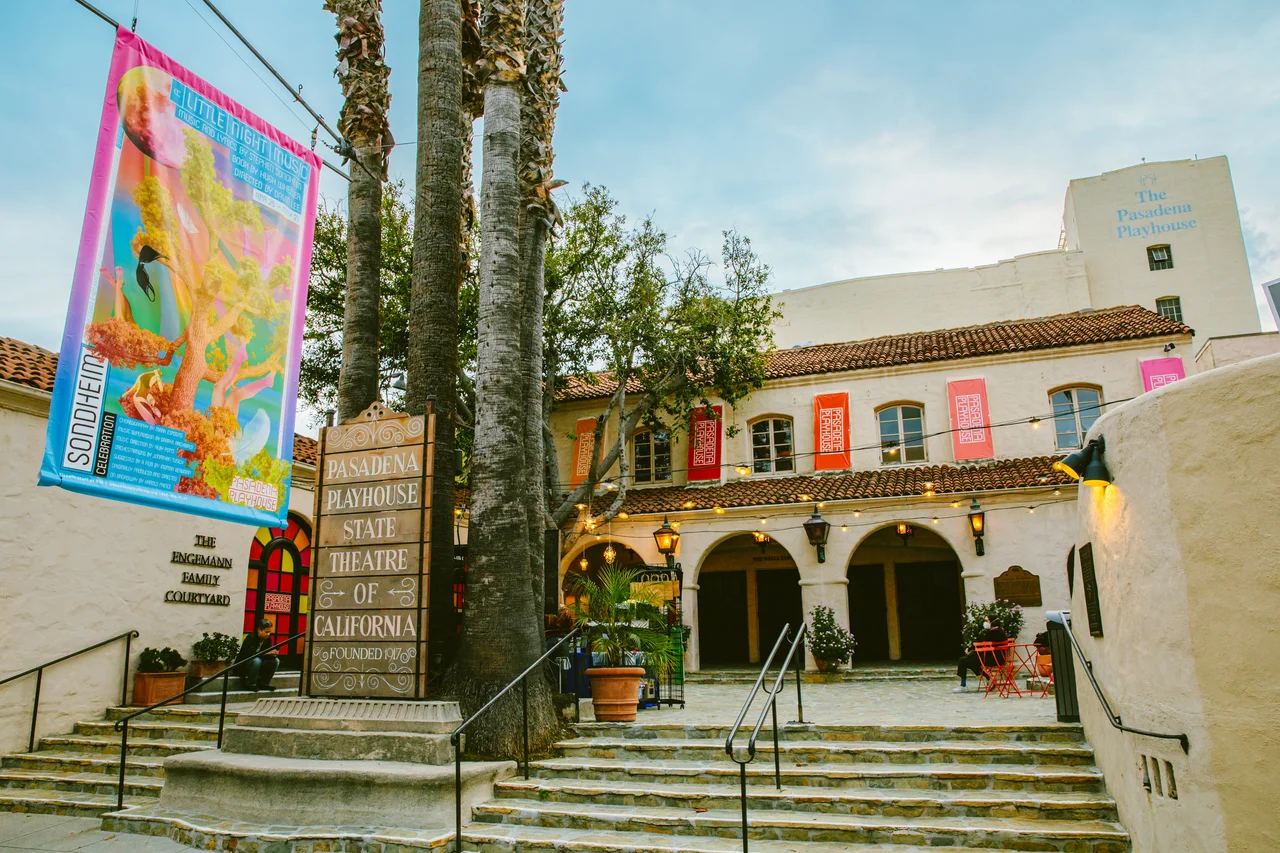

Pasadena Playhouse
George Bernard Shaw had a gift for the extravagant compliment, but when he dubbed Pasadena the 'Athens of the West,' he wasn't flattering the city's weather. He was talking about this theater — the Pasadena Playhouse — and the community fervor that built it. Actor-director Gilmor Brown started producing plays in a renovated burlesque house in 1916. Eight years later, Pasadena citizens raised their own funds to erect a proper home at 39 South El Molino Avenue, designed in Spanish Colonial Revival style by architect Elmer Grey. The result, completed in 1925, was a 686-seat auditorium that would become one of the most consequential theatrical institutions in the American West.
Athens of the West
The Playhouse came of age during an era when the American theater was sorting itself out — regional versus Broadway, commercial versus artistic, amateur versus professional. The Pasadena Playhouse managed to occupy several of these categories at once, and that tension gave it vitality. By 1937, the California Legislature had recognized it as the official State Theatre of California. World premieres arrived here from Eugene O'Neill, William Saroyan, Noël Coward, F. Scott Fitzgerald, and Tennessee Williams — a roster that suggests the theater was doing something right. English-language premieres of significant European dramas also made their way to Pasadena, which meant audiences in Los Angeles County were seeing work that New York hadn't staged yet. Shaw's comparison to the ancient Festival Dionysia wasn't entirely absurd.
The School That Trained Hollywood
In 1927, the Playhouse opened a school of theater arts that would eventually become an accredited college offering BFA and MFA degrees. The alumni list reads like a roll call of mid-century Hollywood: Raymond Burr, Victor Mature, Ernest Borgnine, Charles Bronson, Gene Hackman, Dustin Hoffman, Leonard Nimoy, Angela Bassett, and dozens more studied here. At peak activity, five independent stages operated simultaneously, with 306 to 322 performances on the main stage alone each year. The Playhouse also built and operated one of the first television stations in Southern California, training Air Force technicians in TV and radio operation and supplying the early industry with its first skilled crew.
Closure, Dormancy, and Return
The city purchased the building in 1975, and after the acting school closed, the theater sat dormant for seventeen years. A real estate developer named David Houk relaunched it in 1986 as a touring vehicle — a house for shows that would play other California venues. Over the following two decades, the theater slowly rebuilt its reputation, staging classic drama and new work, growing to an annual operation worth over eight million dollars by 2008. Then, in May 2010, the Playhouse filed for Chapter 11 bankruptcy. It emerged less than four months later, rescued by an anonymous matching-fund contribution and the loyalty of subscribers who donated their unused tickets back rather than demanding refunds — an act of collective patronage that erased over a million dollars in financial liability.
Recognition and the Century Ahead
In 2017, artistic director Sheldon Epps departed after twenty years and more than one hundred productions. His successor, Danny Feldman, arrived from the Labyrinth Theater Company in New York. In 2023, the Pasadena Playhouse received the Regional Theatre Tony Award at the 76th Tony Awards ceremony — confirmation that the institution has not merely survived but holds a genuine place in the national theater landscape. The Spanish Colonial facade on El Molino Avenue still draws the eye as it did in 1925, and the fire curtain inside, painted by Pasadena artist Alson S. Clark, remains a reminder of the civic ambition that first imagined this place.
From the Air
Located at 34.145°N, 118.137°W in central Pasadena, California, visible from low altitudes in clear conditions. The Spanish Colonial Revival building sits in the heart of Old Pasadena, approximately 10 miles northeast of downtown Los Angeles. The nearest major airport is Bob Hope Airport (KBUR) in Burbank, about 12 miles northwest. On approach from the west, the San Gabriel Mountains form a dramatic backdrop to the north.
Nearby Stories
- Amgen 4.9 km away
- Compton, California 8 km away
- Silverado Fire 21 km away
- War Eagle Field 28 km away
- San Bernardino Train Disaster 40 km away
- Santa Barbara Island 54 km away
- Calico: The Ghost Town Walter Knott Saved 99 km away
- The San Andreas Fault at Carrizo Plain 101 km away