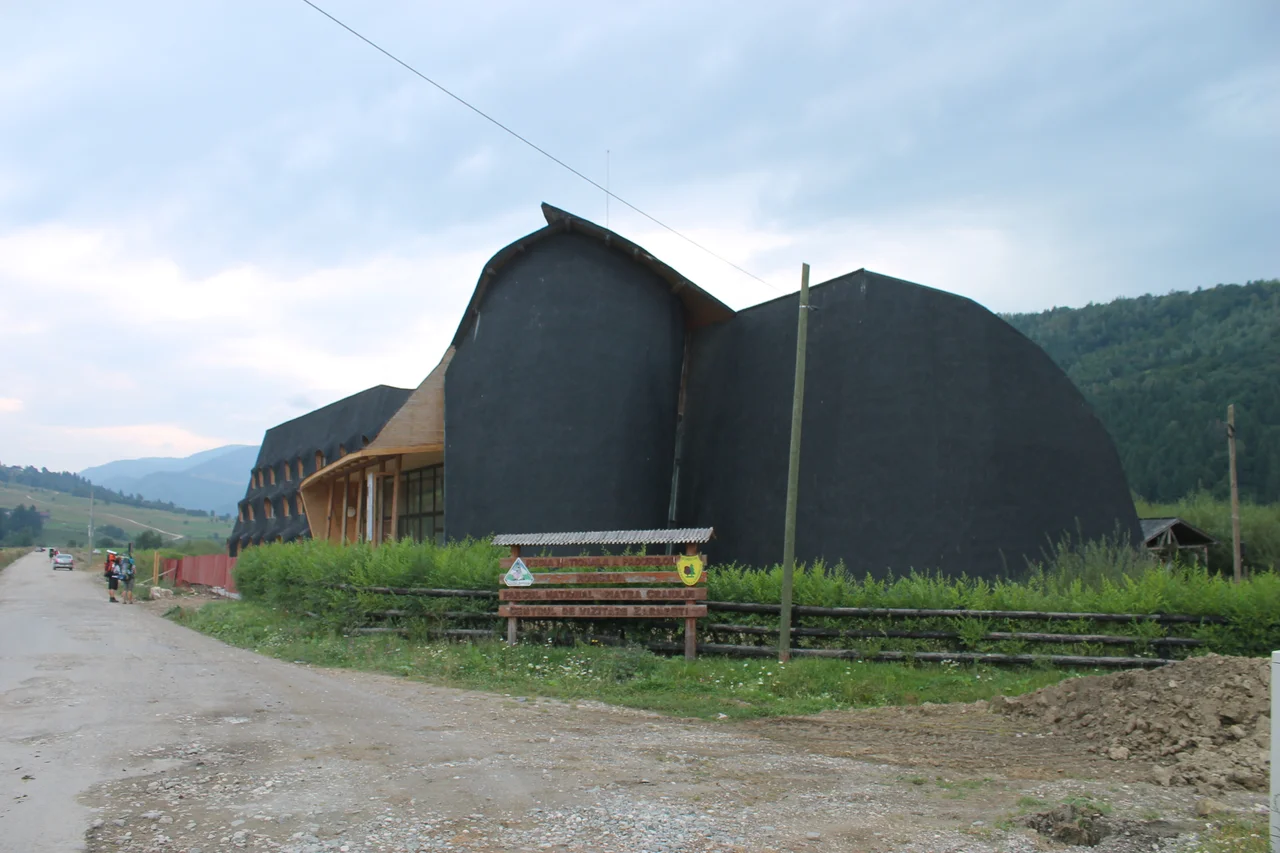

Piatra Craiului National Park
There is one flower that grows nowhere else on the planet. Dianthus callizonus, a small purple carnation the Romanians call Garofita Pietrei Craiului, blooms each July on the subalpine slopes of Piatra Craiului, between 1,500 and 1,900 meters altitude. The fact that a single mountain ridge in the Southern Carpathians holds the entire world population of a species tells you something about this place: Piatra Craiului is not just another national park. It is a limestone blade more than twenty-five kilometers long, rising to 2,238 meters at its highest point, where the geology, the altitude, and the isolation have conspired to create conditions found nowhere else.
The Razor's Edge
Piatra Craiului translates roughly as 'the Prince's Rock,' and the name fits. The massif forms the longest and highest limestone ridge in Romania, running north to south through the Southern Carpathians near Brasov. The highest point, Varful La Om - 'the Peak at the Man' - reaches 2,238 meters. Walking the ridge is a two-day commitment that demands steel nerves: some sections are so narrow and steep that hikers pull themselves along fixed steel cables bolted into the rock. One trail section bears the name Lanturi, meaning 'chains,' with seven cable segments in succession. From the ridge, the drop on either side is severe, and thunderstorms arrive fast at this altitude, with lightning a genuine hazard. The half-dome emergency shelters spaced along the spine offer protection, but carry nothing inside except a steel plate to sleep on.
Wolves, Bears, and Shepherds
The park shelters all three of Europe's large carnivores: brown bears, wolves, and Eurasian lynx. Chamois pick their way along the cliffs, deer move through the lower forests, and 216 species of butterfly inhabit the meadows and woodland edges. Between March and November, visitors can observe brown bears from enclosed observatories - a safer proposition than the alternative, since bears with cubs will charge if surprised at close range. The other animal encounter hikers must navigate involves not wildlife but livestock. Carpathian Shepherd Dogs guard the sheep flocks that graze the lower slopes, and these dogs take their work seriously. The advice from locals is practical: carry a stick, keep stones in your pockets, and shout for the shepherd before the dogs reach you. The shepherds know their animals and respond quickly, but the distance between you and the flock determines how much time you have.
A Flower's Fortress
Dianthus callizonus was the reason the Romanian government first designated Piatra Craiului as a nature preserve. The park was formally established in 1938, making it one of Romania's oldest protected areas. Today it covers a core area of 4,879 hectares surrounded by a buffer zone of 9,894 hectares. Beyond the endemic carnation, the park protects Hesperis nivea, Minuartia transilvanica, and Leontopodium alpinum - the edelweiss that clings to the highest exposed limestone. The virgin forests on the lower slopes remain largely uncut, and the Zarnesti Gorges carve through the rock at the park's northern entrance, where rock climbers find routes ranging from beginner-friendly to grade 8b. Stanciului Cave and the Dambovicioara Cave and Gorges add underground dimensions to a landscape already dramatic above the surface.
Villages at the Mountain's Feet
The gateway town of Zarnesti lies eighteen kilometers southwest of Brasov and serves as the most accessible entry point, with the park's visitor center located at Plaiul Foii, just one kilometer away. But the quieter approaches reveal more character. The mountain villages of Magura and Pestera preserve traditional sheepfold culture, where visitors can taste fresh cheese and tuica, the potent plum brandy that accompanies every gathering. In the mountain huts scattered around the park's base, weekends bring Romanian families who turn the cabana into impromptu barbecue parties lasting deep into the night - and visitors are invariably invited to join. Bring wine. The western valley from Podul Dambovitei to Satic and Lake Pecineagu sees far fewer visitors during weekdays, offering solitude against a backdrop that, from certain angles on newly built mountain roads, frames the entire Piatra Craiului ridge in a single stunning panorama.
Transylvania's Backyard
Piatra Craiului sits in the heart of Transylvania's most storied landscape. Bran Castle, marketed worldwide as Dracula's Castle, lies just to the east. The medieval fortress of Rasnov perches on a hilltop nearby, and the old center of Brasov anchors the region with its Gothic Black Church and Saxon merchant architecture. But the national park offers something these tourist landmarks cannot: genuine wildness. On the ridge at dawn, with clouds filling the valleys below and the limestone glowing in early light, the Carpathians reveal why they remain one of Europe's last great mountain wildernesses. No water exists on the ridge itself, so hikers must fill bottles at the few springs near the mountain's base before ascending. The path is long, the exposure is real, and the reward is a landscape that has not fundamentally changed since the Carpathians first lifted this limestone skyward.
From the Air
Located at 45.53N, 25.21E in the Southern Carpathians near Brasov, Romania. The dramatic north-south limestone ridge is clearly visible from altitude as a pale linear formation cutting through darker forested valleys. Nearest major airport is Brasov-Ghimbav International Airport (LRBV), approximately 30 km to the northeast. The ridge runs roughly 25 km and the peak La Om reaches 2,238 meters (7,343 feet). Bran Castle and the medieval town of Brasov are visible to the east. Look for the Zarnesti Gorges cutting into the northern end of the massif.
Nearby Stories
- Cârța Monastery 10 km away
- Făgăraș Citadel 20 km away
- Cozia Monastery 30 km away
- Slanic Mine 31 km away
- Curtea de Arges Cathedral 36 km away
- Lake Sfânta Ana 50 km away
- Elisabeta Palace 85 km away
- Domogled-Valea Cernei National Park 156 km away